

Urban Farming Examined Part I
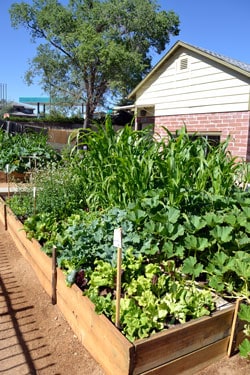
Can Urban Farming Really Work?
Today we are going to look at a couple of opposing viewpoints on urban farming- that being the practice of growing food in an urban environment, more of a food producer than a hobby gardener with a windowsill box of daisies. Urban farming has become hip, cool and somewhat radical in mainstream America over the past few years, with Patti Moreno showcasing the Garden Girl TV that helped lead the way for growing food in the city to become acceptable. Long before that, Will Allen started Growing Power in Milwaukee, WI growing food in an urban landscape and teaching others how to do the same.
Our first article comes via AG Professional, an industrial farming magazine. The author – Maurice Hladik – is from a farming background with a degree in ag economics and was an ag diplomat to several countries. He says that he is a gardener and really enjoys it, but that urban farming in no way can make any measurable positive impact on our food supply, or feed any significant number of people in cities. He uses national land use figures and statistics to prove that the urban landscape is entirely unsuited to growing food. Um, really? What gave you that idea? He cites the fact that his house is built on a rocky outcropping and had to have many truckloads of soil brought in to create the lawn and gardening spaces.
The desire and skillsets of urban dwellers is brought into question next, with the comment of “hype and encouragement” for city folks to get out and grow a garden, with little visible results “given the lack of enthusiastic and capable gardeners” according to him. He challenges the sustainability of urban farming with the lack of suitable soil for growing that has to be trucked in. That soil was once farmland that has been removed from productivity, he states. Apparently he has never heard of the French intensive growing method that fed 90% of the city of Paris with 6 – 7% of the land inside the city limits. For over 350 years.
Water availability is addressed next, saying that rooftop gardens are water guzzlers in a water distribution system that has little excess capacity for irrigation. No mention of drip systems, gray water useage, rainwater collections, mulching or any of the other myriad approaches to reducing the amount of water needed. Urban farming on rooftops is a “thin layer of soil on a cement surface” that needs much more water than a conventional garden. Again, really? He cites a city of Toronto bylaw that states any buildings with flat roofs over 2,000 square feet are required to have some sort of garden. He goes on to say that because of the water issue, food production is out of the question and drought tolerant sedums are used almost exclusively there.
The two most disturbing and concerning points that he makes are at the end of the article. The first is that gardeners should enjoy their hobby and not worry their pretty little heads about feeding the world. Leave that burden to those who can. How @$#!* condescending! The second is that “someone” has a responsibility to feed the world. That “someone”, obviously, is industrial agrobusiness and not anyone else. Why does there have to be one entity that acts as the world’s supermarket? Is there really that need, or is this mantra another construct that has been promoted and pushed for so long that many now believe it? What about improving the capacity of each community and nation to feed itself and get away from the extractive export model? Look at Cuba and Russia as examples of how small, human scale agriculture can, in a real world situation, feed itself.
The article is worth reading, especially the reader comments!
Urban farming is an urban myth
Here is a great rebuttal written by Devon G. Peña, a professor of agroecology, ethnoecology, and the anthropology of food in Seattle.


“Apparently he has never heard of the French intensive growing method that fed 90% of the city of Paris with 6 – 7% of the land inside the city limits. For over 350 years.”
I’d never heard of this and a quick Google search isn’t turning up anything. Can you point to someplace where I can read more? My first question is, which 350 years?
When I think about urban farming feeding people on a large scale, one of my concerns is the density of people in ever-higher buildings. As we concentrate population inward and upward, there’s limited capacity to concentrate sunlight collection in proportion, so it seems to me that it’s inevitable to have some degree of proportional spread of industrialized farming as the distance between homes and food growing extends, with the necessary increase in the minimum distance food has to travel from source to table. Obviously a concern as energy and water scarcity get worse. I’d love to know that there are ways around that bottleneck.
Michael, if you Google “French intensive method history” you’ll get “About 21,300,000 results (0.23 seconds)” according to Google. Not sure what keywords you were using, but there is a tad bit of information out there! Don’t worry, many times I’ve not found what I was looking for, all because of a simple change in a word or two. ;)
Alan Chadwick is usually acknowledged to have brought many of the concepts to the US in the mid-1960s, with John Jeavons expanding on and building on that basis. Mel Bartholomew has proclaimed himself to have “invented” the “Square Foot Gardening” concept, but it is so very similar to the basis of French Intensive Method as to be an offspring, not a new invention.
The French Intensive Method (FIM) was recognizable as a system around the 1500s and peaked in Paris in the late 1800s to early 1900s and started to decline after World War I and the introduction of automobiles.
As for urban farming feeding people on a large scale, look to the examples of Cuba after the oil and trade embargo and how they now feed themselves almost exclusively from small scale and urban farming. Another great example that is too-often overlooked is the Russian Dacha gardening that has fed Russia for over 1,000 years. Today,
This quote is from my Russian Dacha Gardening – Homescale Agriculture Feeding Everyone article, based on research and interviews made by a Russian friend of mine for his master’s thesis.
There are many ways to grow enough food without the industrialized chemical agriculture model that is prevalent in the US.
try this “french intensive gardening”
Thanks Ijan!