Archive | Local Food RSS feed for this section

Russian Dacha Gardening – Homescale Agriculture Feeding Everyone

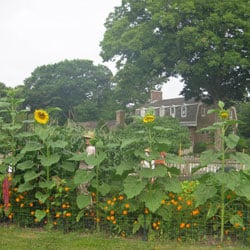
Dacha GardeningThere are a growing number of conversations and discussions taking place around the country, in person and online, about a highly important emerging question – how are we going to feed ourselves with a growing population, diminishing resources and a challenging climate?

We see news reports of crop devastation from droughts, floods and other weather related impacts around the world. There was a world-wide food shortage in 2008, causing a sharp spike in wheat prices that started a series of governmental overthrows in the Middle East. Clearly, food is important in a way that many have not thought about here in the United States. We didn’t experience much in the way of price spikes in 2008, but if we look, there is clear evidence that we are experiencing our own price increases; they are just in a different manner.

The prices for food, when compared to a couple of years ago, have risen significantly, even here in America. Our food system is complex, with major food companies and distributors absorbing the brunt of price increases and passing them along in increments, instead of all at once, so that we are not as aware of the increases in food prices. With a severe drought across most of the country in 2012, and winter moisture levels significantly below normal for this year (2013), more crop failures are predicted along with higher prices.

It is natural that this conversation is beginning to happen. In venues ranging from upscale coffee shops to rural diners to governmental meetings, more and more people are asking, “How are we going to feed ourselves?” The conversation more often than not becomes some form of commercial vs. small scale agriculture, with both sides speaking passionately about the benefits of their systems and judiciously pointing out the shortcomings and detriments of the other systems. It becomes an either/or argument and is a great example of false dichotomy.

We are not against large-scale farms, as there are a number of great examples of how size does not automatically mean a dependence on petro-chemical inputs, using fertilizers, herbicides, pesticides in an attempt to change a natural process into an industrialized, mechanical one to be controlled.

There is a need for a food production system of many sizes and for many reasons. We need diversity in size and scale, as it gives resiliency to our food system as a whole.

Dacha GardeningThere is also an increasingly urgent need to re-examine our food distribution system, as there is an estimated 30 – 40% of food waste that happens before the food even reaches our homes. Utilizing this wasted food would go a long way toward easing hunger here in the United States.

During the course of these conversations a logical disconnect often occurs. The commercial scale folks talk in solid, proven, real world terms and numbers. They should, as this is what they know. They talk about how only industrial farming can feed the world, as it will require their technology, equipment and inputs to grow twice as much food. These are terms that they are familiar with. When the alternative of small scale, local and sustainable agriculture is put forth, they begin to talk in relative and theoretical terms, partly out of ignorance as they are not experienced or familiar with this different approach to agriculture. Sometimes it will be as a dismissal of the effectiveness of sustainable agriculture.

Here is where the disconnect happens: when advocates of local and sustainable agriculture talk, they also tend to talk in theoretical and abstract terms, not in the proven, real world results based terms that the industrial ag folks use. This skews the entire conversation!

Some of this is understandable, as the definition of “local and sustainable agriculture” is completely opposite on the spectrum of commercial and industrial. It is hard to speak about total food production or capacity from the local and sustainable model as it is from the commercial one, for the simple reason that there is more documenting and reporting of figures in large scale agriculture, with almost none in the local one.

This doesn’t mean that alternative agriculture has nothing to contribute. Far from it. Sustainable agriculture, on any scale, is a highly important contributor to the conversation, and our future. There is a school of thought that states, “We will ultimately wind up in a sustainable economic and agricultural model, either by choice or by force.” I’m going to ignore the economic portion of the statement for this article, as it is beyond the scope of our focus.

The thought goes on to show how we don’t have a choice on becoming sustainable in agriculture, as we simply cannot continue our current path of mining our soils of nutrients and using petroleum as a replacement. The petroleum is used for transportation, to power the mining equipment extracting the minerals used to replace those lost in the soil, and for herbicides, pesticides and petro-chemical based fertilizers. Both the nutrients and petroleum are finite, we all know this. What we don’t know is precisely when these resources will run out. They are becoming more expensive each year, looking past short-term fluctuations.

Dacha GardeningWe can make the choices to move our food production into a model where we aren’t strip-mining the earth of its nutrients to grow our food, or we will wind up with no more petroleum to replace these critical nutrients, and our food production on any scale comes to a halt, with devastating consequences. We at Terroir Seeds are working on the choice solution – rather than force – helping to create a better, healthier, more productive, diversified, decentralized and independent food production system that everyone has access to and can participate in, no matter where they live.

During the conversation on feeding ourselves, several examples of sustainable agriculture that are currently being practiced are usually brought up, such as Cuba. When Cuba suffered the oil embargoes and trade restrictions, many citizens died from the catastrophic decrease in daily calories as a result of very limited food production on the island in relation to the size of the population. Everyone lost around 30 pounds as they struggled to find ways to grow all of their own food with most people having little to no gardening experience and a loss of machines to work the land. Eventually they did succeed, and today Cuba is an example of small, local and sustainable agriculture feeding the population.

This example is pooh-poohed by the industrial ag proponents, “Of course Cuba can grow their own food, they are a tropical island, they can grow anything. It’s not like that here or in the rest of the world.” They ignore the difficult history and work that it took for Cubans to be able to grow their own food.

What if there was another example; one of an industrialized, well-populated country that is larger than the USA, grows about half of its total food production in home gardens in a difficult and short-season climate, with no machines or animals to help? Would that example suffice to show that local, small-scale, sustainable agriculture can be a proven, viable alternative to the industrial agriculture model?

Dacha GardeningThat example is Russia, and the model is called dacha gardening. It has provided food for the people of Russia for over 1,000 years, starting as mainly subsistence or survival gardening and evolving into an independent, self-provisioning model between the Bolshevik Revolution and World War II and continues into today.

The term dacha, dating back to at least the eleventh century, has had many meanings; from “a landed estate” to the rural residences of Russian cultural and political elite. Since the 1940s, the term “dacha” has been used more widely in Russia to define a garden plot of an urban citizen. This is when the urban populations began to rapidly expand their garden plots to provide food for themselves, their families and neighbors.

Dacha gardening accounts for about 3% of the arable land used in agriculture, but grows an astounding 50% by value of the food eaten by Russians. According to official government statistics in 2000, over 35 million families (approximately 105 million people or 71% of the population) were engaged in dacha gardening. These gardens provide 92% of Russia’s potatoes, 77% of its vegetables, 87% of the berries and fruit, 59% of its meat and 49% of the milk produced nationally. There are several studies that indicate that these figures may be underestimated, as they don’t take into account the self-provisioning efforts of wild harvesting or foraging of wild-growing plants, berries, nuts and mushrooms, as well as fishing and hunting that contributes to the local food economy.

Clearly, there is something to be acknowledged and studied here! Of note to us Americans, dacha gardening or self-provisioning gardening was the foundational reason that the Russian people did not experience a famine in the early 1990s after the USSR collapsed, and the state sponsored, heavily subsidized, industrial commercial agriculture collapsed along with it. This drew the attention of researchers seeking to find an explanation. Several attempts to explain it away as only a survival strategy have failed, especially when the extensive historical context is examined. Dacha gardening is much more than merely survival, and has always been.

This was not reported outside of Russia, as it wasn’t considered newsworthy. What is truly newsworthy today is that we as a nation aren’t in as favorable of a position if there were a similar catastrophic occurrence in our food distribution, power grid or dollar value. We are all too dependent on outside sources for our food, with most Americans tied to the grocery store and its 3 day supply of food being constantly trucked in.

Dacha GardeningRussian household agriculture – dacha gardening – is likely the most extensive system of successful food production of any industrialized nation. This shows that highly decentralized, small-scale food production is not only possible, but practical on a national scale and in a geographically large and diverse country with a challenging climate for growing. Most of the USA has far more than the 110 days average growing season that Russia has.

Today’s dacha gardening closely resembles the peasant gardening production of the late 19th and early 20th centuries. This shows a continuation of methods and techniques that have proven effective in a small scale garden that works as well today as 200 years ago. The Russians do not use machines – tillers or tractors – or animals on their garden plots, cultivating them in much the same way as the peasants did in the 18th Century.

Dacha gardening is not and never has been simply a survival strategy – a response to poverty, famine, adverse weather or social unrest. Recent studies have shown that Russian food gardening is a highly diverse, sustainable and culturally rich method of food production. This was initially recognized almost a century ago and has been confirmed more recently.

If examined through a strictly economic lens, dacha gardening makes no sense at all. There is much more labor as a dollar value invested than is harvested, but that isn’t the point of this type of system at all. The function of dacha gardens goes well beyond their economic significance, because they serve as an important means of active leisure as well as a way to reconnect with the land. Traditional economic calculations fail to realize the true value and benefits of a dacha garden. Clearly, a wider viewpoint is needed to realize all of the benefits! Time spent in the garden is seen as relaxation, education, entertainment and exercise – all in one. Food production is a very valuable bonus.

Despite their significant contribution to the national food economy, the majority of dachas mostly function outside of the cash economy, as most dacha gardeners prefer to first share their surplus with relatives and friends after saving enough to feed them through the winter, and only then look at selling what remains. A few will sell the remainder at local markets, and move into a small market production model for extra cash.

The Russian mindset relating to the sharing of surplus food is important to examine, as it is one of the keys that ensure the success of the dacha gardening model. In dacha gardening, people will share their excess food out of a sense of abundance or plenty. It is a very positive and powerful motivator which creates an upward, positive spiral of sharing among the community.

Dacha GardeningFor example, a neighbor helps you to build a fence on your property. Instead of paying them money for their help, you give them 50 pounds of apples from your tree. These apples have little monetary value for you, as you have all of the apples you can use for the year stored up, canned, made into apple butter and jams. You are sharing your abundance. The neighbor is overwhelmed, as this is a considerable gift for a few hours of work, so he feels compelled to share some of his gardens abundance with you, for the same reason. He shares from his abundance. This process continues around the neighborhood until there is a solid network of people actively sharing food with one another. This system creates a resilient food network that is not only local and sustainable, but has many other positive benefits as well.

There are no feelings of “owing” from one person to another. When someone gives food to another, it is not “charity” or putting them under an obligation to repay. It is an exchange of excess freely given with no thought of repayment or obligation.

Economic profit is only one of the potential benefits of this type of food production. Other economic components are increased food security with a robust, decentralized and local food supply and distribution. Agricultural sustainability, conservation of bio-diversity and the preservation of heirloom varieties are some of the environmental contributions of dacha gardening. Socially, dacha gardens help create community and a connection with the land and nature.

In addressing the question of “How are we going to feed ourselves?”, we have a lot to consider in looking at the effective, proven and ongoing examples that Russian dacha gardening has to offer us. A closer study of the methods and especially the mindsets will help all of us become more resilient and self-sustaining in our food systems right here at home.

Russian Dacha Gardening Research – Dr. Leonid Sharashkin

Comments { 12 }

Slow Food Prescott Potluck and Fermentation Workshop

Our local Slow Food Prescott chapter held its almost-monthly meeting and potluck, along with a fermentation workshop hosted by Allison Jack, Agroecology faculty at Prescott College and Molly Beverly, Chef at Crossroads Café of Prescott College. This workshop was a reprisal of the fermentation workshop and book-signing that Sandor Katz presented on October 24th. Unfortunately, we were in Italy, tasting our way through Turin and missed his presentation and workshop.

The evening got its usual tasty Slow Food start with a potluck of home-made, home-grown or locally sourced dishes. It has been remarkable to see the growth of this chapter in the past couple of years in respect to its palate, understanding of quality ingredients and love for truly locally made foods. It is pretty common to hear of someone describing their dish as having the majority of the ingredients from their own garden, or proudly naming who grew or raised them from the area. The array of dishes from almost 40 people was inspiring! Not only was the number of people attending impressive, the quality and flavor of the dishes would be at home in a high-end restaurant or supper club. There was a fermented section, with fermented tomato paste, beets, carrots and sourdough bread all adding their unique flavors to the dining.

After dinner was finished the main event was then opened, with Allison presenting some tried and true recipes for a quick kim chee and Hungarian sauerkraut. Everyone brought assorted vegetables that they wanted to ferment, and the fun began! After a short presentation by Allison, everyone got to grating, chopping and slicing their veggies and putting them into jars to start the fermentation. People got to see some new techniques of vegetable processing, new combinations to ferment and generally had a lot of fun learning from each other.

We recorded a short video to help bring the experience and flavors to you. Enjoy!

Comments { 0 }

Horsepower – Direct to Consumer Online Marketplace

Horsepower

Horsepower

We recently met the wonderful folks that started Horsepower at The Heirloom Exposition in Santa Rosa, CA mid September. The founders are both active farmers that attended Cal Poly. The development team is also from Cal Poly, and David is a great person. Not a farmer, but highly interested in the local food economy and finding ways to use technology to help bolster local agriculture.

Horsepower is an online marketplace that helps consumers find producers and a lot more. In addition to the standard “Where can I buy …” type of connections from consumers looking for locally produced foods, Horsepower goes beyond this to its’ real strength, of providing producers a portal to promote and sell their produce to the market of their choosing, from consumers to distributors to restaurants to processors. This is a perfect place for the diversified farms who are growing, raising and producing much more than just a couple of commodities. As their website says, “Horsepower users are made up of a community of sellers and buyers wanting to connect directly with each other. They are farmers and ranchers, farm suppliers, consumers, restaurants, FFA and 4H projects.”

There are a number of other web based producer to consumer applications that do a good job. What makes Horsepower different is that it was started by farmers and has grown from the perspective of a producer and how to communicate what is grown or raised to their customers. The depth and breadth of the menu can be a little overwhelming as a consumer, with listings such as Commodities, Animals, Farm Supply, Fresh Produce, Nursery, Dairy, Meat, General Store and even Real Estate. Each category is broken down into more defined areas to make it easier to search for what you are looking for. While most other farm-to-consumer website feature exclusively food and food related items, Horsepower will help you find equipment, buy or rent land, get a load of compost or see who has the closest supply of home-made apple butter. As a consumer, it is a bit like getting to see what the old fashioned feed or general store would have been like, as this is exactly how many of them worked within a farming community.

Horsepower was started by Diane and Ralph Friend after they had gotten frustrated by brokers earning more income than they did as producers, as well as seeing their customers paying much higher prices than they themselves would have charged. The concept was solid, but technology and social networks needed to grow to the point of being able to support the direct to consumer, social based web presence that it has become. That has taken some time for technology to catch up, but it has now. They are in the start-up or initial roll-out phase of getting everything working, with some great initial response and results. Both producers and consumers have shown a high level of interest, as the program provides transparency and empowerment for the farmer, giving them more control over who they’re selling to and how they’re selling. This translates to a win for the consumer as well, due to the fair, honest prices for the farmer usually reflect a savings to the consumer in the direct-marketing model. The consumer gets to know and understand the producer while directly supporting that producer and receiving a premium product at a better than average market price in the bargain. How’s that for a win-win solution?

Family Farmers Breathe New Life into Direct-to-Consumer Online Agricultural Marketplace

Comments { 1 }

Local Food Movement Feeds Commercial Customers

The Local Food Movement Gets A New Prescription

Local Food Economy

Local Food Economy

The local food economy is entering a completely new chapter with such seemingly unlikely partners as St. Joseph Mercy Hospital of Ann Arbor, Michigan. Leading edge, innovative hospitals such as St. Joseph’s are working to incorporate more local, sustainably grown produce into their menus and food systems. Things quickly become complicated due to the sheer amount of food that is prepared and the time needed for prepping. For instance the soup du jour for 600 people is 65 gallons. The ingredients needed in one just day’s vegetable soup would require hours of prepping and chopping, but is supplied by the current food distribution system already pre-washed, sliced, diced or cubed and ready for the cooking process. As an example, the green beans sourced from a local grower – 200 pounds of them – required 8 hours of washing, snipping, stringing and slicing to prep for that day’s evening meal. Even though the food was sustainable, the processing wasn’t as the kitchen isn’t equipped to handle that amount of prep work on a continuous, daily basis.

There is a tremendous enthusiasm and pressure from consumers of all sizes for more local food. These consumers aren’t just the mom and dad at the farmer’s market on Saturday, but are increasingly including the large scale commercial consumers such as hospitals, universities and large businesses that are looking to satisfy their customers and employees desire for better tasting, more healthy, local food. This is a good, or possibly great thing, if it can be handled to benefit everyone in the equation. One of the biggest challenges for local food economies is that the commercial consumers have been set up to take advantage of the industrial food distributors efficiency and convenience. They are the keystones as to why and how large distributors reign supreme in this market. Everything shows up prepped and ready to use – something that isn’t even thought of in the local food model. Granted, there can be some improvements in the commercial consumers kitchens, as most of them do not have any facilities set up for any prepping whatsoever. This can be remedied, but takes dollars, forethought, planning, construction and time to accomplish.

Farmer’s markets are an important piece of building the local food system, but they are still such a small part of the entire US food production – less than 1 percent for the just over 7,000 markets across the country- that significant growth and positive impacts for the legion of local growers can be realized by connecting small and mid-sized local farms with these institutional, commercial consumers in their local communities. Even very small changes in the purchasing patterns of these consumers can have major changes in the local food system, as an average sized hospital’s food budget can easily top $4 million annually. Just 1% of that is $40,000 that would stay in the local food system, making a huge positive impact. A more realistic figure of 2 – 3% purchasing change means $80,000 – $120,000 going into the local grower’s systems. What benefits and opportunities can you see $80,000 having on your local farmer’s market and local food network?

There are a couple of workable solutions to the questions of efficient local food distribution to make life easier for these larger customers. One is a regional food distribution hub, which some models have proven successful and others have failed in different regions of the country. Another is a co-operative system that partners with a smaller, regional food distribution system that is already in place, effectively adding a “local, sustainable food” section to it’s inventory of supplies and services. There are still others that bear examining and evaluating to see if they would work for a particular need or application.

There are a growing number of institutions just like St. Joseph’s who are responding to their customer’s desires and needs by putting their not inconsiderable moral, ethical and financial weight behind new local food initiatives. The market is there, it just needs some evaluating, adjustments and planning to make it happen, with hugely beneficial results for both the growers who can create the relationships and supply the needs as well as the institutional consumers that can broadcast the triumphs of inter-weaving local, healthy, sustainable food into their menus.

A New Prescription For the Local Food Movement

Comments { 0 }

Food Justice and Security Starts at Home

Food Justice Starts at Home

Food Justice Starts at Home

Food is at the forefront of many people’s minds today, with daily news channels reporting on foods to avoid for health reasons, food safety recalls almost daily, foods that a new study has shown will fight this or that disease, the growth of farmer’s markets and endless debates on local, sustainable food. Some articles and organizations trumpet the dire need to “feed the world”, while others are talking about feeding ourselves. There is ample evidence that food waste is a serious problem and that distribution systems are the culprit. Food has become noticeably more expensive over the past couple of years, with higher prices expected due to this year’s hard drought across much of the Midwestern US.

What’s a person to do today about sourcing and eating real, good and healthy food? One excellent example is that of Hnin W. Hnin, or more specifically, her mom. That’s right, her mom – a local, sustainable, cultural food hero to her family and an example of what is possible for everyone. Hnin’s family immigrated to New York over 25 years ago, but her mom has faithfully kept their cultural food traditions alive by cooking daily. She shops at the local farmer’s markets when she can, and the supermarket or discount stores when she can’t. She doesn’t cook every day to be hip, trendy or because some article in some magazine said it was the thing to do. She does it because that’s how she has been able to keep her family fed all these years on a shoestring budget. They have cooked their traditional, cultural foods that have helped them keep their identities intact in a world that wants to assimilate and homogenize everyone and everything. We could learn some serious lessons from them. Americans have the blessings and simultaneous curse of having a melting pot culture. Many of us have no strong cultural identity to ground us today, and so are swayed by corporate advertising that promises us a better life or to make us feel better about ourselves if we eat this or drink that. We are lead to believe that healthy food is more expensive, when the exact opposite is more often the case.

Eating real, good and healthy food everyday is not just the realm of the wealthy or famous, as is sometimes thought when we see the prices of organic produce in a Whole Foods market. It is possible to eat well and not spend a fortune doing so. That is where food justice and local and sustainable agriculture comes in. Everyone is more engaged with a local agricultural community, from the producers to the consumers. There is much more transparency, so everyone has a higher stake in the process, with resulting higher overall quality. The Slow Food organization mission statement is for food that is “good, clean and fair”. There are no modifiers in that statement, so it applies to everyone, everywhere. By bringing together a focus on good food – healthy, tasty, chemical free with clean food such as organic, local and sustainable along with fair food that brings sovereignty, food access and fair wage and labor into the mix there is a community of diversity that has not been seen yet on the world stage that is food. There is some real potential here, a nationwide community that is as diverse as it is engaged, committed and passionate about “good, clean and fair” food for everyone. It is surprising to some to see the growth in decentralized, independent food communities and pathways that have appeared across the nation. It is of no surprise to others who have worked to make it happen, a little at a time.

Sustainable food is how we will eventually feed ourselves on this planet, either by choice or by force. The current system is patently unsustainable and will continue to create more damages than benefits as it grows and continues, until it collapses. By definition, we will arrive at a sustainable food system or we won’t arrive at all. Exactly how this sustainable system functions is very much a work and dialogue in progress, with everyone having a say in it. Good, clean and fair are excellent starting points to found this new paradigm, and continue the work of building a network of diverse local food communities that nourish all of us.

Mom knows best: How food justice starts at home

Comments { 0 }

Urban Farming Examined Part II

“We are in an era when gardens are front and center for hopes and dreams of a better world or just a better neighborhood…”

Another Urban Farm

Another Urban Farm

What if urban farming isn’t just about feeding the hungry? There are many other crops – tangible and intangible – that are cultivated, raised, protected, harvested and shared from the soil of an urban garden or farm. The immediately obvious ones are the foods produced, but there are others such as education in many different directions, from how food is grown to ideals of peace and justice grown from your own backyard soil. Connections are planted, grown and strengthened as well. People get to know each other and can learn to accept other viewpoints and ideologies without the need to be right or win a discussion. Skills and growing techniques are passed on and strengthened.

One of the biggest crops that urban farming and indeed all human scaled agriculture is planting today is hope and reconnection. Hope that there is a way to provide food for ourselves and those that need a little extra without all of the destruction and isolation that is the norm for today’s industrial corporate agricultural model. Hope that we can heal the land that has fed us for multiple generations but has been so severely disrupted and damaged by chemical agriculture in the name of more production. The reconnection comes when ordinary everyday folks see how food is grown and can be grown in a simple, approachable and honorable manner. One that restores and improves the soil and landscape with each successive crop instead of weakening it.

By many indications, urban farming and human scale agriculture is on the rise and has been proven a success in many major cities across the United States. Burlington, Philadelphia, Detroit, Milwaukee, Chicago, Oakland, Los Angeles, San Francisco, and dozens of other American cities are showing that sustainable urban agriculture is not only possible, but effective in growing many more crops than just food. There is a saying, “If you want to change the world, plant a garden.” How does that work, exactly? Some of the produce is understanding, community, social transformation, and catalytic action along with the tomatoes and kale. Food connects people to economics, justice, pleasure, work, health and the future. The lessons learned and shared that are grown and harvested in the garden have far reaching effects, feeding minds as well as bodies.

Revolutionary Plots | Urban agriculture is producing a lot more than food

Comments { 0 }

Urban Farming Examined Part I

Can Urban Farming Really Work?

Urban Garden

Urban Garden

Today we are going to look at a couple of opposing viewpoints on urban farming- that being the practice of growing food in an urban environment, more of a food producer than a hobby gardener with a windowsill box of daisies. Urban farming has become hip, cool and somewhat radical in mainstream America over the past few years, with Patti Moreno showcasing the Garden Girl TV that helped lead the way for growing food in the city to become acceptable. Long before that, Will Allen started Growing Power in Milwaukee, WI growing food in an urban landscape and teaching others how to do the same.

Our first article comes via AG Professional, an industrial farming magazine. The author – Maurice Hladik – is from a farming background with a degree in ag economics and was an ag diplomat to several countries. He says that he is a gardener and really enjoys it, but that urban farming in no way can make any measurable positive impact on our food supply, or feed any significant number of people in cities. He uses national land use figures and statistics to prove that the urban landscape is entirely unsuited to growing food. Um, really? What gave you that idea? He cites the fact that his house is built on a rocky outcropping and had to have many truckloads of soil brought in to create the lawn and gardening spaces.

The desire and skillsets of urban dwellers is brought into question next, with the comment of “hype and encouragement” for city folks to get out and grow a garden, with little visible results “given the lack of enthusiastic and capable gardeners” according to him. He challenges the sustainability of urban farming with the lack of suitable soil for growing that has to be trucked in. That soil was once farmland that has been removed from productivity, he states. Apparently he has never heard of the French intensive growing method that fed 90% of the city of Paris with 6 – 7% of the land inside the city limits. For over 350 years.

Water availability is addressed next, saying that rooftop gardens are water guzzlers in a water distribution system that has little excess capacity for irrigation. No mention of drip systems, gray water useage, rainwater collections, mulching or any of the other myriad approaches to reducing the amount of water needed. Urban farming on rooftops is a “thin layer of soil on a cement surface” that needs much more water than a conventional garden. Again, really? He cites a city of Toronto bylaw that states any buildings with flat roofs over 2,000 square feet are required to have some sort of garden. He goes on to say that because of the water issue, food production is out of the question and drought tolerant sedums are used almost exclusively there.

The two most disturbing and concerning points that he makes are at the end of the article. The first is that gardeners should enjoy their hobby and not worry their pretty little heads about feeding the world. Leave that burden to those who can. How @$#!* condescending! The second is that “someone” has a responsibility to feed the world. That “someone”, obviously, is industrial agrobusiness and not anyone else. Why does there have to be one entity that acts as the world’s supermarket? Is there really that need, or is this mantra another construct that has been promoted and pushed for so long that many now believe it? What about improving the capacity of each community and nation to feed itself and get away from the extractive export model? Look at Cuba and Russia as examples of how small, human scale agriculture can, in a real world situation, feed itself.

The article is worth reading, especially the reader comments!

Urban farming is an urban myth

Here is a great rebuttal written by Devon G. Peña, a professor of agroecology, ethnoecology, and the anthropology of food in Seattle.

history shows urban farms can feed cities

Comments { 0 }

Urban Farm Grows Sustainable Food in Parking Lot

Sustainable Food Grows in Strip Mall Parking Lot

Holland Town Center Urban Farm

Holland Town Center Urban Farm

The Holland Town Center in Holland, MI is a mostly empty, struggling strip mall with an engaging, unique story. Located in what is described as a food desert – a low-income population center that has limited access to supermarkets or large grocery stores – the mall management contacted Eighth Day Farm about tearing up 1.3 acres of parking lot to grow a sustainable food garden, feeding and educating the local community from it. Produce from the farm will go to Eighth Day’s CSA program, with a farm stand on the property selling directly to the local public.

As one would imagine, there were significant challenges to overcome just in getting the soil ready for planting. After stripping off the asphalt, the top 2 feet of soil were removed and replaced with quality topsoil. Irrigation had to be completely established, compost worked into the soil, fencing built, beds planned and made before planting could even be thought of. They were starting a lot further back than just vacant land.

The Holland Town Center location is much larger than their other property, allowing them to expand the amount of food they can grow and reach many more people that do not otherwise have reasonable access to fresh and healthy food. In reaching this new market segment, people will have the opportunity not only to visit the farm when buying food at the farmstand, but participate in learning how and where some of their food is grown including picking their own food. There has been incredible community interest and support in the early stages of the new project.

Strip Mall Parking Lot Torn Up to Make Way for Sustainable Urban Farm Oasis in Food Desert

Eighth Day Farm KickStarter Project

Comments { 2 }

Food Prices Increase with 50 Year Drought

Food Prices Increase?

Food Prices Increase?

Food prices are expected to increase due to the worst drought in more than 50 years pushing more than 1,000 counties in 26 states into natural-disaster status. The USDA announced the news last week, stating that about 55% of the US has been designated as experiencing moderate to severe drought conditions, the worst since December of 1956. The worst conditions might not have arrived yet, either. If the weather doesn’t turn and deliver some desperately needed rain, the majority of food crops could be impacted. Right now corn and soybeans are feeling the biggest hit, as the worst of the drought conditions are centered around the Corn Belt.

Let’s look at how this plays out for you and me as everyday citizens.

Corn has a huge economic ripple effect in both the food and energy markets, as #2 field corn is the commodity of choice when the word “Corn” is mentioned. Most likely genetically modified to be Roundup Ready, #2 field corn is not used much as corn, but disassembled into components used in the processed food industry. If you haven’t looked at what food ingredients are derived from corn, you are in for a surprise! Google “Ingredients derived from corn” and start reading. There are a few hundred commonly used food ingredients the corn supplies us via the extraction process! Pretty much any food that has a wrapper or is processed has some form of corn in it, unless it is Certified Organic. Corn is also a major ingredient in commercial beef feed, so expect to see a resultant increase in the price of store-bought beef.

There could be a loss of almost 40 – 50% of this year’s corn harvest.

Obviously if this year’s corn crop is wiped out in a significant number of areas – many farmers in the Corn Belt are calling 2012 a total loss – the commodity or base price for corn will rise. It has already doubled in the past 2 months and is expected to double again or even more. Any packaged or processed food could see a noticeable increase in price in the coming months.

Now would be a perfect time to take a hard look at what packaged and processed foods you routinely buy and look for alternatives. Look for fresh, locally grown or minimally processed replacements. Find a local baker, butcher and get to know them or know them better. Your local farmer’s market is a great resource for locally made replacements to processed and packaged foods, often tasting much better and being healthier in the bargain. You might be surprised to find that they just might cost the same or even less! This way, you are less dependent on price fluctuations from a major food supply shock while supporting your local economy and keeping your money closer to home.

Drought in U.S. reaching levels not seen in 50 years, pushing up corn prices – The Washington Post

Comments { 0 }

FarmPlate – Better Food Every Day

FarmPlate – Technology Connecting Producers with Eaters Everywhere

FarmPlate

FarmPlate

The burgeoning local food movement has a powerful new ally in FarmPlate to connect more people to those around them that are producing, promoting and distributing locally grown food. It can be very hard to find out who is in your neck of the woods, or in the next town that is part of local food. Communication is difficult, as there is no real central channel yet. There are a few resources that are devoted to showing us where the local “foodies” are, and this is one such resource that is making great strides in connecting the producers with the eaters of local ingredients.
FarmPlate is a revolutionary online community that connects farmers, fishermen, foragers, food artisans, restaurants, markets, distributors and foodies everywhere. Our searchable directory of 40,000+ business listings across the country, networking tools and reviews make it fun and easy to find and enjoy real foods near you.”

Using the top search toolbar, you can find a specific ingredient or foodsource near you, no matter where you are. I especially like to enter my zip code and click the red “Go!” button. It shows everything starting with what is closest to your zip code and works out from there. This is a great way to explore a new area, or if you are traveling and don’t know what is available locally – this is your ticket!

They showcase farmers, artisans, restaurants, markets and foods, so there is no loss for variety to choose from. Their blog is very informative and has a series of Young Farmer stories of, you guessed it, young farmers making their mark in today’s local food world. Take a look for yourself and see what is local to you.

FarmPlate

Comments { 1 }