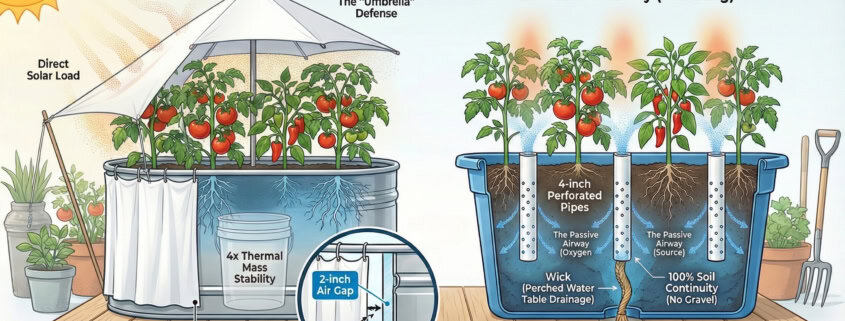
Why do most pots fail in August? It’s not water; it’s physics. Discover the 5 engineering principles of regenerative container gardening—from “Thermal Jackets” to “Wicking Beds”—and learn how to build a living soil system that thrives in the heat.

Why do most pots fail in August? It’s not water; it’s physics. Discover the 5 engineering principles of regenerative container gardening—from “Thermal Jackets” to “Wicking Beds”—and learn how to build a living soil system that thrives in the heat.
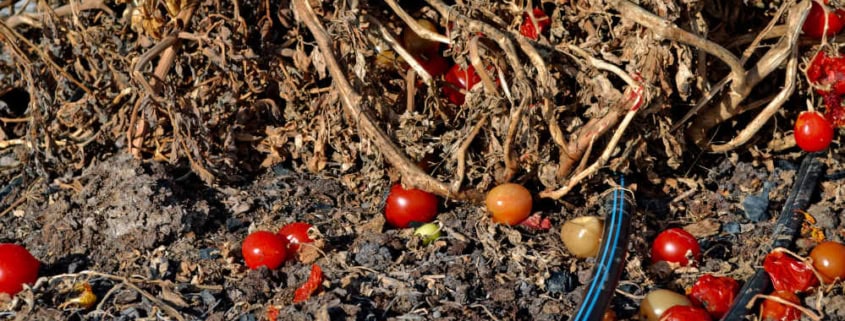
Transform your garden with effective garden cleanup strategies to prevent pests and diseases for next season’s success.

Get ready for a vibrant spring garden! Learn why fall is the perfect time to plant wildflowers and flower seeds for a blooming display.
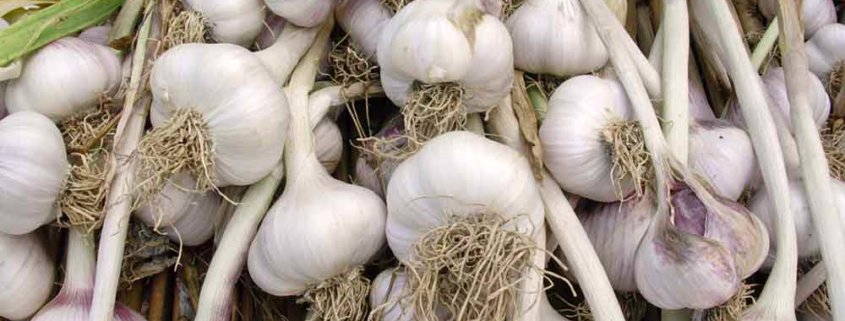
Hardneck garlic has a more complex, richer, spicier flavor that is more ‘garlicky’ than the supermarket types. We show you how to grow your own great garlic!
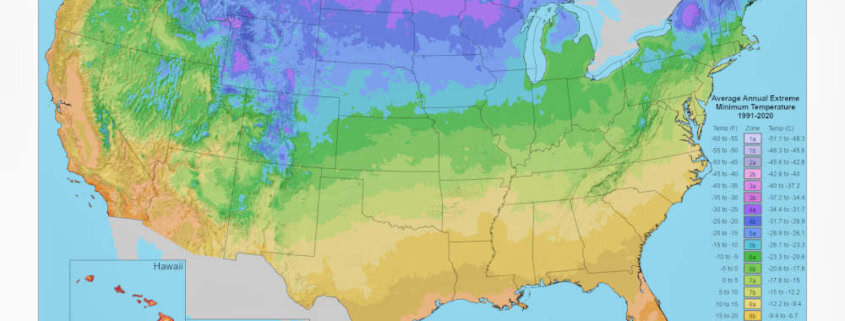
Struggling with gardening in a hot climate? Learn to sidestep the summer heat and unlock your best growing season. Our guide for warm-winter gardening shows you how to master the “second spring” for a bountiful fall and winter harvest.
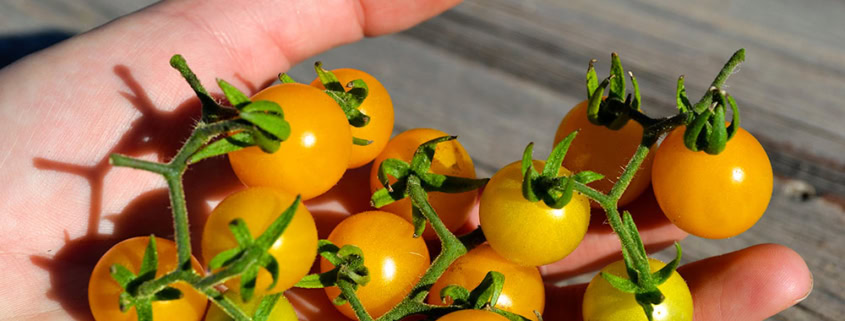
Discover the incredible resilience and adaptability of the Wild Galapagos Tomato. Learn about its history and how it’s being used in innovative research.
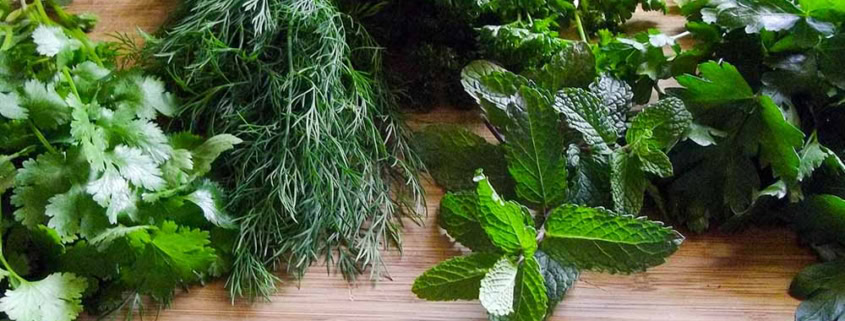
Bring the flavors and scents of fresh herbs into your home with an indoor herb garden. Learn how to easily cultivate herbs indoors.
Discover the power of cover crops for easy soil improvement in your garden. Enhance soil health, suppress weeds, and attract beneficial insects with these natural helpers.
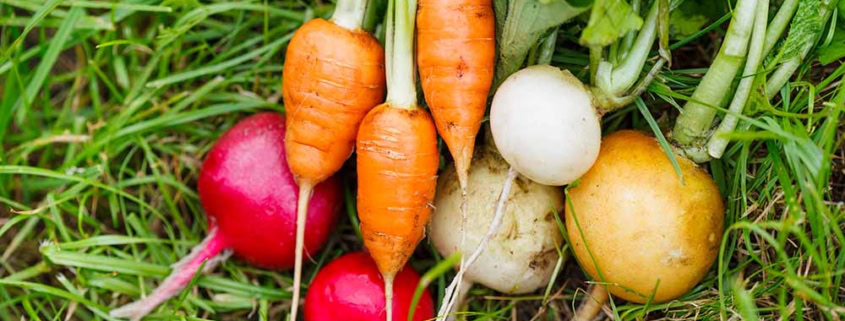
Successful Fall and Winter Gardening depends on summer planning for cool season harvests. We show you an easy way for great fall produce!
Historically, our soils were developed through the interaction of diverse plant and biology growth but much of this has been lost through large scale commercial agriculture becoming increasingly dependent on chemicals to feed the plants, instead of the soil and its organisms. This “trickle-down” effect has also affected home gardeners and small scale growers, and now we struggle to find ways to bring that plant diversity back to the garden.
Planting a multi-species cover crop in your garden will greatly stimulate the soil life and biology while suppressing weeds, interrupting disease cycles and even supply nutrients for next season’s crops.
We spend a significant amount of time teaching straightforward ways home gardeners can improve their soil, so we are often asked: “How can I manage pest and disease issues in my garden?” The simplest answer is: “Improve your soil.” Immediately followed by: “Plant a cover crop.”
The next question we hear is usually: “How will that help my pest and disease issues?”
Let’s take a closer look, and remember that a diverse cover crop mix can accomplish several of these at once.
We’ll start with a few of our customers’ gardens and let them tell you about their experiences in their own words! Then, we’ll explain how and why planting a cover crop in your garden this season will boost your soil’s fertility.

“Experimented in one of my six raised beds (4’W x 16’L) and was very happy with virtually no weeds. Plan to use this as a between plantings cover crop going forward!!”
– Skipper
“I needed a ground cover that would improve my really bad soil and offer the disappearing bees and pollinators a refreshment stand. As usual, Terroir filled the bill. I planted these seeds in several different locations and they sprouted and grew in every one of them – from crushed granite mixed with sandy soil to soil that had been covered for YEARS by heavy green plastic. Full sun, partial shade – it made no difference. They thrived.
And two days ago they started to bloom AND I saw three honey bees land on them. “
– Karen

“Germination was excellent. I have a beautiful cover crop that the bees are totally enjoying. This mix has been the easiest cover crop I have ever planted, no fuss, very little upkeep, just add a little moisture. It’s so magnificent I spend 5-10 minutes every day just enjoying it.”
– Linda
“I’ve grown vegetables in my 4 4’x12′ raised beds for over 25 year, renewing the soil annually with a layer of compost; yields had become just OK. Two autumns ago I planted the Cover Up Mix, turned it into the soil in spring, covered the beds with the usual compost; happily report last year’s yields were up appreciably. The garden was positively lush (an unusual state in our high desert environment with 2017’s prolonged high summer heat). So I planted your cover crop mix again last fall and am looking forward to this year’s results. Definitely recommend!”
– Kerry
“First time I’ve used a cover crop; planted 6 weeks ago in 1/2 of my garden because the other half was still producing. Easy to plant, grew quickly with great coverage. The best part is that everywhere the cover crop was planted there are NO WEEDS! Morning glory has been my biggest problem and I have none where I planted the cover crop. Seeing the comparison between the two halves has made me a believer… already re-ordered enough for the whole garden for next year, and plan on using it in my flower beds, too. Highly recommend!”
– Pamela
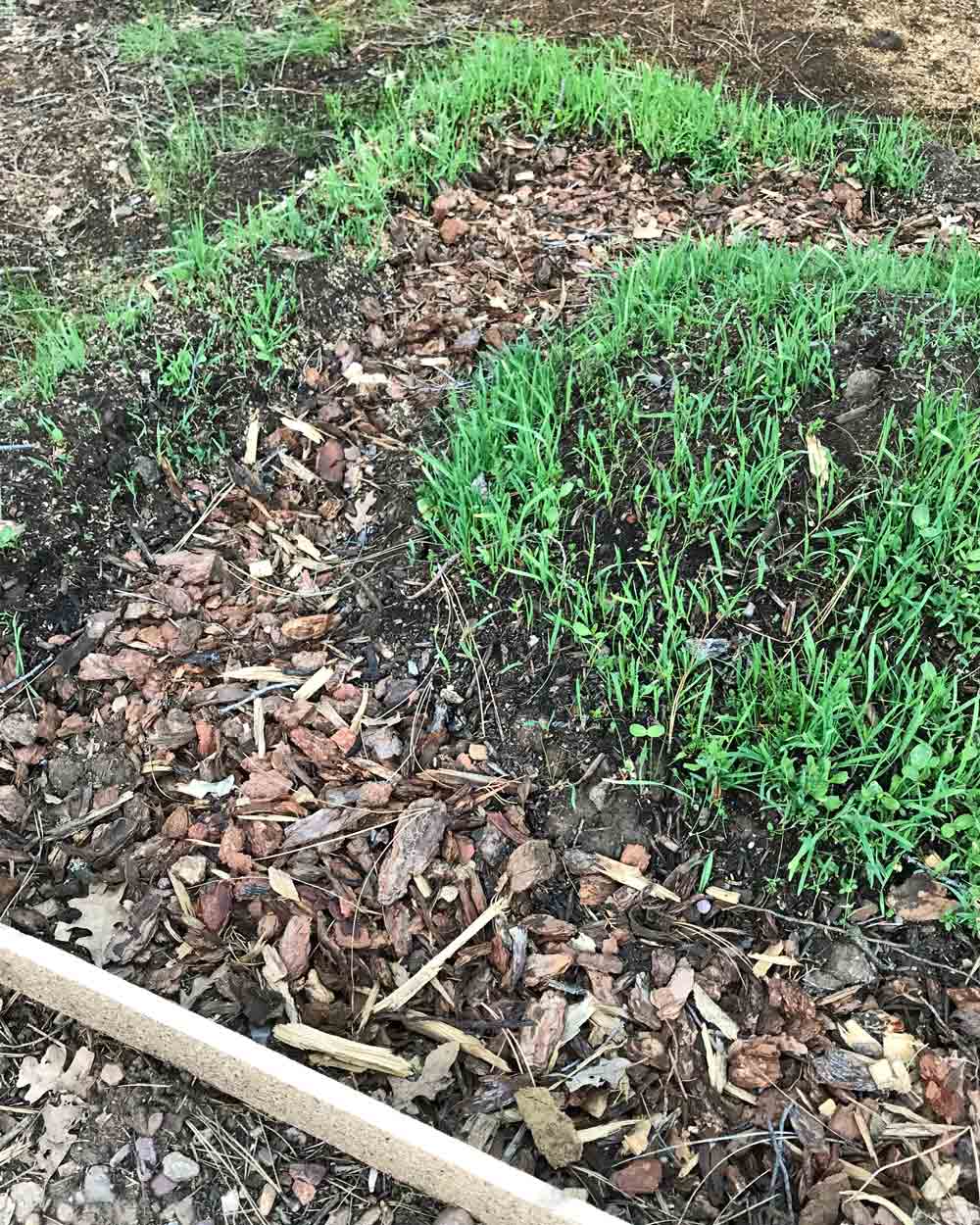
“Great germination, fast early growth and very thick. Really looking forward to better soil.”
– Victoria
“I love this! It is growing so healthy and lush. I love the great variety of plants in it. It will get turned in as a green manure day after tomorrow and I am so looking forward to reaping the benefits!”
– Donna

The best way to suppress weeds is with a highly competitive crop that quickly forms a canopy and shades weeds out. Summer annual cover crops like buckwheat and crimson clover form tight, dense canopies and will often outgrow many weeds. A diverse mixture of cover crops like our Garden Cover Up Mix – which includes both buckwheat and crimson clover – is much more weed-competitive than a single species.
Planted in late summer or early fall as part of our Garden Cover Up mix, cereal rye is one of the best weed-suppressing tools if your next crop in that bed will be a legume like beans, chickpeas, lentils, peas, or soybeans as it aggressively ties up nitrogen – leaving little for weeds to use.
The legumes don’t mind, as they just fix their own nitrogen.
If your next crop is nitrogen demanding like corn or green leafy vegetables, a fall legume like hairy vetch can be used to both produce nitrogen and suppress weeds. Vetch does make nitrogen, but when it is cut or frost-killed the nitrogen is a protein and must decompose before it is available to either crop or weeds.
Both rye and hairy vetch form a thick mulch when cut that helps suppress small-seeded weeds like Palmer amaranth – better known as pigweed – by starving them of sunlight after germination so they run out of energy. Both rye and vetch produce biochemical compounds that stunt weed growth, called allelopathy.

This is best accomplished with a diverse mix dominated by legumes like our Garden Cover Up Mix. Remember, mixtures are capable of fixing much more nitrogen in a more stable and plant-useable form than single-species cover crops alone.

As gardeners, this should be our very first priority.
As we have learned more about how soil organic matter is formed, we have come to realize the most important contributor to soil organic matter happens in the root zone through what is known as root exudates – biologically active compounds deposited into the soil through the roots – and not simply the aboveground plant growth as previously thought.
Therefore, the best and fastest way to dramatically improve your soil health and fertility is through significantly increasing root growth of a diversity of species and plant families, along with as much aboveground biomass as possible.
Diversity of plant families makes for a more nutritious diet for the soil organisms that build organic matter in the soil, as some species have root exudates high in sugar, others high in protein, others high in lipids, while others are high in minerals; when combined, it makes a more complex and balanced diet than a single cover crop can provide. In general, since the production of root exudates depend on the level of photosynthesis, the more biomass a plant produces, the higher the root exudates and the faster you build soil organic matter.
Inoculate your first planting with our mycorrhizal fungi – MycoGrow. Mycorrhizal fungi form mutually beneficial relationships with plant roots, extending their reach and monitoring nearby soil nutrients, feeding needed nutrients that are otherwise out of reach of the plant roots.
The soil proteins – called glomalin – produced by the mycorrhizal hyphae is the most persistent form of organic matter known and does wonders for the soil.
Hopefully, you have a much better understanding of why and how cover crops can make a big positive difference in your garden, no matter if you have a traditional row garden, raised beds, or large containers. If you have soil, cover crops will improve it!
We’ve watched the skepticism on people’s faces when we talk about the multiple benefits of using cover crops in their garden, but then when they try them, the skeptical looks turn to astonishment when they describe how much better their gardens performed.
Did this help you understand cover crops better? Do you know a gardening friend who could use this information in their garden?
Please share this with your friends – either with the buttons below or on your social network of choice.
Trap cropping – also called intercropping – is an older pest control approach used by commercial growers that is not widely known or used in home gardens, but it should! Essentially, a trap crop acts as a decoy or sacrificial plant for invading pest insects and luring them away from your vegetables. Once the destructive insects attack the trap crop, you can deal with them there instead of on your valuable food crops. Techniques include removal or spraying with a soap-based solution or natural recipe, all the way up to using insecticides on the trap crop.
Using trap crops isn’t a “one-size-fits-all” approach, as each crop attracts a specific set of pests. However, it fits perfectly into a home garden, no matter how big or small. Almost everyone can take advantage of trap crops, from traditional in-ground rows to raised beds to container gardens.
Trap cropping is one part of an integrated, organic management approach to gardening. Instead of just managing pests, this approach includes attracting beneficial insects that prey on the destructive ones while helping to pollinate your garden better. Other parts of organic management include planting cover crops and companion planting.
There are two main ways to use trap crops: to test for specific pest insects and then to attract those pests to better control and minimize or prevent their damage to your desired food crop.
When testing for specific pests, the most accurate results are obtained by using a border planting approach surrounding the garden. This way, pest insects have to pass through the desirable trap crop to reach your food plants, making it easier to monitor the pests and make better choices about identifying and controlling them.
Destructive pest insects are most attracted to plants in the reproductive stage of growth – flowering, fruiting, or setting seeds. This is why most trap crops are planted before your desired food crop – anywhere from a few days to a couple of weeks earlier, depending on how long the trap crop needs to start flowering.
After the insects attack your trap crop, you can be ruthless in controlling them – from spraying aggressive bug solutions and removing leaves up to removing the entire infested plant. Depending on the type of planting, this creates the first line of defense or an added layer of protection for your main vegetable, herb, or flower crop with no chemicals or sprays needed.
Just as there are different ways to grow a garden – traditional rows, raised beds, containers, hoop houses, and greenhouses – there are different ways to plant trap crops that increase their effectiveness and benefits.
Border planting – Just as it sounds, planting one or more pest-attracting crops outside of the garden or area where the desired crop is grown. This can be completely surrounding the garden or between the garden and where the pests come from – for example, between the garden and an open field.
Intercropping – Planting the trap crop in alternating rows or areas within the garden or desired crop. For example, planting a row of lovage on either side of your tomato row will attract tomato hornworms before they get to the tomatoes.
Mixed intercropping – Trap crops are planted among the desired crops with no distinction. This looks exactly like companion planting but for the opposite reason – you attract pest insects to the trap crop instead of bringing in beneficials. An example is planting red giant mustard among your cabbages to attract the cabbage caterpillar.
Now that you understand more about trap crops, how they work, and the different types of planting, it’s time to see exactly which crops can be used and what type of pests they help control.
Initially, you may be surprised to see so many familiar, common garden crops listed. However, remember your gardening experience – how many of these crops seemed to attract the exact pests listed here?
This is simply a different perspective or approach to deciding what to plant in your garden, when, and for what reason.
| Crop Protected | Pests Controlled | Trap Crop | Planting Method |
| Cabbage | Cabbageworm, Flea hopper, Mustard aphid | Chinese Cabbage, Mustard, and Radish | Intercropping |
| Cabbage | Diamondback moth, Cabbageworm | Collards | Border planting |
| Cabbage | Cabbage caterpillar, Harlequin bug | Red Giant Mustard | Mixed Intercropping |
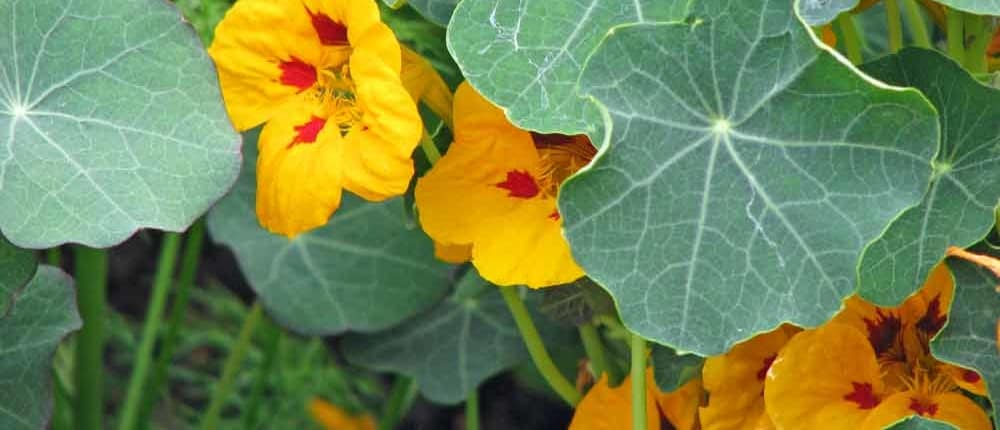
| Cabbage and Squash | Aphids (blackfly, greenfly, whitefly), Flea beetle, Cucumber beetle, Squash vine borer | Nasturtium | Mixed Intercropping |
| Cabbage family | Flea beetle, Root maggot, Cabbage maggot, Harlequin bug | Radish | Intercropping |
| Carrot | Carrot root fly, Thrips | Onion and garlic | Border planting or intercropping |
| Corn | Leafhoppers, Leaf beetles, Mustard aphids, spider mites, whitefly | Beans and other legumes | Intercropping |
| Corn | Corn seedling maggot | Rye | Intercropping |
| Cucumber, Vegetables | Cucumber beetle | Amaranth | Border planting, Intercropping |
| Garlic | Thrips | Basil | Border planting |
| Potato | Colorado potato beetle | Tansy | Intercropping |
| Solanaceous family | Colorado potato beetle, spider mites, whitefly | Eggplant | Intercropping |
| Squash, Cucumber | Squash bug | Millet | Intercropping |
| Tomato | Tomato hornworm | Dill and lovage | Intercropping |
| Tomato | Colorado potato beetle | Potato | Border planting |
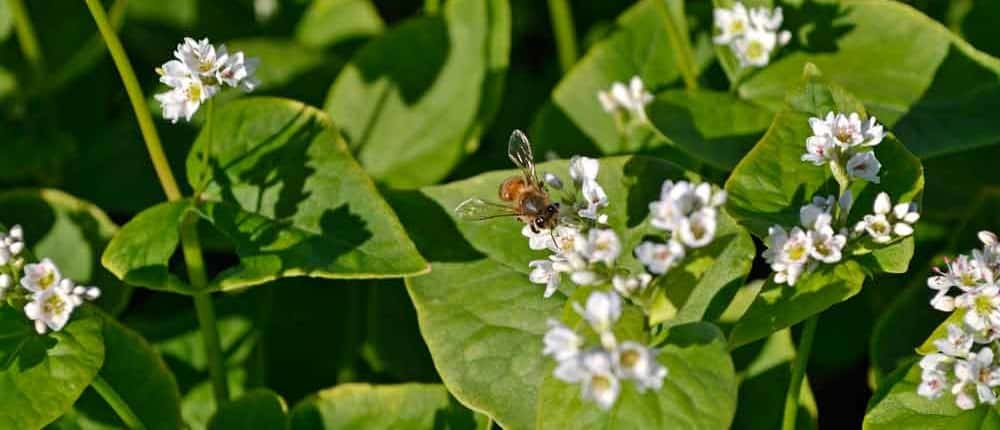
| Vegetables | Stink bug – attracts both pest and beneficial insects | Buckwheat | Border planting |
| Vegetables | Slugs | Chervil | Intercropping |
| Vegetables | Mexican bean beetle, Stink bug | Green beans | Intercropping |
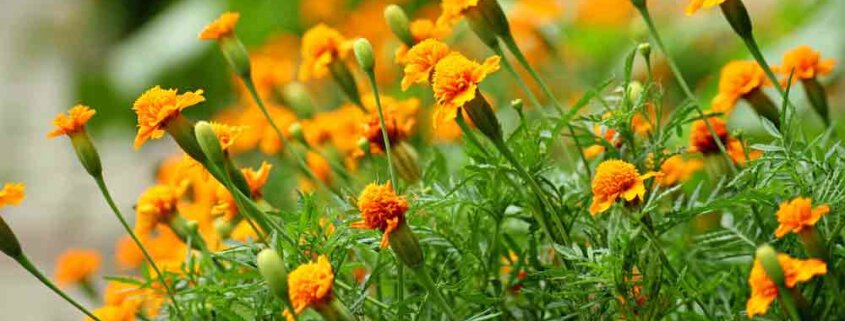
| Vegetables | Thrips, Nematodes, Slugs | Marigold | Intercropping |
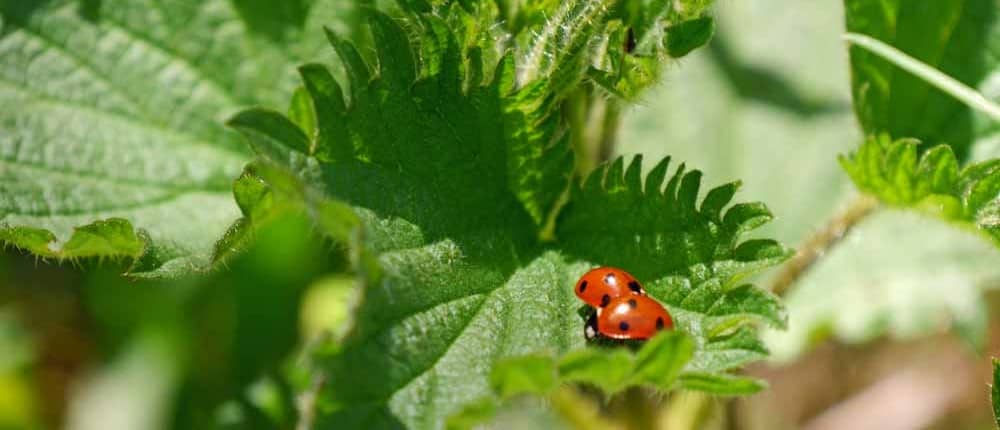
| Vegetables | Aphids early in the season, followed by ladybugs | Nettles | Intercropping |
| Vegetables | Stink bug, tomato aphids | Okra | Border planting |
| Vegetables | Heliothis moth species, Leaf-footed bugs, Stink bugs | Sunflower | Intercropping |
| Vegetables | Japanese beetle | Zinnia | Intercropping |
| Vegetables, Tomatoes | Stink bugs, corn earworms, leaf-footed bugs | Sorghum | Border planting |
| Vegetables, Tomatoes | Cucumber beetle, Squash vine borer, Squash bug, Whiteflies | Squash | Border planting |
Remember, your main crops – vegetables, herbs, or flowers – are usually entirely different species than your trap crops, but not always. In long-season climates, an early group of cherry tomatoes is transplanted to attract common tomato pests, protecting the main planting 2 – 3 weeks later.

To get the most benefits from trap crops, you must be diligent in inspecting them for pest insects and take immediate, decisive action. This often means picking the bugs off, removing leaves, branches, or the entire plant in some cases. Appropriate action can also mean treating the pest insects by spraying, from a mild soapy solution or Garlic Juice Concentrate to our Home Garden Bug Solution.
Improper management of the trap crop can create “pest nurseries” – just the opposite of what you are trying to do!
You must be ruthless in taking action with the trap crop – remember, it is a sacrificial target to protect your valuable crops.
It can be difficult to manage multiple pests simultaneously, as planting multiple trap crops can be larger than your garden. It’s best to use trap cropping to manage your biggest pest insect infestation, then use companion planting to attract beneficial insects to work on the other pests.
As mentioned above, trap cropping isn’t a silver bullet, a one-size-fits-all solution, but it can be a valuable tool in an integrated organic management approach. A diverse mixture of plants makes it far less likely that the destructive pest insects will settle on your main crops, and when they arrive, they will be followed by beneficial insects that feed on them.
A comprehensive organic pest control plan includes –
The easiest yet most effective way to get started using trap crops in your garden uses these steps:
The level of your success depends on several factors, but you should see significant improvement in the population of pests, the amount of damage, and the health and amount of harvest in the first season you start using trap cropping.
Keep a notebook with your experiment’s details and results, successes and challenges, weather, and other related factors. After a couple of seasons, you should begin to form a clear picture of which direction is best for you and your garden in your particular climate.
This isn’t a quick-fix approach; it’s about understanding your garden better, more of a Systems Approach than a silver bullet. However, if you commit to an organic pest control approach, you will see a steady decrease in destructive pests and a comparable increase in beneficial insects. You will also see fewer damaged vegetables and increased harvests of healthy food from your home garden.
Did this help you better understand trap crops? Do you know a gardening friend who could use this information in their garden?
Please share this with your friends – either with the buttons below or on your social network of choice.
It not only helps them have a better garden, but you help introduce us to more gardeners who can use our unique approach to creating a better garden in partnership with Mother Nature!

Fresh, bright and invigorating, the scent and flavor of citrus is most enjoyable for many gardeners, especially where citrus trees are not a possibility. Several different herbs and flowers have a pleasing citrusy scent or flavor – either lemon, lime or orange – either as the main fragrance or as a delicate note that brightens the scent.
Popular for teas, sachets, aromatherapy, and recipes, they bring a bright, cheerful flavor to dishes like pasta, fish, and chicken.
If you are looking to add a lovely citrusy aroma to your garden, here are several herbs to consider!
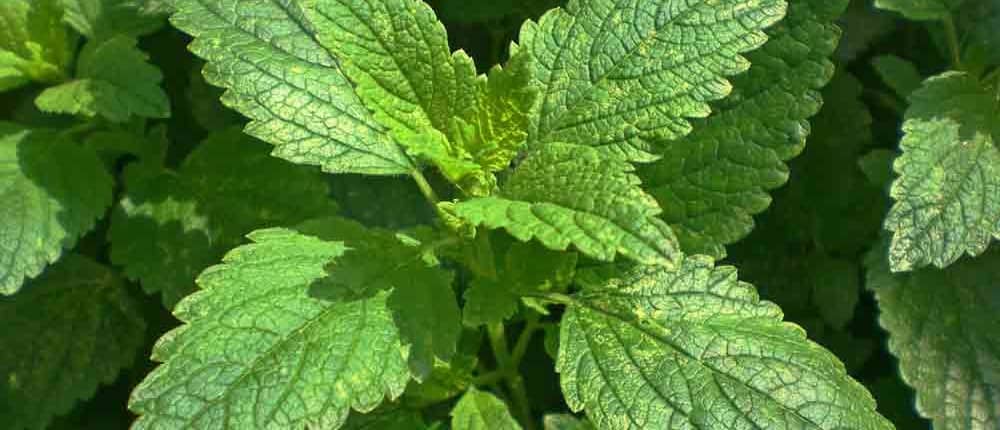
A proud member of the mint family, lemon balm (Melissa officinalis) is native to Europe and the Mediterranean and, if allowed, will spread into unwanted areas of your garden. It’s easy enough to contain in a planter or large container, or simply give it an area that it can fill in and be happy. Hardy to USDA Zone 5, it grows to about 2′ tall with abundant crinkled leaves and tiny white or pale blue flowers that attract a surprising amount of pollinators, given how petite the flowers are.
Rubbing the leaves brings out the lemon scent, and walking by the plant on a warm day repels biting insects. The scent is crisp, clean, and forward – you immediately get the heady fresh lemon-rind aroma that is very refreshing. Grow in part shade with moist soil or sunnier spots in cooler areas.
Harvest the leaves like basil with several cuttings during the season, and dry them to preserve that summer flavor into the winter, or chop the leaves and freeze in ice cubes for a lemony punch in iced teas or other drinks.
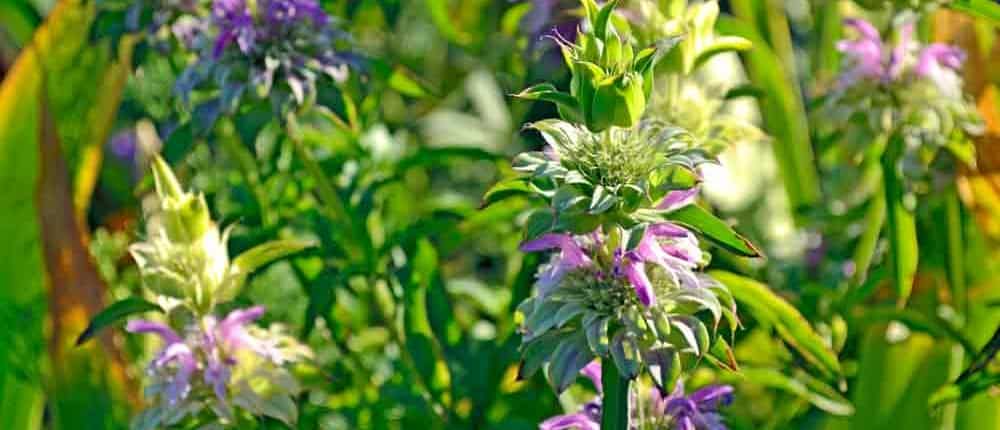
Completely different than the above two balms, lemon bee balm (Monarda citriodora) is both the perfect name and description of this highly fragrant plant. Being downwind of a thick stand will make you think you’ve come across a hidden lemon grove, then multitudes of hummingbirds and butterflies draw your eye to hundreds of minuscule compound flowers, stacked one on top of the other, marching up the stem. As you draw closer, the bees appear, covering the flowers in an intricate dance from flower to flower.
Both the leaves and flowers are used; making refreshing, calming lemon-scented teas and potpourri. The stalks make excellent additions to flower arrangements, both fresh and dried.
This annual native is fairly cold hardy, rarely killed by winter cold, surviving by underground rhizomes. They can spread in moderate climates, so use planters or pots to keep them contained, or give them an area of their own.
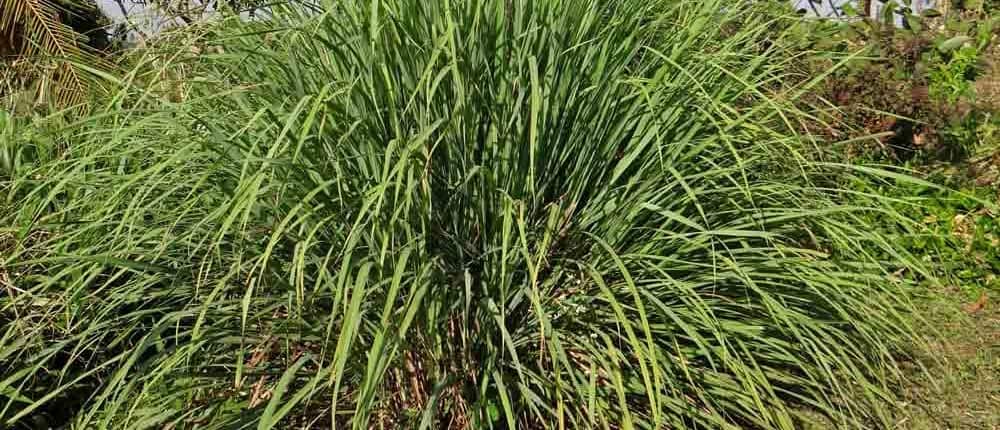
A favorite in Asian cooking, lemongrass (Cymbopogon flexuosus) looks similar to bunchgrass but with a pleasantly strong lemon scent and flavor. It has the same volatile oils as lemon rind, with the same fresh, clean, citrus flavor and scent. Easy to grow in pots and containers for cooler climates, lemongrass loves the heat thanks to its tropical origins.
Harvest by cutting a stalk at the outside of the clump near the base, leaving the rest to continue growing. Lemongrass is best used fresh, as it loses some of its lemony pungency when dried or frozen. This is why many gardeners will grow a pot of lemongrass for fresh use, moving it outside in the spring and summer, then bringing it inside for the fall and winter.
We love to ferment fresh lemongrass with chiles and garlic to make a delicious paste for Asian cooking.
Insect repellent booster –
Plant lemongrass and lemon balm together to double their individual insect-repellent powers!
Just standing in arms reach should be enough to fend off the worst of the biting bugs – consider planting a large pot to place near your summer barbeques.
They’re effective against mosquitos, gnats, and wasps, and you can break off a couple of leaves to rub on your skin or clothing to take the protection with you.
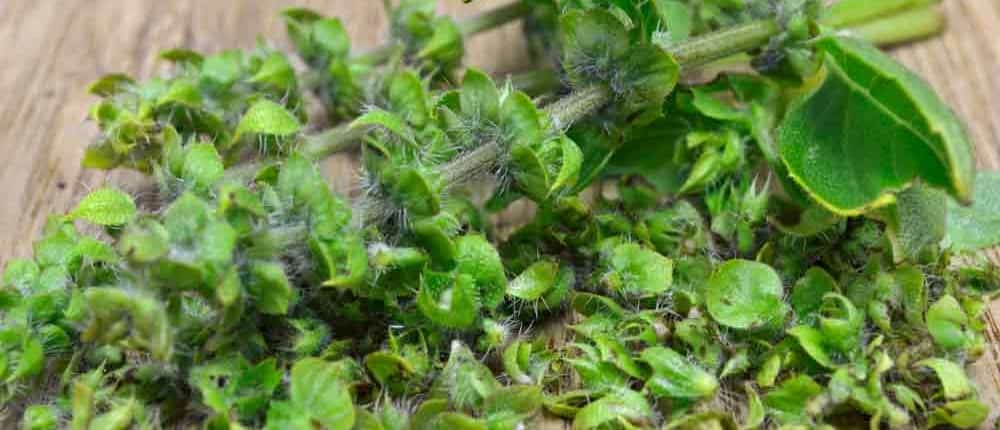
All of the flavor that makes basil such a beloved herb with a lemony punch gives lemon basil (Ocimum americanum) an exciting flavor to explore in the kitchen. Lemon and basil go well together, and this combines the best of both.
Heat-loving and repellant to biting insects, it makes a wonderfully different pesto and adds a boost of flavor to soups and stocks. As with other basil varieties, the flavor is at its peak when fresh-picked, but drying will retain some of the citrus aromas. Once it starts flowering, let some of the stalks go to seed to use as a spice and flavoring in salads, on sandwiches, and in summer iced tea.
This is another great candidate for growing in pots or containers that can be brought inside in cold weather to brighten up a winter dish.
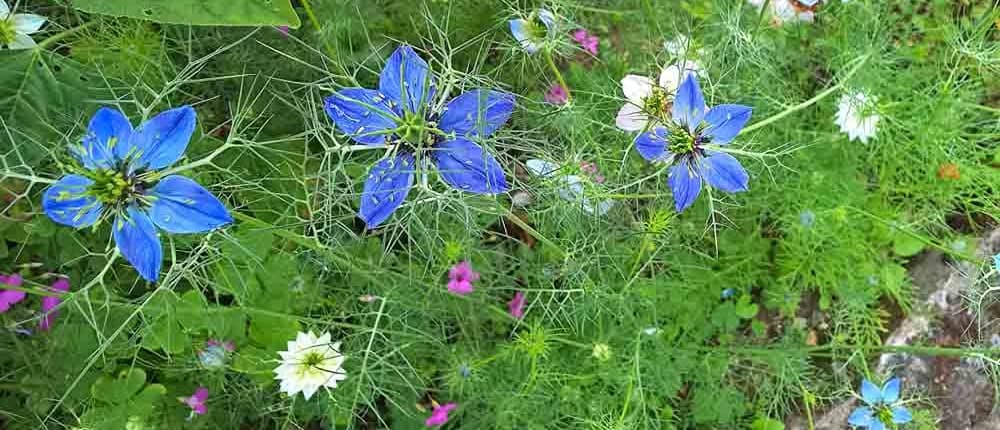
Rightfully called “The cure for everything but death”, nutmeg flower (Nigella sativa) shows off with blankets of gorgeous tiny blue-tinted flowers that produce the seeds that made them famous. The seeds are used as a spice for flavorings and medicinally for ailments. Also called Four Spice for its lemon-carrot scent followed by strawberry-pepper taste, it has flavored curries, breads, and cakes since ancient times.
Nutmeg flower prefers well-drained soil in full sun, and can often be found growing wild in rocky ground, fallow fields and scrubland. Because of its hardiness, it’s easy to grow and is often recommended for beginning gardeners, children, and low maintenance gardens.
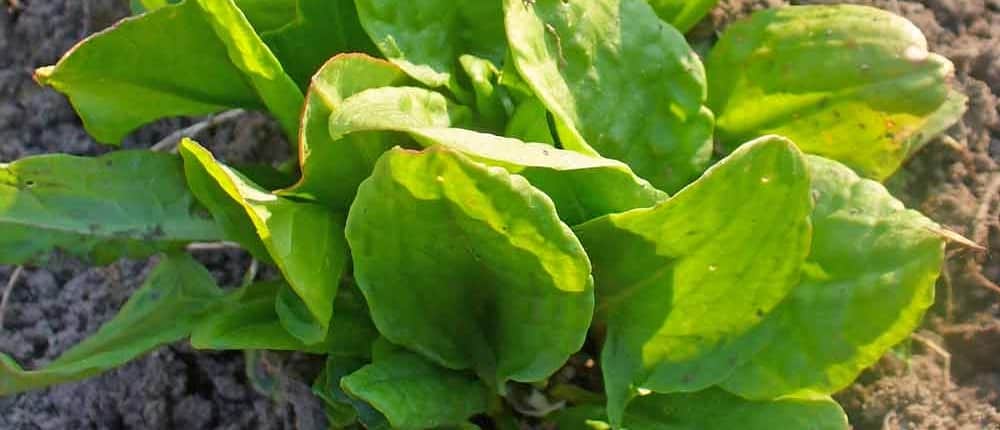
Known to many Europeans as the lemonade leaf, Large Leaf Sorrel (Rumex acetosa) is prized by chefs and is indispensable in French cuisine. The sour-citrus taste has been prized throughout the world for thousands of years as a wake-up call for taste buds dulled by bland winter foods.
Very hardy and early growing, sorrel was often one of the first fresh greens people ate each spring in the days before refrigeration. It is still a popular ingredient in spring tonics, and ancient Greeks and Romans used the herb to promote digestion.
Each one of these herbs is easy to grow in a container or pot, so no matter where you live the bright, refreshing flavors of citrus can be yours with little work and lots of rewards!
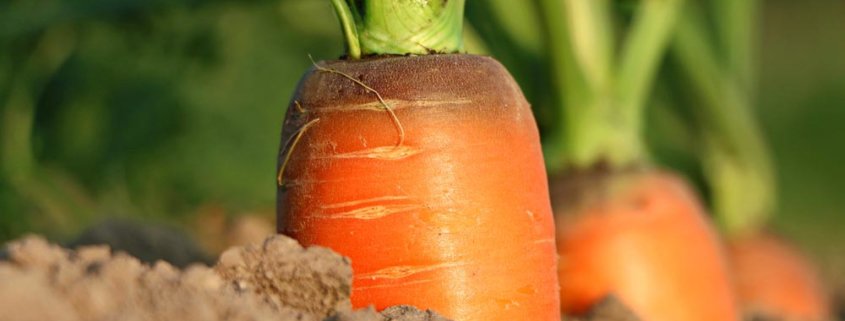
Discover the secrets of growing perfect carrots in your backyard. Our guide covers everything from seed selection to harvest time.
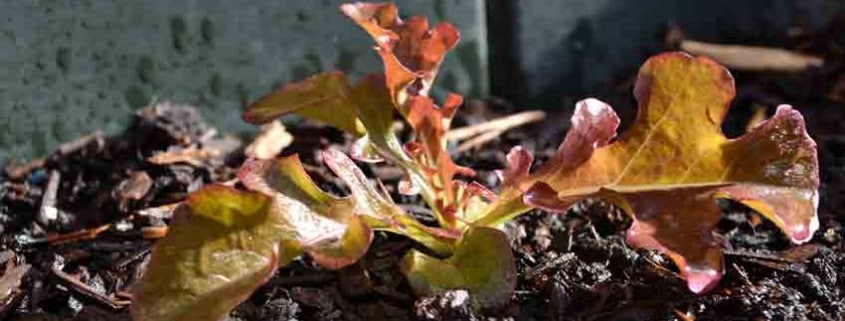
One of the most anticipated times of year for gardeners is Spring, with the attendant planting season. Everything is new and fresh, a chance to start over and improve on last year’s garden. A big subject for gardeners is what to do with the soil to prepare it for planting. If you have been reading our articles over the past several years, you know we advocate building the health and vitality of the soil in a natural, biologically safe manner. Soil becomes healthier, more productive, and disease, weed, and pest resistant. It results in an upward spiral where the garden gets better year after year.
Here is a unique recipe for a spring garden elixir that is easy to mix, completely non-toxic, and hugely beneficial for jump-starting your garden’s soil and getting it ready for planting. It comes courtesy of Crop Services International, which has over 35 years of experience helping growers accomplish their goals. They provide a Non-Toxic/Biological/Sustainable approach to growing food, from a full-scale commercial farm to the home gardener. We have read “The Non-Toxic Farming Handbook,” which they wrote to educate ourselves on improving our knowledge and approach.
This recipe is based on a 20′ x 50′ garden or 1000 sq. ft. Adjust for your garden size.
This recipe and applications assume an average garden soil that is basically good but could use some help.
It works in fertile soils by subtracting the lime or gypsum application, adding compost before spraying the elixir.
It helps very poor soils, but won’t give as much effect.
Preparing your garden beds for the elixir will require a couple of things.
First, evenly spread a 50 lb bag of high calcium lime (for acidic soils) or gypsum (for alkaline soils) across your beds. Your local garden center should have this. If using lime, it should be high calcium lime with as low magnesium as possible. 5% or less is great, up to 10% is acceptable, but nothing over 10%. The higher magnesium percentage releases excess nitrogen into your soil, greatly decreasing its fertility. It also overloads both the chemical and biological processes of your soil. Do not buy Dolomite lime, as it has too much magnesium.
Then, follow with 100 lbs of rich, aged compost, spread evenly across your beds, about 2 full-sized wheelbarrows. This can be purchased or from your own compost pile. Again, the best is made by you, and it is easy – “Compost – Nourishing Your Garden Soil” has all the details.
After doing both of these, make and apply the elixir.
This recipe is based on a 20′ x 50′ garden or 1000 sq. ft. Adjust for your garden size.
Apply the mix evenly over lime or gypsum and compost base with sprayer. If needed, go back over with second application to use up all of the batch, just make sure to apply evenly.
Broad-fork or lightly rototill garden soil. If using a rototiller, don’t go more than 2 inches deep at the maximum. Most of the biological growth happens at the 2-3 inch mark and the soil is turned over an inch or so beyond what the tines reach. Tilling deeper only destroys microbial life in the soil, setting you back in your efforts to create and build biologically active soil.
It must be noted that the sprayer cannot have been used to spray any chemical treatments like herbicides, pesticides, etc. as this will put those chemicals onto your soil, killing the microbial life in the soil and feeding the chemicals to the plants, where you wind up eating them!
Once you have applied the elixir and broad-forked or lightly tilled the soil, prepare your garden planning and seedlings. We have another planting elixir to use just after planting the seeds and transplanting the seedlings into the garden that we’ll share with you: In a gallon milk jug, mix 1/2 cup of fish emulsion, 1 tsp sugar (preferably raw or brown), and 1/2 cup of cola. Fill the jug with water and shake well. Apply the mixture over the seeds and transplants. Each gallon will treat approximately a 50-foot row.
This is a great start towards sustainable, biological agriculture in your own garden. Remember, though, it is just a start, a good step in the right direction. To continue to make progress in knowledge and soil health, you need to find out where you are starting from. Do more reading, ask questions, and get a complete soil analysis, not just the widely offered NPK and pH soil tests. Spend the money to find out exactly where your garden soil is, and then you can make sound decisions on where you want and need to go. Then you won’t be guessing and shooting in the dark, trying to do what is right but not really knowing if you are making positive progress.
Eggplant gets its name from a small white Oriental variety that is rarely grown in the United States. We are used to seeing the large, shiny purple elongated globes, so the original name is somewhat of a mystery to most gardeners. It is known by other names around the world, including aubergine in Europe, brinjal in India, eggfruit, tomato-fruited eggplant,
Fresh-picked, home-grown eggplant is mildly sweet and delicious, taking up other ingredients into itself when cooked. The all-too-familiar bitter, off-putting flavors come from fruits picked slightly unripe, trucked to a store that are almost a week old before appearing on the shelves. Grow your own and taste the differences!
A member of the Solanaceae or nightshade family, its cousins are tomatoes, peppers, and potatoes. Southeast Asia – likely India, China, Thailand, or Burma – is considered to be the center of origin where it still grows wild; a spiny, bitter, orange, pea-sized fruit that has been cultivated and refined for over 1,500 years.
The earliest uses seem to be medicinal as some of the earliest written Ayurvedic texts dating to around 100 BC describe the health benefits of using eggplant. The Chinese spent much time domesticating and breeding for desirable traits, as Wang Bao’s writing in 59 BC details the transplanting of seedlings at the Spring equinox. Later Chinese documentation shows the specific changes that growers brought to the fruit, from small, round, green fruit to the recognizable large, long-necked, purple-skinned fruits we know today.
Trade spread the seeds into Europe, where Spanish explorers brought them to the New World and by the early 1800s, both white and purple varieties were common in American gardens.
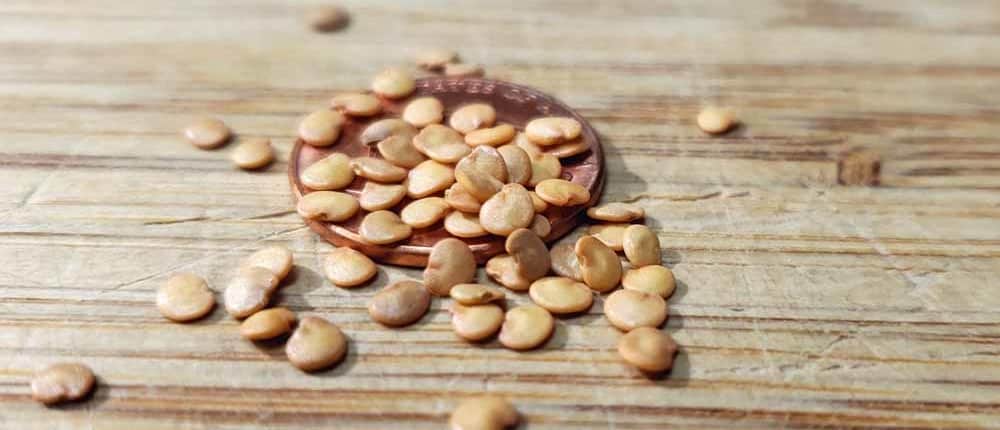
Eggplant is heat-loving, growing happiest in gardens with five months or more of warm to hot weather. Choose a sunny location where the sun can warm up the soil early. Raised beds and large black containers work wonders in colder climates to warm the soil sooner than in-ground gardens. Cool temperatures below 60°F reduce fruit production. In hot weather climates, afternoon shade can prevent leaf and fruit scalding, as fruit production decreases above 95°F.
Three to four plants will supply a steady stream of fresh delicately sweet fruit for a family, with extra for friends, neighbors, and co-workers.
Like its tomato cousins, eggplant is a heavy feeder needing a rich, fertile soil to grow well and produce the best fruits. Adding well-aged compost into the bed the fall before planting provides nutrients all season. Fall cover crops improve the soil structure and fertility, as well as feeding the beneficial soil organisms doing the heavy work of transporting specific nutrients to the plant roots.
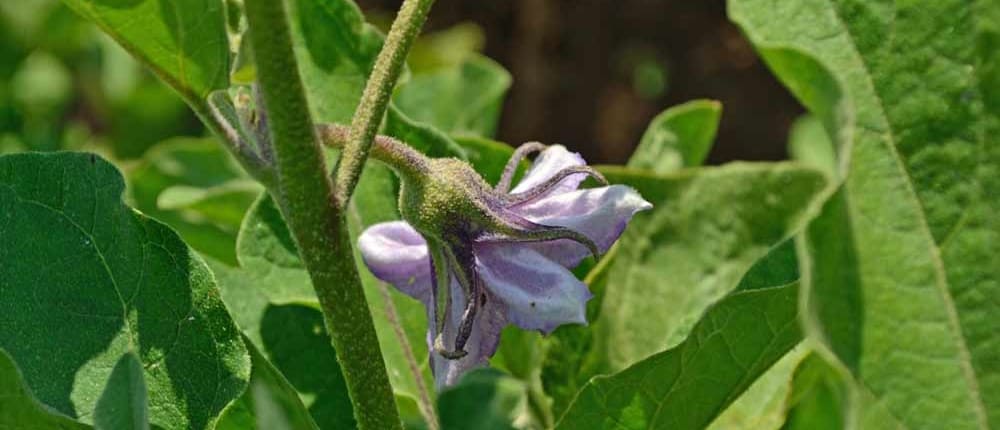
Soak the seeds overnight and plant in warm soil – ideally 80° to 85°F, but no less than 70°F – to greatly improve the germination rates. In warm soil, sprouts will appear in 7 to 12 days but can be delayed to three weeks or more in soil less than 70°F.
For almost all of North American gardeners, starting seeds indoors and transplanting them out after the soil warms up is the most successful method. Sow seeds indoors 6 to 8 weeks before your last expected frost date. Plant the seeds no deeper than twice their size in loose, moist soil then reduce the soil moisture to barely damp after the seedlings appear to reduce damping off and fungal issues. Transplant seedlings as needed into larger pots or containers to give the roots room to grow. Some gardeners will delay transplanting until a couple of weeks past last frost date to ensure bigger plants and earlier harvests, as well as avoiding early flea beetles.
Harden the young plants off by setting them outside on warmer days and bring them in the late afternoon, helping them become more robust and ready for transplanting into the garden. Transplant after the soil is warming up and not dropping below 60°F at night. Measure the soil temperature first thing in the morning to see what the minimum is.
Give the plants enough room to grow with good air circulation – eggplant doesn’t thrive in an intensively planted setting. 2 to 3 feet between plants is a good distance, allowing the sun to reduce molds and mildew while ripening the fruits faster and more evenly. Adding a bit of well-aged compost into the transplant hole helps feed the plants.
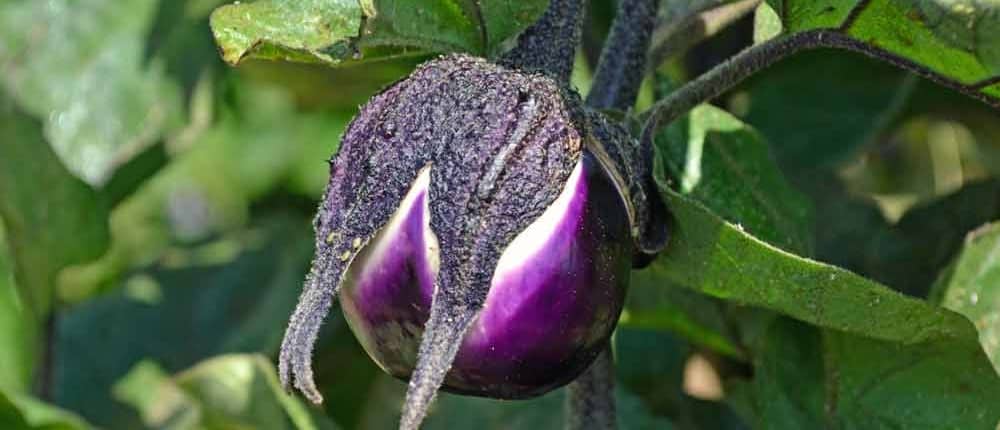
Eggplant has a shallow root system, so avoid cultivating too closely and pull or clip weeds carefully to not disturb their roots. Better yet, use a 2 to 3-inch layer of mulch for weed suppression that also insulates the roots and soil from excessive moisture loss while keeping them cool in hot weather.
Bigger yields come from starting the plants early and transplanting big, robust, healthy starts into warm soil in a sunny area. Keep them warm with moist roots and pest-free, otherwise, they can be set back and have a difficult time recovering. Producing lots of fruit requires lots of nutrition, so feeding a diluted liquid fish emulsion, milk & molasses snack, or other organic liquid fertilizer once a month will keep the plants in tip-top condition and health.
Companion planting is an excellent weed and pest control technique. An early season crop of lettuce, French parsley, or spinach followed by herbs like French tarragon, thyme, or Mexican marigolds. Beans and peas provide needed nitrogen and shade in hotter climates. In cooler climates, make sure the beans or peas don’t shade out the sun-loving eggplant.
One word of warning on companion planting beans and Mexican marigold – they are antagonistic, so don’t plant both with eggplant, choose one or the other!
Other nearby companion plants to consider are beneficial insect flower mixes to bring in ladybugs, lacewings, and others to keep aphids under control.
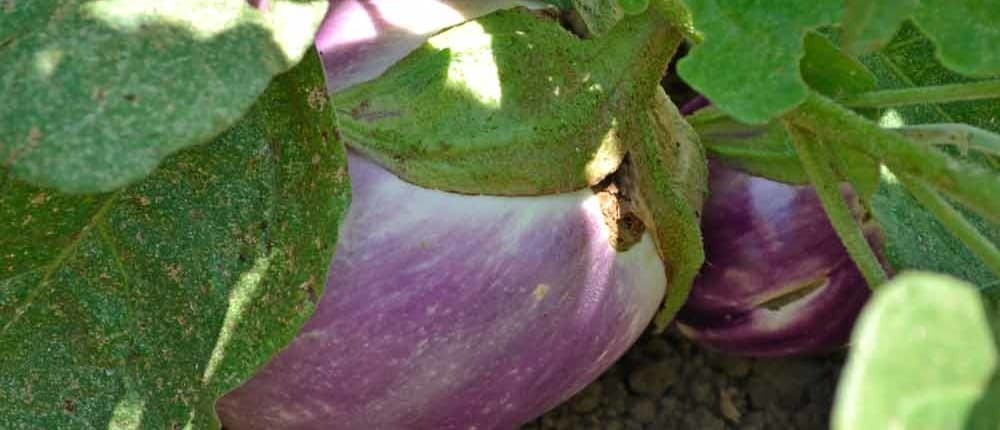
Colorado potato beetles can be a threat, but growing a companion crop of bush beans will help repel them. Inspect the undersides of leaves for the tell-tale yellow egg masses and pick them and any adult bugs off immediately.
Tomato worms can appear, so pick them off as you would on tomato plants. Knock aphids and red spiders off with a blast of water from the garden hose.
Flea beetles are the largest threat and can riddle young plants with tiny holes seemingly overnight. Small round holes in the leaves and tiny insects that jump like fleas are signs of flea beetles. In extreme infestations, the plants can lose their leaves and die. Young transplants are most susceptible and early detection is the key to preventing extensive damage.
From our personal experience, you can have very riddled leaves on your eggplant and still produce fruits. Do not give up hope, try to rid the plant of the beetles and give a little extra nutrition.
Trap crops of mustard planted near the area are helpful, as is interplanting with Daikon radishes to repel the flea beetles. If there is a sudden infestation, floating row covers and yellow sticky traps will help control the adult population.
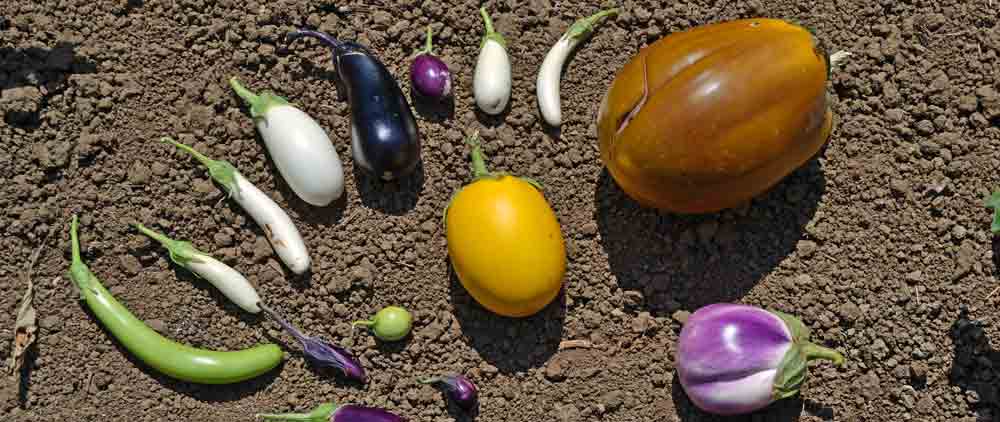
Fully mature fruit has a shiny, smooth skin and firm texture. If the skin is dull, has any wrinkles, or is not firm to the touch – it is over-ripe or old and will be bitter.
When harvesting, cut the stems with a sharp knife or shears, don’t twist or pull them off as that damages both the fruit and plant. Handle carefully as they are delicate and bruise easily.
Harvest can start once the fruit is about one third mature size and still be tasty. This is a saving grace in the fall when frost threatens, just pick the young ones and have one last feast of baby eggplant!
Flavor is at its absolute peak just after harvest, but they can usually be stored a day or two in a cool place before starting to turn bitter.
Sicilian Eggplant and Tomato Sauce is an easy and simple but brilliantly delicious way to showcase your home-grown, fresh-picked garden bounty!
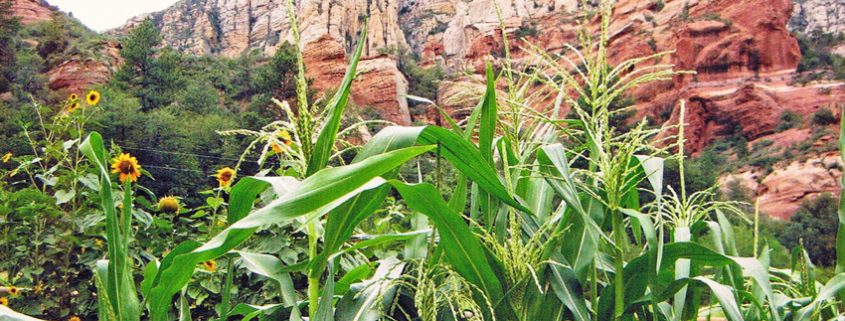
Heirloom corn is one of our oldest domesticated foods, feeding us for an estimated 7,000 years. Originating in Mexico, this cultivated grass is highly versatile and adaptable, providing so much more than simply food for our lives today.
Corn is ubiquitous, appearing in almost everything we use – from food, to fuel, to fiber, to medicine, to whiskey, and many more items.
When we think of corn today, we usually think of a uniform bright yellow row of kernels on a fat cob of sweet corn, but that’s only the modern face of this ancient and revered food. Tribes in Mexico still grow hundreds of varieties of corn each year and call themselves people of the corn.

Peruvian Heirloom Corn Display
When we shared a photo from a Peruvian corn display on our Facebook page, it had lots of “likes”. It showed a rainbow of shapes, sizes,and colors like these Peruvian varieties and made us wonder how many gardeners who liked the photowere growing some of their own corn this season.
Peru grows more than 55 varieties of corn and indigenous Mexicans identify with around 60 varieties. In the hills to the east of Oaxaca, Mexico the farmers have grown corn for centuries, maintaining the varieties they consider sacred to their people. They have numerous small fields, each growing a single variety, tucked into hills and little pockets that are used only for one special dish during a specific feast day or holiday. This is one of the reasons they consider themselves to be “people of the corn”.
It seems like everyone likes to eat corn but fewerAmerican gardeners are growing it, depending on others to grow, transport, and market it. This creates a problem for all gardeners, but it’s one we can fix. This is a perfect examplewhere one person makes a difference, one garden at a time.
I want to take you on a short tour of a few of the unique and delicious varieties we offer, with a little about each one. Maybe you’ll feel inspired to try something new in your garden this season!

Bloody Butcher Heirloom Corn
Bloody Butcher has an unusual name with an equally unusual story. The Meadows family in West Virginia has maintained this variety since the late 1800s, with family history tracing its origins back earlier.
The common description is of a blood-red corn originating in the 1800s by the mixing of Native American corn with white settler’s seed. There is more to the story, however!
The origin of the seed seems to be when Betsey Gibson escaped her captureby Native Americans in the early 1800s, bringing the seeds of what became known as Bloody Butcher with her. That corn kept her grand-daughter Ebby alive through some tough times, as well as Ebby’s son’s and grandson’s families through the Depression. They still grow it every year todayand claim it makes the absolute best cornbread.
Bloody Butcher is now a recognized treasure from the Appalachia region, used to make a regionally celebrated polenta, distinctive cornbread, and even a Kentucky Bourbon.
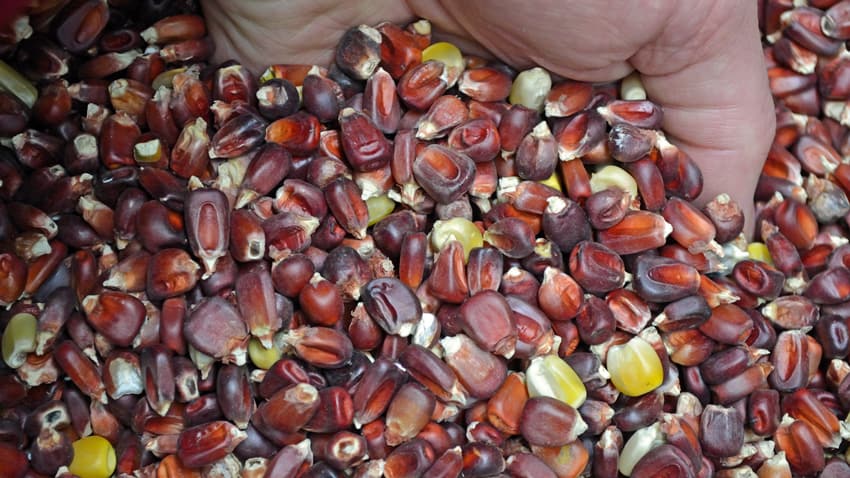
Bloody Butcher Heirloom Corn Seed
This is a “dent” type, meaning it’s not a sweet, fresh-eating corn. Dent corn gets its name from the distinctive dent that appears in the top of the kernel as it dries. It has higher protein and lower starch and sugars than sweet corn, making amazing cornbread or pancakes.

Hopi Blue Corn
Native American corn grows in many colors, which have special meanings. Each color corresponds to the cardinal directions – blue for north, red for south, yellow for west and white for east. White corn goes into traditional bread or is slow-roasted on coals buried underground or in mud ovens. Young women’s ceremonials use red corn, while yellow corn is for weddings.
Blue corn is sacred and held in high esteem by most of the Southwest Native American tribes. Historians believe the Hopi bred it from the ancestral varieties migrating through trade from Central America some 5,000 years ago. The Hopi language has many words for blue corn, based on the different shades and uses.
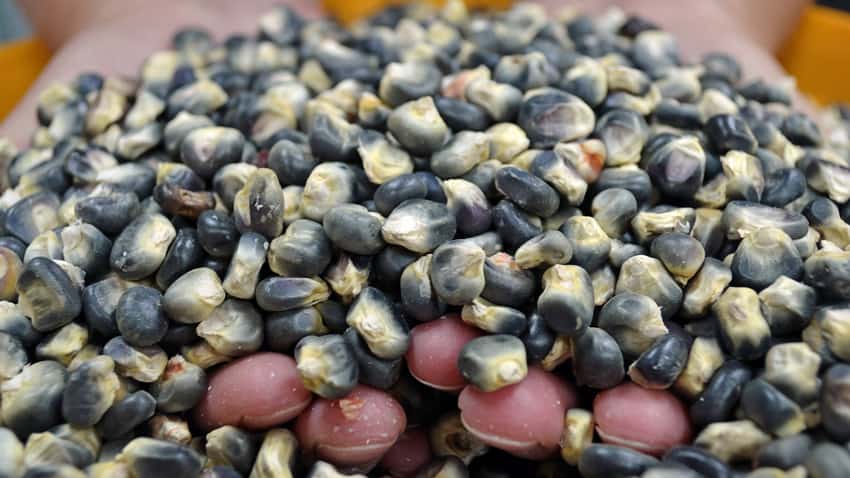
Hopi Blue Corn Seed
Blue corn is a key ingredient in many foods, some familiar like chips, pancakes, corn cakes, and cornbread, while others are newer innovations like bourbon.
This is a “flint” type, named for its hard texture once dried. It has less soft starch than dent corn and a hearty nature with a higher nutrient value. Traditional Italian polenta uses flint corn and most popcorn is a flint type. Navajo and Hopi roast the young corn in its “milk” stage when it is still sweet.
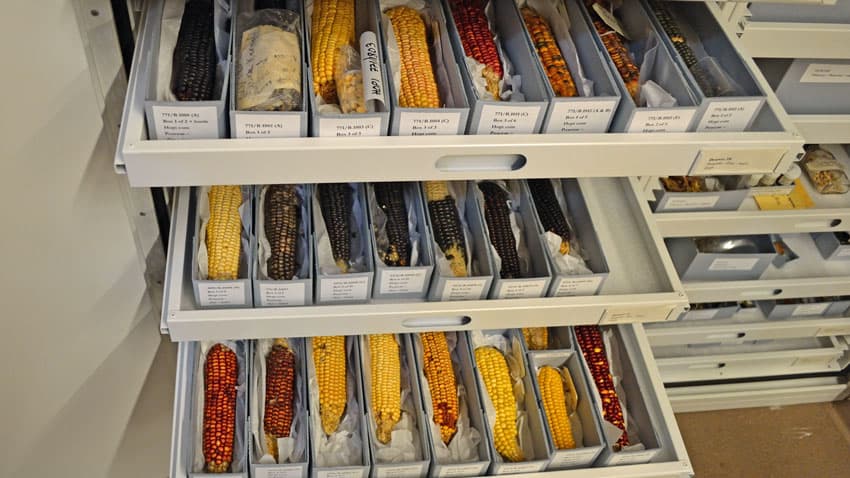
Heirloom Corn Herbarium
What happens when corn isn’t grown and kept alive in its natural state? First, it becomes a curiosity or novelty, grown for the colors or decorative qualities. Think about the “Indian corn” you see every fall, beloved by interior decorators for the bright colors and rustic feel it contributes. No one eats that corn anymore.
If it isn’t really popular as a novelty or decoration, then it might wind up stored in a museum as a piece of documentary evidence of how life was lived at a certain time in a certain place. The ears in the photo above are in an herbarium, or documentary storage at the Museum of Northern Arizona, showing how the cobs and kernels of particular varieties of corn looked when they were grown. Some of these cobs date from the early 1900s.
If these varieties haven’t been grown out elsewhere, then they are most likely lost, as these ears of corn are dead and can’t grow after being stored for so long. These are all samples from the Hopi and Navajo reservations – the colors and varieties are intriguing. There are eight varieties of blue corn in just these three drawers.
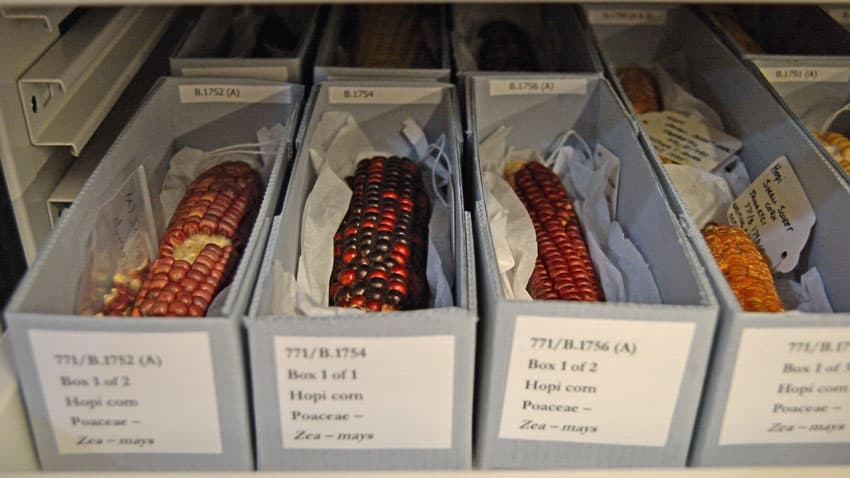
Hopi Corn Herbarium
A closer look shows the color variations among the ears. The flavors would be just as varied as the colors, and most likely used for different purposes in the life of the tribe.
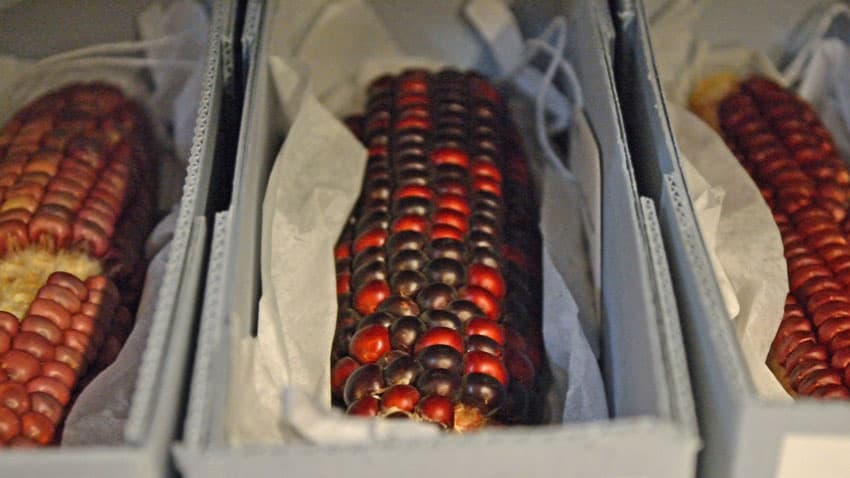
Hopi Corn Herbarium Closeup
As pretty as these colors are, their only existence shouldn’t be in a specimen box in a museum herbarium as a display of the past. They should be grown, eaten, and enjoyed for the living treasures they are.
It would be a travesty if this only place you could see this variety of corn and not be able to taste it anymore.

Oaxacan Green Dent Corn
Besides roasting fresh sweet corn, there are many delicious dishes you can make with dent or flint corn. Polenta, cornbread, pancakes, and chips have already been mentioned, but corn that’s been ground into flour or cornmeal is used in many more recipes.
This is Oaxacan green dent corn, from the Oaxaca (wah-HA-ka) area in central Mexico. Drought-resistant and very flavorful, it has been grown by the Zapotec for many centuries and is the key ingredient in green corn tamales, a beloved regional treat.
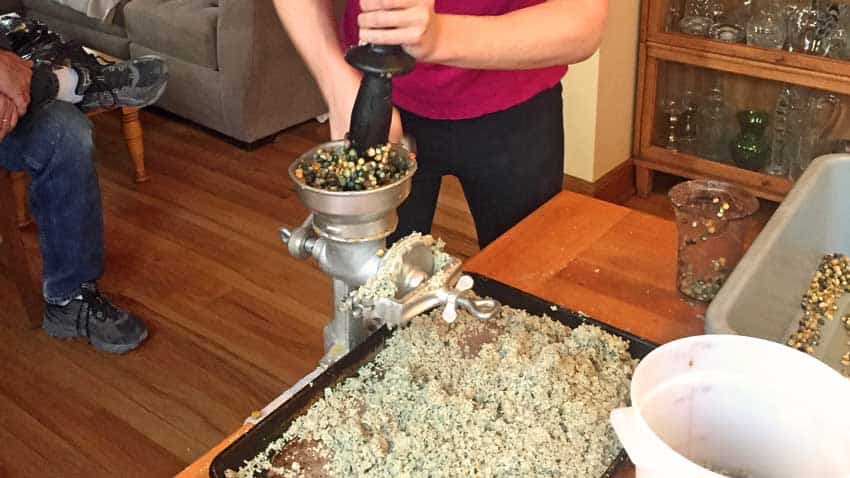
Grinding Oaxacan Corn
Oaxacan green corn tamales are made from green dent corn that has been lightly dried until the kernels are loose, then ground into masa to make the tamales, giving them a unique earthy, herbaceous flavor. American green corn tamales typically use regular yellow corn masa with green chiles – a much different flavor!
While you can buy instant masa at most supermarkets, fresh masa has an unparalleled sweet richness. Our friend Andy makes an annual fall tamale dinner for the Denver, CO area Slow Food group.
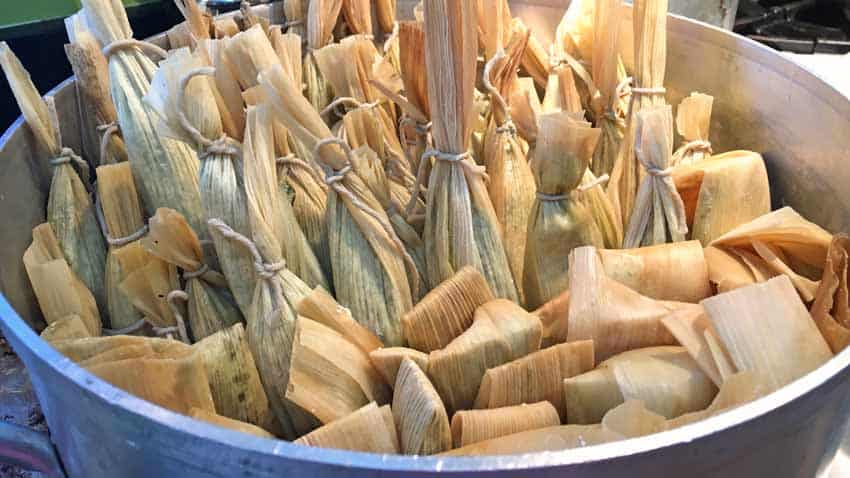
Green Corn Tamales
The tamales are filled and cooked by steaming. The green colors are peeking out from underneath the husk wrappers, waiting to surprise diners with their wonderful flavors!
We’ve shown you some delicious heirloom corn varieties, a little bit of their history & how to use them, what happens when we stop growing corn and how to prevent that – now it’s your turn!
You don’t need a large plot to grow a little corn – a 5-foot square will do nicely. Corn produces best growing in a block, instead of a row because it is wind-pollinated. As with most gardening, start small and get some experience before trying to grow enough to feed the neighborhood!
For further inspiration and to see how easy it can be to make your own fresh masa, here’s an article from Saveur magazine to get you started.
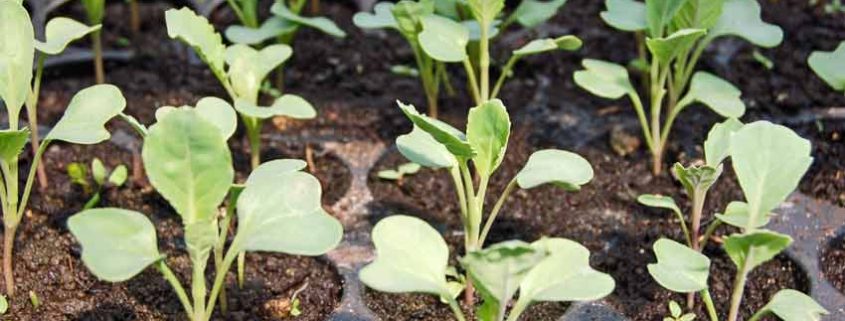
One of the best ways to grow a bigger or better garden is to start with robust, healthy seedlings and transplants. Starting them yourself allows you to select and control the conditions, which often means needing a seed starting station. Gardeners and growers looking to improve their seed germination rates and have stronger, healthier transplants that produce earlier and longer need this tool!
A seed starting station can be almost any size—from a single seedling tray to a full commercial table system. Most gardeners use a moveable wire restaurant rack as the frame, but there are many other ways to set one up.
A major advantage is that placement is not limited to a sunny and warm location because the light and heat are on the station itself. This gives you flexibility in placing it in your house, workshop, or garage—anywhere that remains above 50°F at night.
We’re sharing what we’ve learned from building and using our seed starting station for almost 25 years – what works, what doesn’t, and how to save some money!
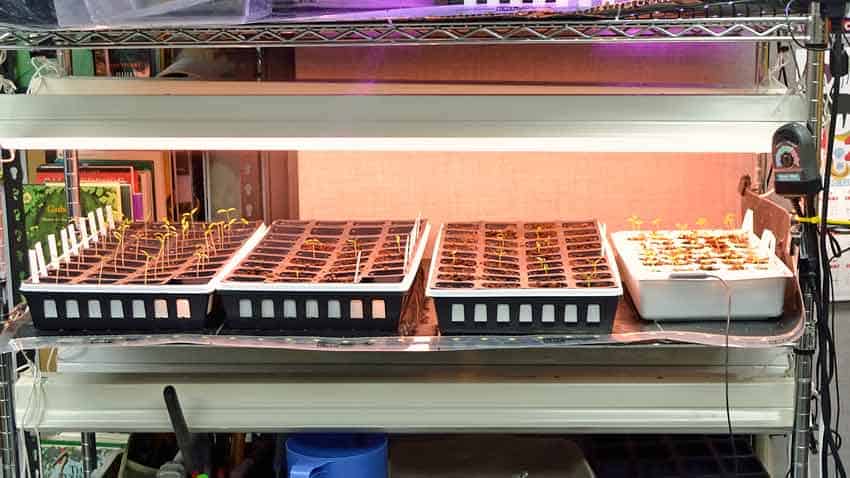
Seed starting station with seedling trays on top of heat mats with lights and thermostat.
A dedicated seed-starting platform isn’t required for a great garden, but it helps! A good seed starting station is self-contained, creates the perfect conditions for seed germination, and adjusts those conditions as the seedlings grow and develop. You easily control the warmth, moisture, and light in just the right amounts.
We invested in our initial seed rack almost 25 years ago; it still has most of its original parts, and we use it every season. A few parts have been replaced or upgraded as needed, but the money spent two decades ago is still paying out – every season – and will for the next couple of decades. That is money well spent!
Here are three more reasons to seriously consider your system –
1- Get a head-start on your season
Starting seeds like tomatoes, peppers, and eggplant earlier gives you bigger and stronger transplants than with a seed flat in the window. Instead of having a 4 – 6-inch tall seedling, you can have a 10-inch tall transplant, as you see at the garden center, which is robust and more resilient to weather fluctuations. An added benefit is earlier harvests as they go to work sooner than smaller seedlings – as much as a month earlier! In very short-season climates, a seed starting station is almost required to have vegetables like tomatoes, peppers, and squash that need longer to mature.
A seed starting station has adjustable lighting, so seedlings grow stronger and more compact instead of spindly and weak ones that struggle toward the light in a window. The protected environment keeps your young, tender, and delicious seedlings from becoming snacks for critters and insects looking for an easy meal outdoors.
The station works for spring, fall, or winter gardening—we start our spring seeds in mid-to-late February and the fall crops in August for transplanting in early September.
2- Dramatically improve your seed germination rates
The seed starting station has light and heat, and you provide moisture using germination trays with lids, adjusting as needed. Dial in heat and add moisture after planting your seeds, then add light when they sprout while reducing the moisture and heat to grow stronger, more robust seedlings than ever before.
Starting seeds becomes so easy that you can start transplants for your friends and neighbors with almost no additional effort, becoming the local garden hero.
3- Grow salad greens or microgreens indoors year-round
Lettuce, spinach, baby Swiss chard, and mustard are greens that grow well in little soil and cooler temperatures – making your seed rack the perfect location. Just dial the heat down – or turn it off in warmer climates – and keep the lights on with sufficient moisture. You’ll have fresh salads in January, even in Alaska.
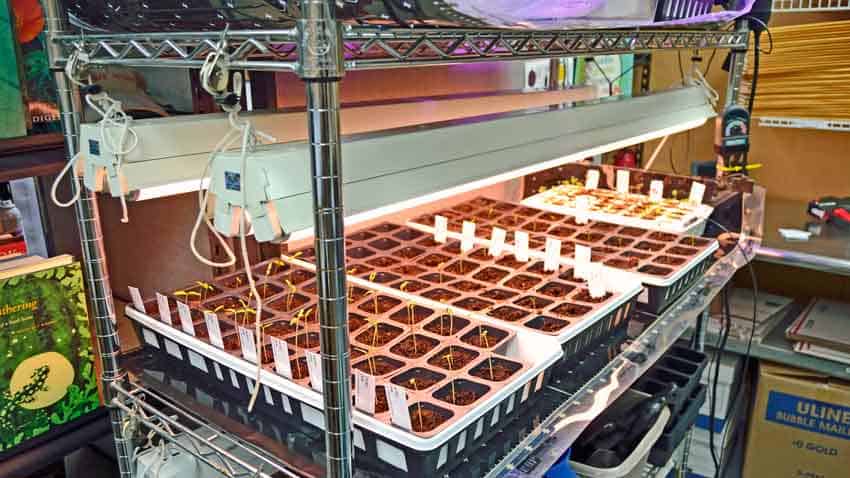
Another view of the grow rack with seedling trays, heat mats, thermostat, and adjustable lighting.
A growing station, grow rack, or seed starting station is any setup that provides light, heat, and moisture in a controlled environment and can be easily changed as needed.
Often made from commercially available wire racks on wheels, they can be as simple as a couple of hoops made from PVC tubing supporting lights over seed starting trays with lids and a heat mat or heating pad underneath.
They are usually very space efficient, only needing a couple to a few square feet, and can be tucked away in little-used areas because they provide their own light and heat. A spare room, unfinished basement, or even a garage will work to start your seeds, as long as the minimum nightly temperature is above 50°F.
A growing station – simply stated -helps you start seeds better and grow stronger transplants.
It really is that simple.
Anyone starting their own seeds gains an immediate advantage using a grow station. You have complete control over the specific conditions that seeds need to germinate – light, water, and heat. This means you provide the perfect environment at the perfect time for faster seed germination, then decrease the moisture and heat while increasing the light to grow stronger seedlings than ever before.
The foundation of any seed-starting system is the support structure that holds the lights above the seed trays, allowing them to move up and down over the young seedlings as they grow. Larger stations support the seed trays and heating mats, while simpler systems suspend the lights over any level surface.
If you have space, investing in a restaurant-style wire rack on wheels gives you a lifetime of use—and possibly more! Our rack is almost 25 years old and is still functioning just as well as the first day we assembled it. We’ve moved its location about 8 – 10 times and reconfigured the lighting system a few times as we tried different ways to hang and adjust the lights over the seed trays.
We easily see another 25 years of use from it because there isn’t much stress on the rack. We’ve removed two original shelves to give us more vertical space for growing seedlings and provide light above each shelf.
The five-shelf system that we use (74-in Tallx 48-in Wide x 18-in Deep) is ideal if you’re growing a larger garden or want to start and transplant several dozen seedlings indoors simultaneously. Depending on your needs, you have the flexibility in how many shelves are in use at once – from one to all of them. Here’s a materials list with sample pricing from Home Depot:
TOTAL COST: $355.04with Plant and Aquarium bulbs from Home Depot
OR
TOTAL COST: $295.26 with Daylight bulbs
Once you see the cost of a professional seedling cart (without heat mats), you’ll see what a difference building it yourself makes!
The consumables—items that are reasonably expected to wear out—are the power strips and bulbs. The power strips should last 3 – 5 years, possibly more, while the bulbs have an average lifespan of 20,000 hours. Using them 14 hours per day gives almost four years of continual use, but normal use is about four months for both spring and fall transplants, giving a potential 12 years. In our experience, we usually see about 8 – 10 years of use.
The pricing example above is for purchasing brand-new equipment simultaneously, but it doesn’t have to be built this way. Your local Craiglist is an excellent option, and you can set alerts for keywords—”wire shelving,” for example—to avoid having to search every day. Yard or garage sales, used equipment, or restaurant supply companies in your area are other choices. If you get creative, you’ll find several ways to save money over buying new.
Even if you buy new, you can build a shelf or two at a time as needed – nothing says you have to build it all at once!

Spectrum-tuned LED grow light – good idea, but it doesn’t last long enough for the price.
You’ll see two different choices in bulbs in the materials list – Plant and Aquarium bulbs vs. Daylight bulbs. Both are fluorescent and will last 20,000 hours, but they emit a different spectrum of light. Red and blue are the two most important colors that plants use, as most of the photosynthetic activity of chlorophyll is in the blue and red frequencies. In simple terms, blue wavelengths encourage vegetative growth, while red is best for flowering and fruiting.
The Plant and Aquarium bulbs are tuned toward the red end of the spectrum, while the Daylight bulbs are more blue. If you are using the grow station exclusively to start seedlings for transplanting, then use the Daylight bulbs. For those using the grow rack for growing greens for harvesting, choose one of each type of bulb for each fixture, giving you better coverage of the spectrum.
LED lights are available, and we are testing some, but we aren’t ready to recommend any particular brands yet. The advertised advantages are a longer-lasting light that uses less power than fluorescent bulbs. The disadvantages are usually higher initial costs and less than optimum real-world lifespan. For example, one light we tested cost $30—which is good—but started to fail in the second year of use, which is bad.
Commercial LED lighting is extremely expensive and has not – yet – lived up to all of its claims. Research is ongoing, and we expect to see a large shift to more affordable and better LEDs soon.
Most vegetable seeds don’t require light to germinate, but some herbs and flowers do. When we start vegetable seedlings, we don’t turn the lights on until they have popped up and opened their cotyledon leaves. This is when they switch from living off the stored food and energy in the seed to making their own through photosynthesis. 10 – 12 hours of light is good to start. The lights are lowered to about 3 – 6 inches above the seedlings or moisture domes to give them the strongest light possible.
Monitor the soil moisture levels, as the warmth from the lights can sometimes dry out the soil.
You can’t hurt the seedlings with too much light – they will not use what they don’t need. In photosynthesis, there are two cycles – a “light” and a “dark” cycle. The light cycle depends on light to function because it’s based on photosynthesis, but the dark cycle doesn’t require light. That doesn’t mean it needs to be dark for the “dark” cycle to function – it happens after a certain amount of energy is built up from photosynthesis during the light cycle, which then switches to the dark cycle to store that energy. This switching happens continuously, so don’t worry about giving your plants too much light!
Providing lots of light builds strong plants because they have lots of light energy to capture and store for future growth.
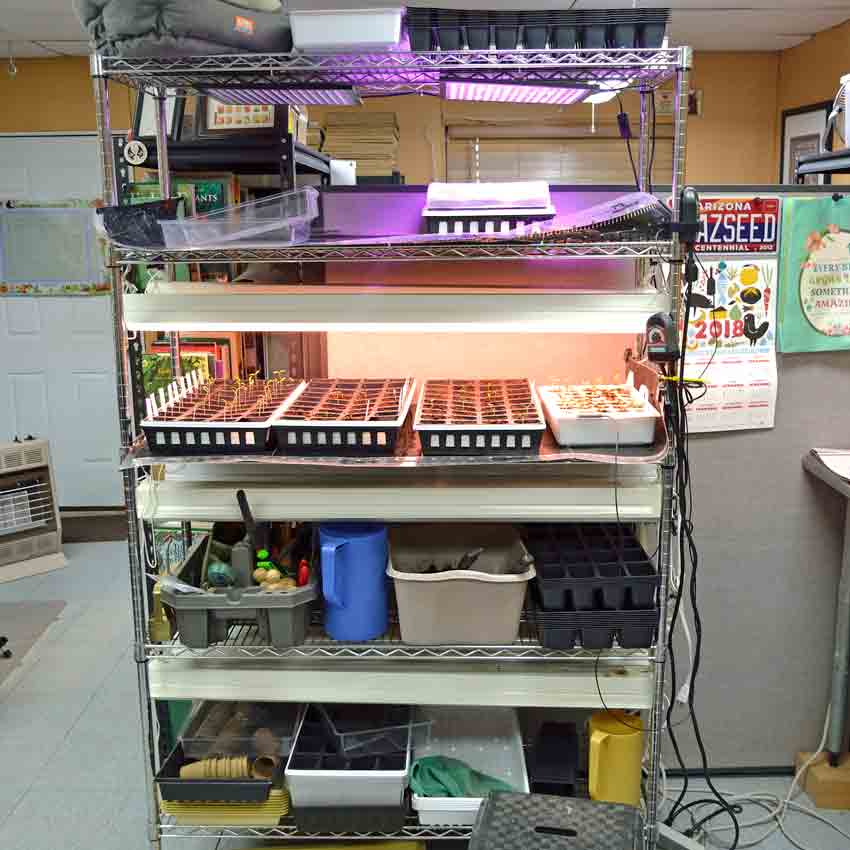
Early season view of our grow rack with two shelves for starting seeds.
Now that you know what you need, let’s walk through how to set it up and start your first batch of seeds!
Start with the wire rack – this is the foundation for everything else. Use the instructions and carefully assemble the rack, installing the rollers on the bottom. Moving the rack to install or adjust heating or lighting makes it much easier.
We allow about 18 inches between each shelf, installing the top at the very top and the bottom at the bottom to give us the most room possible. The top rack is used for storage and to support the top level of lights. This gives room to move the light, keeping it 3 – 5 inches above the seedlings.
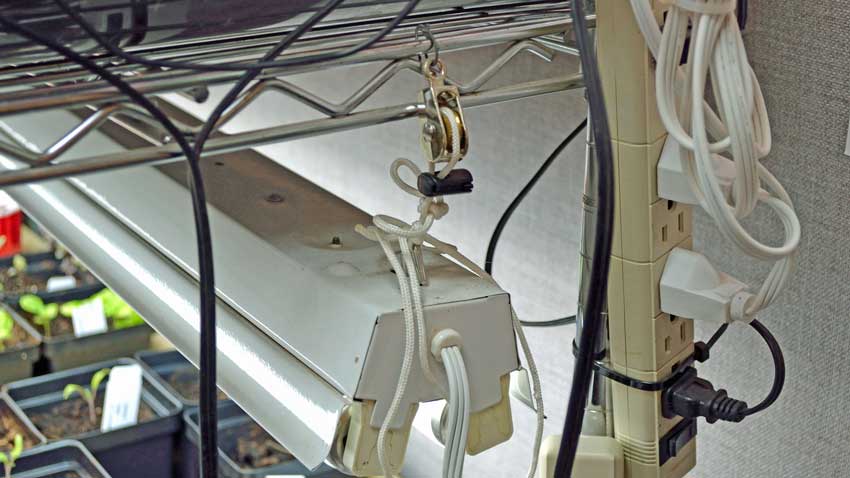
Lighting and electrical connections, showing pulley and cord on the light fixture.
Using the Zip ties, fasten the power strips to one of the wire shelves within easy reach. We use one set for the lights and another set for the heating mats—this way, we can turn all of the lights on with the flip of one switch.
Cut two pieces of the nylon cord into 24-inch sections and securely tie one end onto the provided hooks for the shop light housing. Then, install the hooks into the housing. Zip-tie the small pulleys onto the end of the shelves to support the shop lights, run the cord through the pulleys, and tie them off. If you aren’t confident with your knots, the optional cord locks might come in handy. Finally, install the bulbs into the fixtures and plug the cord into the appropriate power strip.

Heat mat and thermostat with temperature probe.
We use commercial heat mats on two wire shelves, setting the seedling trays directly on top to keep the soil warm. Thermostats with temperature probes keep the soil at a pre-set temperature range and are adjustable according to the needs of the seed or seedling. Both are commercial quality and last many years, but they are an investment as they are somewhat costly. We set them at 80-85°F after sowing, then reduced them to 75°F once the seedlings were up and lowered them to 70°F as they matured. Providing heat to the roots keeps the plants healthier and allows them to tolerate air temperatures as low as 50°F overnight with no adverse effects.
Gardeners in warmer climates may not need heat mats, as the fluorescent bulbs provide heat to the shelf above. If you are in a milder climate, experiment with this before investing in heat mats and thermometers!
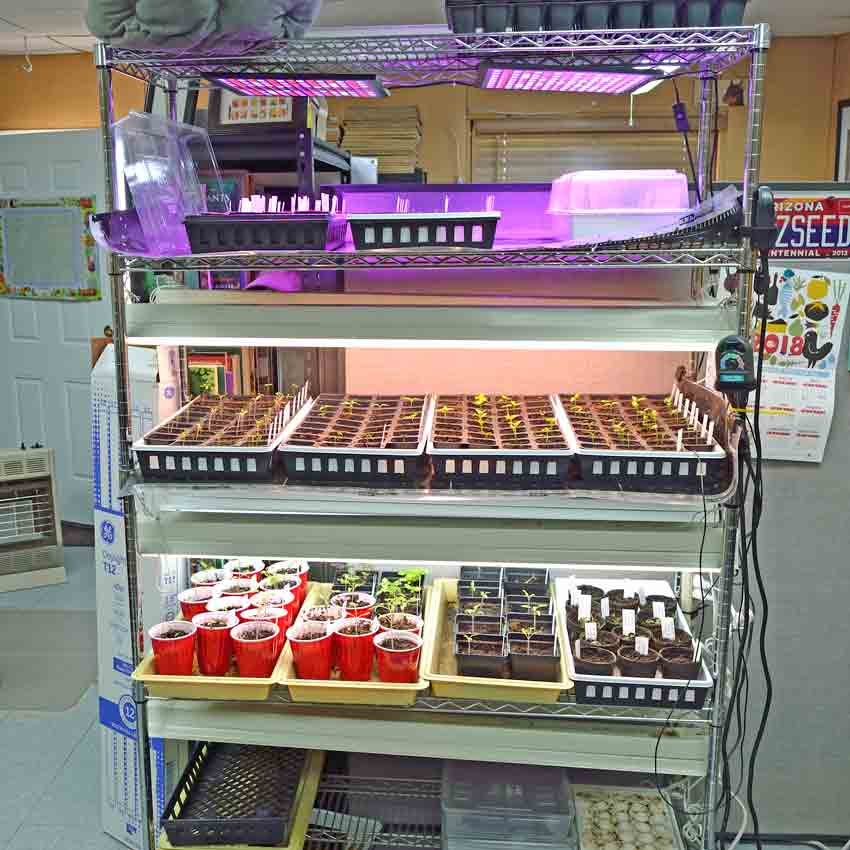
Mid-season growing station configuration with larger seedlings on non-heated shelves (click to see larger photo).
Once the seedlings are transplanted into larger cups, they are moved off the heating mats onto lower shelves, allowing them to grow in cooler conditions closer to those they will experience in the garden. We only have two shelves with heat mats for this exact reason.
Even if you have little (or no) extra space, you can get creative in setting up your seed starting station. A longtime friend lives in an apartment with little extra space and gardens in a community garden, so she has come up with a remarkably inventive method to start her transplants.

Starting seedlings under a table.
She uses the underside of a table to support the lights for her seed-starting station! Her apartment is naturally warm, so combined with the warmth of the lights, there is enough heat for the seedlings to thrive.

Larger seedlings mature before being transplanted. The heat mat is turned off.
We’ve provided you with lots of information and details on building your own seed starting station. Use this article as a checklist, and you’ll soon see the strongest and healthiest seedlings ready for transplanting into your garden!
As you progress, we’d love to see photos of your creativity and how you solved particular challenges with your climate or situation. We will share them with everyone to help others overcome similar issues!

Shade for a garden is a polarizing subject – it seems like we’ve either got too much or too little. Today we’re focusing on gardens that need some shelter – the ones with perpetual sun-scaldon tomatoes and peppers or cilantro that bolts almost immediately after sprouting.
Shading a garden often seems overwhelming, especially if you live in the very sunny zones of the US, Canada, Australia, or in other bright parts of the world, but it shouldn’t be complicated or expensive. Today we focus on simple and easy methods for giving your garden some relief – exactly where and when it is needed.
Vegetables like tomatoes, peppers – both sweet and hot, eggplant, lettuce, spinach, along with herbs like cilantro, all benefit from a little shade, especially in the sunny, hotter afternoons of mid to late spring through late summer or even early fall.
Full sun in the early to late morning gives plants plenty of energy through photosynthesis without excess heat stress, allowing them to grow and produce to their full potential. Providing afternoon shelter relieves a lot of the heat buildup, lowering the amount of moisture lost through leaves and the need for extra water to keep the plant healthy. This allows the plant to spend its energy on growing delicious fruits and vegetables, not in transporting water from the soil just trying to stay alive. We talk more about this specifically for peppers in Grow Better Peppers with Shade.

Oak tree shade
Now that you know why shade is beneficial for a sunny garden, what – exactly – is shade? Let’s look at the different types of shade through commonly used terms.
Deep Shade – there is no direct sunlight at all and only a small amount of reflected light, such as from the wall of a light-colored house, garage or fences. This would be under the canopy of several large, fully mature trees.
Light Shade– gets only one to two hours of direct sunlight a day, but has quite a bit of reflected light from nearby walls and fences. Most likely underneath large trees, but has either morning or afternoon sun reaching the ground.
Partial Shade– sees direct sunlight for two to six hours per day with dappled shade the rest of the day. This would be from less mature trees, a fewer number of trees close together or those without an extensive leaf structure.
Full Sun – receives at least six hours of sunlight per day but more likely eight to ten hours. This could be shorter or younger trees, wider spaced plantings, or species with smaller leaves and less shade structure, such as elms as compared to oaks.
Use this information as you plan on what varieties to plant where.
When do your plants need some shelter? Typically during the hottest parts of the day – afternoons – during the hottest parts of the year – May or June through August or September. The exceptions are the areas routinely above 110°F like Phoenix, Tucson, Las Vegas, and Palm Springs – they grow better with mid to late morning shading lasting all afternoon. For the rest of us, if our plants start seeing some shadows by about 1 pm, they are comfortable and produce nicely.
What this means is that permanent overhead shade structures are usually not needed. They can be a nice addition if part of the structure is over a picnic table or BBQ area next to your garden, but the garden doesn’t always need that much cover for that long.
The upside to temporary shade for part of the day is it can be removed for cool weather crops needing as much sun as possible to capture the warmth on the soil to grow earlier or later in the season.
Where is the best place for your shade? Most plants need some afternoon protection, meaning the shadows should come from the west side of your plants, or that you plant on the east side of the protection. Confused? Don’t be – think of it this way. As the sun moves to the west, it casts shadows to the east and that’s where you want your plants to be – in the shadows!

Achocha vine on west wall
In the photo above, the Achocha is growing on the west wall of this courtyard and has afternoon protection – this photo was taken about 11 am, with full morning sun. After about 1 pm, the shadows arrive and the area cools down, even though it reaches 100°F or more each afternoon during the summer. When we first tried growing it on the east wall, it received morning protection but was baked in the afternoon’s direct sun, struggling to grow and not producing any fruits. The fruit production exploded and it was much happier once we moved it!
Beyond east/west shade, you might consider giving your garden protection to the south. Shading a section of your garden along the south fence with each row having its own screening on the west side gives more sensitive plants extra protection from the sun.
Wind moderation is another advantage of shading, as each successive row slows down the prevailing breeze, making the growing conditions more favorable. Plant hardier plants upwind and less wind tolerant ones downwind.
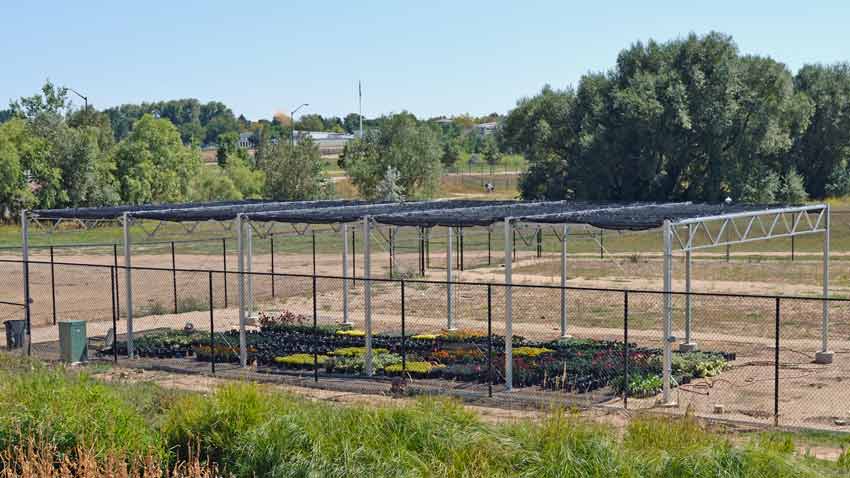
Commercial shade structure
Giving your plants some much-needed sun shelter can be easier than you might think. Here are some examples to get you thinking about your garden and how it is set up.
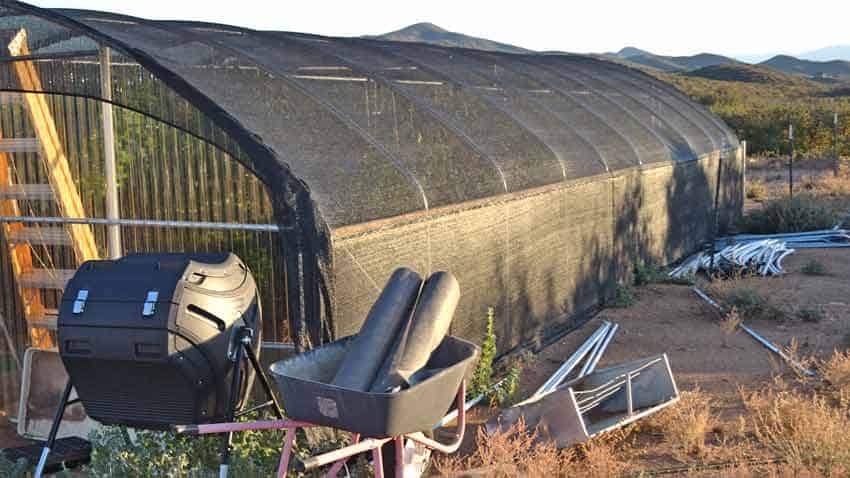
High tunnel with shade cloth
Permanent structures
This is what everyone seems to think about first when talking about shading a garden. The commercial type shade structure, supported by big square steel poles with the whole garden shaded is one approach.
Another is simply planting in containers on the east side of your house or garage. This is exactly how our container garden is set up, starting right next to the east wall and stretching out for about 10 feet. It gets full morning sun and starts seeing shade in the early afternoon, and by the hottest part of the day it’s in light shade – no direct sun and only reflected light. We’ve grown cilantro in the container closest to the house almost all summer without it bolting.
Yet another is a chain-link fence with privacy strips woven into it, either 6 or 8 feet tall. Some houses already have these as a border fence and all you need to do is add the privacy weave. A tall wooden fence gives you built-in shading.
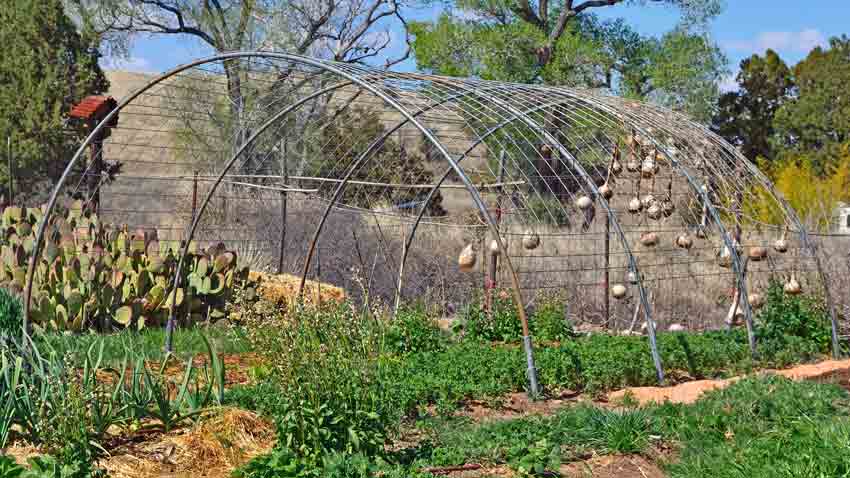
Cattle panel hoop house
Temporary structures
These are the most common types of non-living sun screen, easily put up and taken down as needed. One example is shade cloth zip-tied to the south fence of a garden, providing both shade and wind filtering. The amount of shade depends on the height of the fence.
Another is the T-post and shade cloth approach. 8-foot tall T-posts are pounded in on the west edge of the row or bed at 4 to 6-foot intervals, then shade cloth is zip-tied to them. This gives about a 7-foot tall shade wall, as the T-posts are driven in about a foot deep, giving a good shade and windbreak for vegetables. Removal is easy when fall approaches and the sun is needed all day.
Another example is a hoop house made from semi-rigid 20-foot long cattle panels arched over a bed or couple of rows and covered in shade cloth or clear plastic as needed. The plastic makes the hoop house into a large cold frame early in the season for lettuce, spinach, Swiss chard, and other cold-season greens, then is switched for shade cloth when tomatoes, peppers, and eggplant are transplanted in early spring. The plastic is re-installed in the fall for another season of cold-season crops before winter.
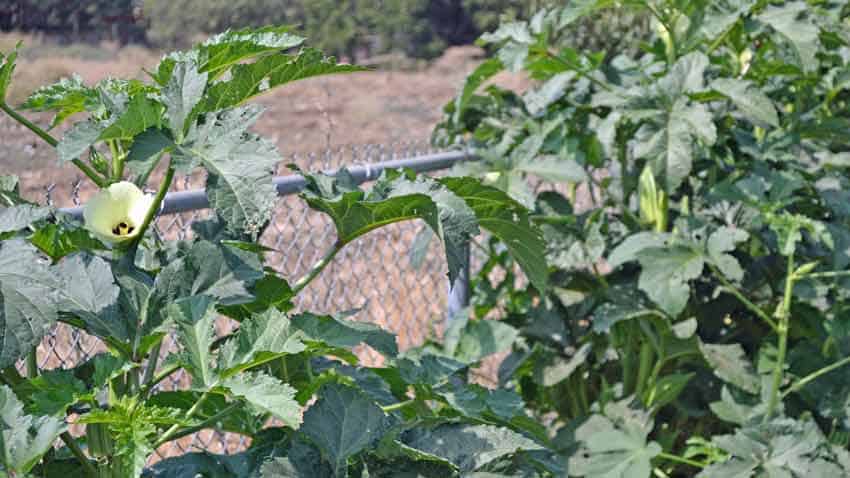
Okra as living shade
Living structures
These can be either temporary – as in a wall of Russian sunflowers on the south fence, or more permanent – like a large trellis or hoop house made from cattle fencing panels as above and planted with a vining, leafy vegetable that crawls up and shades the entire area. The trellis is permanently installed, while the vines are replanted. A planting of okra along a fence, as the photo above shows.
You’ve increased your knowledge and added another set of tools to your gardening toolbox, helping you be that much more successful this coming season! Use this article to plan where and when you need shade the most to boost your garden production and impress your family, friends, and neighbors.
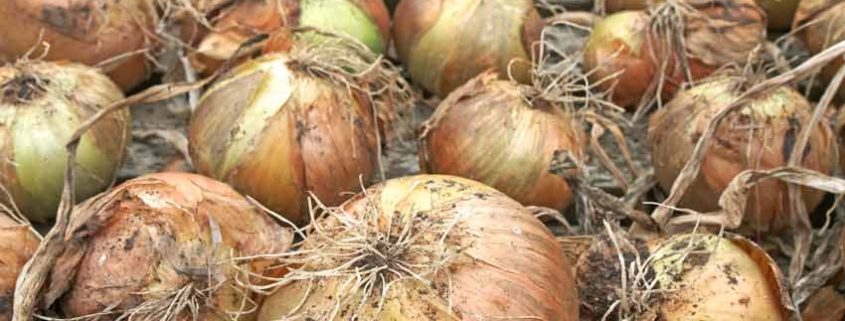
Many gardeners begin growing their onions from transplants or bulbs bought at their local garden center. They are convenient, easy to grow and a great way to learn about growing delicious onions in your garden, but they have some drawbacks. Like tomatoes and peppers, the selection is limited to what the grower chooses and freshness isn’t always a given.
Growing onions from seed opens up a world of diversity in shapes, sizes, flavors, and colors to grow. Starting from seed typically rewards you with bigger and better quality onions, with larger harvests being a bonus from the abundance of seed in a packet.
Onions grown from seed almost always perform better than those grown from sets. They are less prone to disease, store better, and bulb up faster, especially if you have some knowledge and tips to do it right. Growing onions isn’t quite like growing other vegetables, so here’s how you can grow better this season!
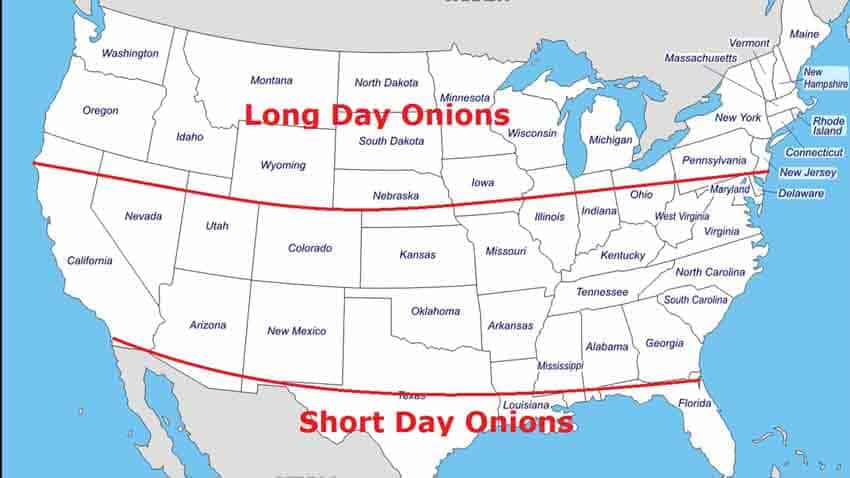
Long vs Short Day Onion Zones
Which onion varieties are best for you depends on where your garden is located. There are three different types of onions and picking the right type is key to growing a great crop.
Short-day onions need 10 – 12 hours of daylight to form bulbs. They’re perfect for gardeners in the southern US where summer days are not as long throughout the growing season. Growing short-day onions in the north results in tiny bulbs that go to flower early because the bulbs stop growing once the days lengthen.
Long-day onions need at least 14 hours of daylight to form bulbs. They’re best for gardeners in the northern tier of the U.S. and Canada. Just like growing short-day onions in the north, long-day onions won’t form bulbs in the south because the days aren’t long enough to trigger bulb formation and you wind up with small bulbs or bunching onions.

Intermediate Day Onion Zone
Intermediate-day onions form bulbs when the daylight ranges from 12 – 14 hours long. If you live somewhere across the mid-section of the US, day-neutral or intermediate onion varieties are the best fit.
There are three distinct ways to grow your onions from seed and the best way for you depends on your particular gardening style, equipment and available time. Onions grow best in loose, fertile soil that drains well.
The simplest method is direct to sow your onion seeds directly into the garden soil. Before sowing, refer to the garden bed preparation section below. Draw a line down the middle of the bed about 1/8 – 1/4 inch deep and sow the onion seeds with about 3-inch spacing to avoid crowding. Lightly cover the seeds and dampen well. Onion seeds will tolerate a light frost.
The pros of this method are its simplicity – sow your onions once, then harvest when ready. No transplanting for you!
The cons are making sure you plant the seeds early enough for the bulbs to develop by mid to late fall. You also have to deal with weather events and being able to possibly protect the seedlings if there is hail or heavy rains. Most northern states don’t have a long enough season to support direct seeding.
The good news is experimenting is inexpensive – a packet of onion seeds will set you back a grand total of anywhere from $3.15 to $3.35, and you get about 500 seeds to work with. You’ll also invest a little bit of your time in learning what works best for your garden.

Onion seedlings in tray
Starting your onion seeds in trays requires a small amount of equipment or conditions and some time on your part. You’ll need a tray to catch the excess moisture and either a flat with cells or individual pots such as peat pots, paper pots, or similar filled with a high-quality pre-moistened seed starting mix. If you aren’t sure which mix works well, read our Seed Starting Mix article. You can also use a container about 3 – 4 inches deep and fill it almost to the top instead of pots or flats. Used berry or take-out containers work well with holes poked in the bottom and lid. Start your seeds about 10-12 weeks before transplanting date, which is about 2-4 weeks before your last frost date.
Plant the seeds by placing 2 seeds per cell or pot and covering with about 1/8 inch of soil. If you are using the container method, scatter the seeds on top of well-moistened potting soil then cover with the 1/8 inch of additional soil. Label the containers or flats, place in the catch tray and cover with a humidity dome or lid. Place on a heat mat, heating pad, or warm area where it’s a constant 70-75°F. Once the seeds start sprouting – about a week – remove the humidity dome and move to a cooler area, about 60-65°F. Give them plenty of supplemental light with a grow light or other fixture for about 12 hours per day. Trim the tops back when they are about 5 inches tall to encourage stronger root and stalk growth.
Onions will tolerate cool spring temperatures but must be acclimated first – a process called hardening off. Start about 6 weeks before your last expected frost date (look yours up here) by giving them exposure to natural sunlight, cooler temperatures, and a less moist soil environment. Begin by placing the tray in a sheltered location outside during the day for an hour or two, increasing a little each day until they are outside from morning until night time. Onion seedlings will tolerate a light frost, so don’t worry if you get a late-season cold snap!
They are now ready for transplanting, and you should be about 2 weeks before your last expected frost date. Before transplanting, refer to the garden bed preparation section below. To transplant, remove the soil blocks or gently dump the tray out, then tease the seedlings out of the potting soil into clumps of no more than 2, placing them 3-4 inches apart next to the furrow. Stage or pre-place all of the transplants before planting them to save time and your back!
Using a dibber or other similar tool, poke a hole into the furrow about 3-4 inches deep and drop each clump in – don’t worry, this isn’t too deep! Gently firm the soil around the transplant and keep the beds well watered and weeded until the onions are well established.
The pros for this approach is you know exactly where your onions are, as you can see the green tops sticking out. You can also select the strongest seedlings to transplant, creating a better chance of a good harvest.
The cons are that seedlings will have some transplant shock and you’ll lose some – grow extra transplants to fill in the gaps. Young, tender greens are snacks for all sorts of critters in early spring, so you may need to provide some protective cover until they are more established.
This is perhaps the second easiest option as it takes little time on your part and almost no equipment. Winter sowing is basically cold-stratifying your onion seeds to the outside temperatures, then they sprout when conditions are right in the spring. You can plant your seeds this way anytime from early December to mid-February in most locations.
Seed sowing is similar to starting seeds in a container, except you skip the heat mats, grow lights and all of the other equipment. Start with a container that has some holes in the bottom for drainage, fill to within an inch of the top with good quality dry potting soil and sow your onion seeds across the top with a sprinkling motion, giving them about 1/4 to 1/2 inch spacing. Poke 1/4 inch holes in the lid for ventilation and put it on the container after labeling it with the date and type of onion you planted.
Now place the container in a shady, protected spot outside. It doesn’t matter if it freezes or snows – the onion seeds are acclimating to the changing conditions and will remain dormant until the conditions are right. This is why you use dry potting soil!
When the temperatures and day length are right, your onion seeds will start sprouting inside the container. As the weather starts to warm up during the day, check your seed container every couple of days for signs of sprouting. Once you see the tiny bits of green peeking out, then you’ll need to water the potting soil, keeping it slightly moist but not wet. As they grow, open the lid on warm days and close it at night, still keeping it out of direct sun. If you get a hard freeze once the seedlings have germinated, cover the container with a blanket or towel at night to protect them, but remove it next morning.
As soon as you can work your garden soil in early spring, transplant your seedlings just like if you had started them indoors. Before transplanting, refer to the garden bed preparation section below.You don’t need to harden them off because they’ve been outside all winter and are acclimated to the temperatures.
The pros to this method are the plants are used to the natural temperature and light cycles and are primed to germinate at the right time. They usually form larger bulbs more consistently as well.
The cons are remembering to check on the container that might be out of sight outside, especially when the temperatures warm up.
Prepare your garden bed for either sowing or transplanting before you need it to save time, back strain and headache. The basics are the same -dig a furrow about 4 inches wide and deep, then fill it with rich, well-aged compost. It’s best to do this in the fall before the ground is too hard, but it can be done in early spring as soon as the ground can be worked.
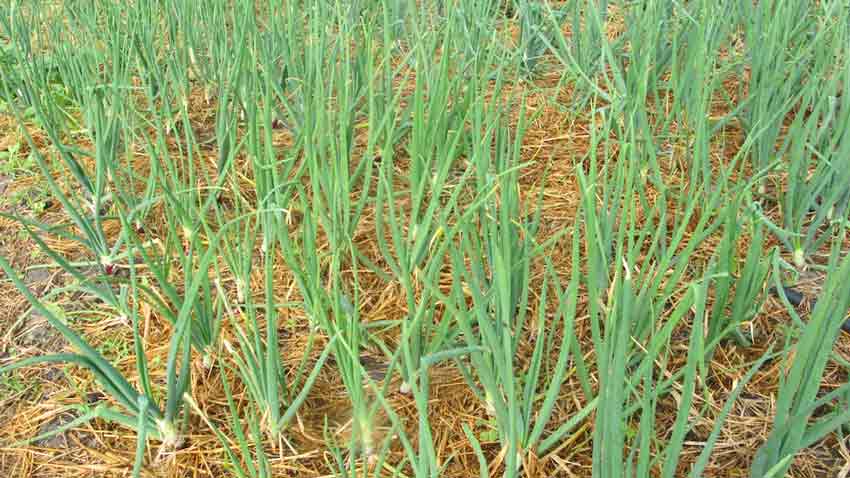
Mulched Onions
Start with fresh seed and seed starting or potting soil mix each year. Onion seed germination decreases after the first year, so why chance it? Fresh mix minimizes the chance of diseases during the long germination and seedling periods.
If starting inside, bottom heat really speeds seed germination up. 70-75°F soil temperature can create sprouts in about a week, versus 2 or 3 weeks at cooler temperatures.
Feed only the onion roots – just underneath the onion itself. They have short, shallow roots and can’t reach far, so provide the rich, well-aged compost where they can use it best.
Onions don’t compete with weeds very well because of their slow growth and small root structures. Weeds will significantly reduce your onion harvest, but there are better ways to fight weeds than weeding.Minimize weeding by mulching heavily between seedlings after transplanting.
Water onions efficiently with a drip system or soaker hose placed right next to the plants – remember their short roots. Doing this minimizes the amount of water they need, as well as reducing available water to potential weeds.
Congratulations! You now know a lot more about how to grow delicious onions from seed and why you would want to. You’ve got several tools to use in planning your garden for onions and how to set yourself up for success this season.
As always, please let us know your thoughts, experiences, or questions in the comments below. If you like this, sharing with your circle of friends helps us help them!
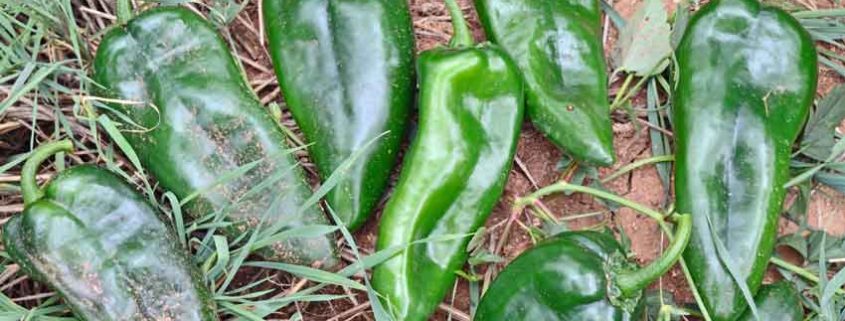
Growing peppers seems to come naturally for some gardeners, while others always seem to struggle. Sometimes this stems from easily-avoided mistakes or accepting certain myths or misinformation as correct.
Today we’re looking at the basics of growing peppers in your home garden and some mistakes and myths to be aware of and avoid. You might look at this as a how-not-to guide because occasionally it’s just easier showing what not to do than describing and explaining the right way. Plus, seeing other’s mistakes sometimes sinks in faster.
These are our observations from our 20+ years of gardening combined with the past 10 years of gardening questions we’ve answered.
The initial conditions you choose are critical to sprouting, transplanting and growing success, no matter what seed you are planting. Here are some things to consider as you grow your peppers this season.
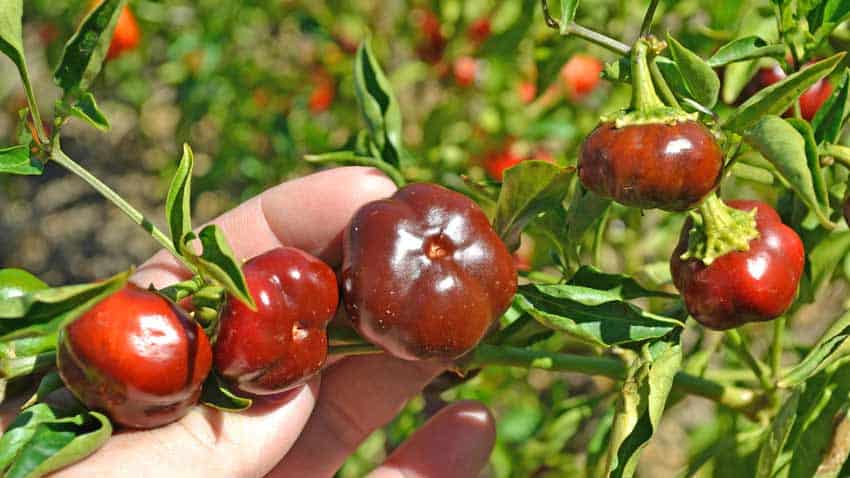
Chocolate Mini Bell Peppers
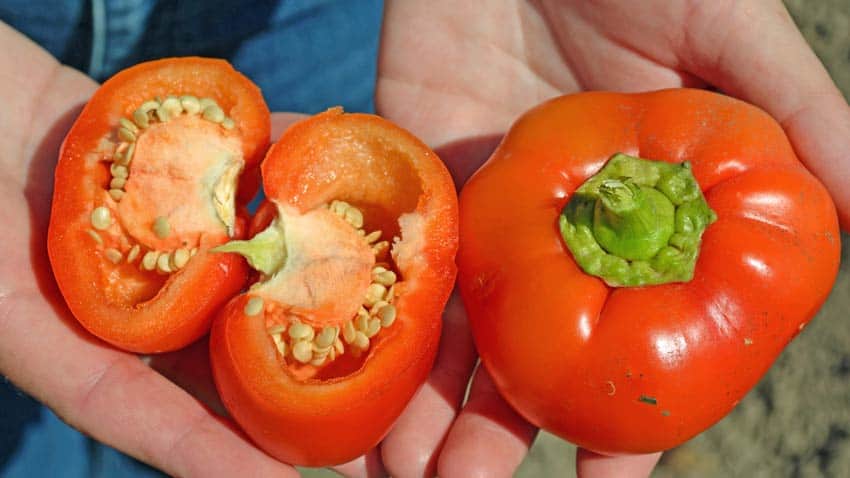
Alma Paprika Pepper
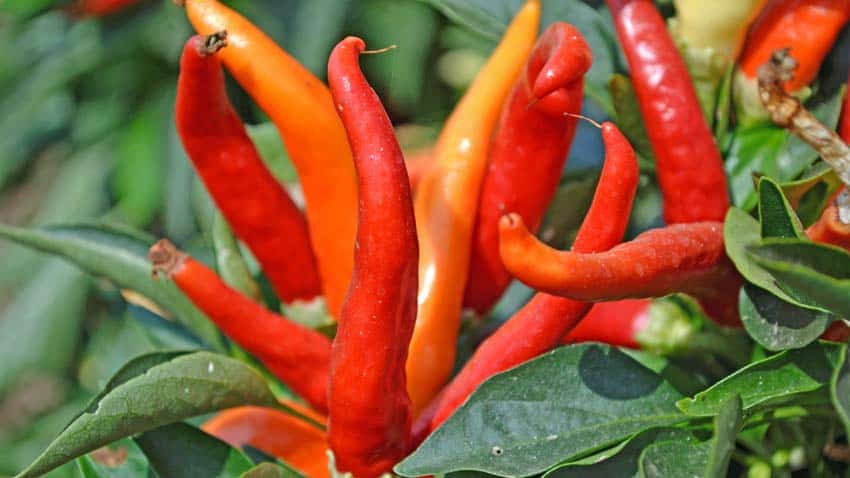
Serrano Peppers
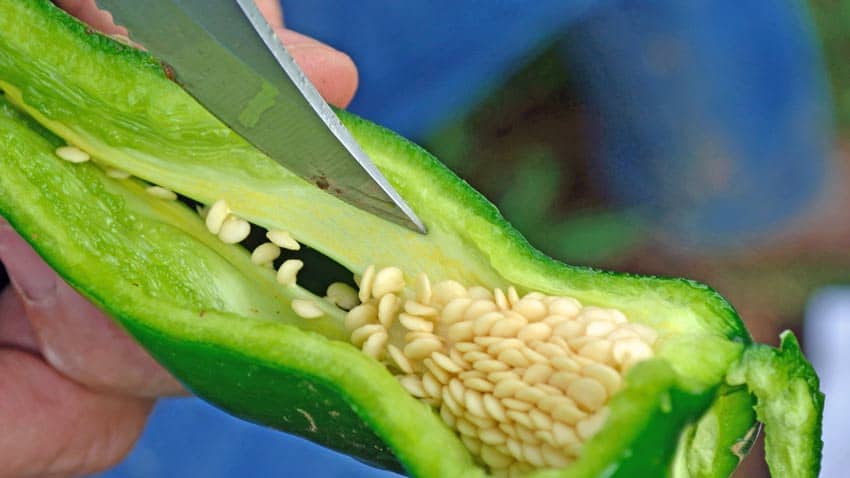
Line of Capsaicin
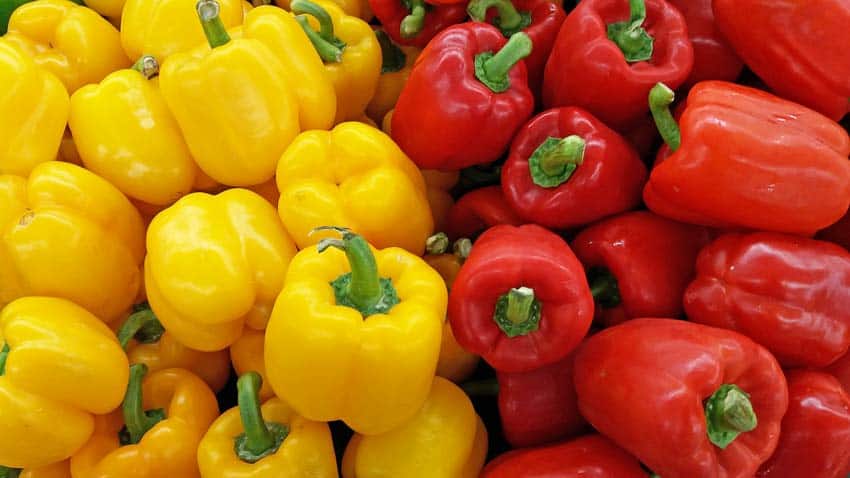
Red and Yellow Bell Peppers
One of the biggest myths we’ve seen is the one that the different number of lobes on a bell pepper determines it’s sex – such as “3 lobes means it’s female and sweeter, 4 lobes is male and hotter”…
Another myth is that all red peppers are hot, while green peppers are sweet.
What are your proven, never-fail tips for growing the best peppers? Share your experiences below so we can all grow better peppers!

In a handful of soil from your garden, you hold potentially billions of different living organisms hard at work making your soil a better place for your plants to live. Most of these team players are microscopic – too small to see with the eye, but a few are large enough to observe. Bacteria, fungi, mycorrhizae, protozoa and possibly algae are on the microscopic side while earthworms, pillbugs, arthropods and some nematodes are big enough to see in your hand.
We pay lots of attention to improving soil, for good reason. Healthy, fertile soil grows stronger, healthier, more productive plants while reducing insect and disease damages. You see and taste the difference in richer, brighter colors and sweeter or more flavorful vegetables and fruits.
Most attention focuses on the structure and chemistry of the soil – is the soil made up of sand, loam, clay or some mixture? The chemistry shows what nutrients are present and in what amounts. This is the common approach but leaves out one of the biggest components of soil improvement – the biological community.
It’s easy to overlook them because they can’t easily be measured – like determining soil structure or reading a soil analysis for nutrient deficiency.
There’s a saying among soil consultants that,”You must build a house for the biology.” That means that soil structure and chemistry must be aligned before the beneficial organisms can fully go to work. It also recognizes the critical but often overlooked role they play. Beneficial soil organisms release tied up nutrients in the soil and move them into the reach of plant roots, improve soil structure and increase nutrient retention, among many other things.
Now that you understand a bit more about them, let’s introduce you to your team!
Starting with the larger, more visible players-
Earthworms – An acre of good garden soil can have between 2 and 3 million of these black gold producing workers, constantly processing organic matter into readily available nutrients your plants absolutely love.
That means each square foot of good soil in your garden can have up to 45 – 70 earthworms. You won’t be able to see all of them, as they can range a few feet deep.
Arthropods – are ants, mites, and springtails who voracious shred decomposing plant leaves, stems, and mulch. They do the heavy lifting, getting the plant organic matter into bite-sized pieces for the smaller team members.
Pillbugs– are land-based crustaceans, distant cousins to lobsters, crabs, and shrimp. They are scavengers, mainly feeding on moist, decaying plant materials – very useful in shredding dead plant matter so it can be fully decomposed.
If you see these guys in your handful of soil or in your garden, you are doing several things right. They won’t stick around in dead soil with little or no organic matter, or in soils that are heavily contaminated with pesticides.
Now, on to the smaller and less visible players that are no less important –
Fungi – More common in woodland soils or in areas where woodchips have been laid down. They can appear as mushrooms with stems and caps – especially after a rain – but are more often seen as a whitish growth on moist and decomposing parts of the woody material. They send out hyphae or long, thin strands to decompose organic materials, transport nutrients, and improve soil structure while stabilizing it.
Protozoa – Single-celled animals that are always busily feeding on bacteria, soluble organic matter, and sometimes fungi. As the feed, they release nitrogen that is used by plant roots and other players on the team.
Actinomycetes – (pronounced act-in-o-my-seetees), are special beneficial bacteria that are responsible for the rich, earthy smell of freshly turned soil. Their specialty is digesting the high carbon cellulose in wood and the chitin of shed pillbug shells and insect bodies.
Beneficial bacteria – These microorganisms are more common in the nutrient-rich garden soils, forming associations with annual vegetables and grasses.
Beneficial nematodes – Not all nematodes are destructive, and these guys search out, infect, and kill targeted destructive insects. Different nematode species attack different pests.
Mycorrhizae – A very specialized fungi that bond with the tiny, hair-like roots of plants in a mutually beneficial relationship. The fungi send out hyphae into the soil to bring back specific nutrients needed by the plant, in return for a sugar-based plant sap that feeds the mycorrhizae. In essence, they feed each other what they can’t get for themselves. Mycorrhizae can only survive on living plant roots, and about 95% of our garden plants depend on their fungi friends to thrive.
Now that you’ve met the team working tirelessly for you in the garden, help them out with making sure they’ve got food, water, and shelter – which compost provides almost everything for them!
When you hear someone talk about “beneficial soil organisms“, you will know exactly what they mean!
If we are peaceful, if we are happy, we can blossom like a flower, and everyone in our family, our entire society, will benefit from our peace.
Life is filled with suffering, but it is also filled with many wonders, like the blue sky, the sunshine, the eyes of a baby.
To suffer is not enough.
We must also be in touch with the wonders of life. They are within us and around us, everywhere, any time.
– Thich Nhat Hanh

The glory of gardening: hands in the dirt, head in the sun, heart with nature.
To nurture a garden is to feed not just the body, but the soul.
– Alfred Austin
Gardening simply does not allow one to be mentally old, because too many hopes and dreams are yet to be realized.
– Allan Armitage
A garden is a grand teacher.
It teaches patience and careful watchfulness; it teaches industry and thrift; above all it teaches entire trust.
– Gertrude Jekyll
Everything that slows us down and forces patience, everything that sets us back into the slow circles of nature, is a help.
Gardening is an instrument of grace.
– May Sarton
Eden is that old-fashioned house
we dwell in everyday
without suspecting our abode
until we drive away.
– Emily Dickinson
He who plants a garden plants happiness.
If you want to be happy for a lifetime, plant a garden.
Chinese proverb

We have the world to live in on the condition that we will take good care of it.
And to take good care of it, we have to know it.
And to know it and to be willing to take care of it, we have to love it.
– Wendell Berry

The single greatest lesson the garden teaches is that our relationship to the planet need not be zero-sum,
and that as long as the sun still shines and people still can plan and plant, think and do,
we can, if we bother to try, find ways to provide for ourselves without diminishing the world.
– Michael Pollan

A society grows great when old men plant trees whose shade they know they shall never sit in.
– Greek proverb
The greatest fine art of the future will be the making of a comfortable living from a small piece of land.
– Abraham Lincoln
I like gardening – it’s a place where I find myself when I need to lose myself.
– Alice Sebold
But always, to her, red and green cabbages were to be jade and burgundy, chrysoprase and prophyry.
Life has no weapons against a woman like that.
– Edna Ferber

We are exploring together.
We are cultivating a garden together, backs to the sun.
The question is a hoe in our hands and we are digging beneath the hard and crusty surface to the rich humus of our lives.
– Parker J. Palmer
Plants want to grow; they are on your side as long as you are reasonably sensible.
– Anne Wareham
You can spend your whole life traveling around the world searching for the Garden of Eden, or you can create it in your backyard.
– Khang Kijarro Nguyen

I don’t want to return to the world outside these Gardens.
All I want is to notice the dew on a leaf.
The holy busyness of worms in the soil.
– Tor Udall
The garden is a kind of sanctuary.
– John Berger

I’d love to see a new form of social security … everyone taught how to grow their own; fruit and nut trees planted along every street, parks planted out to edibles, every high rise with a roof garden, every school with at least one fruit tree for every kid enrolled.
– Jackie French
These photos are the result of a leisurely, late afternoon spent wandering through the Denver Botanical Garden in early September.
Many of you know we are avid gardeners and own an heirloom seed company, but you may not know we also have a small farm. Gardening or working with our horses, ducks, and pigs always leaves our hands and body dirty.
We’ve searched for a good, all around soap, but it didn’t seem to exist. All of the bars we tried – and we tried a bunch – either cleaned well while stripping all of the moisture from our hands or left an unsettling film after rinsing. Almost none lasted very long and we had just about given up hope of a non-chemical, non-commercial soap we could use and really enjoy.
Researching what goes into soap opened our eyes – especially commonly used ingredients and processes used to make it. We began to understand why most soaps irritated our skin, didn’t clean well or melted too quickly.
The more we learned, the more we knew we wanted a natural and organic soap – something made entirely from plant-based, unrefined ingredients.
When we found and tried this particular soap, we knew our search was a success. We use and love this soap daily, so it made sense to offer it to our customers!
Just like our seeds, we contract with a small family company to produce the absolute best soap possible. Join us as we explore what goes into a great bar of soap!
Unscented Soap
A bar of soap appears simple sitting in your hand, but it must balance and maximize its best qualities – creamy fluffy lather that cleans while moisturizing, feels good and lasts well – all in one bar.
This takes work – research, experimenting, and testing – to accomplish. A perfect bar soap is a result of carefully choosing and balancing the various ingredients to boost the bar’s hardness, lather quality, cleaning, and moisturizing ability. For example – moisturizing ingredients don’t contribute much to lather quality, and what makes great lather often dries our skin out.
All soap is made through a chemical reaction where part of an oil molecule attaches to a sodium ion from sodium hydroxide, commonly called lye. This is called saponification.
A properly produced soap consumes all of the lye during the saponification process, eliminating any chance of skin irritation. Superfatting assures that all lye is consumed. This process retains extra skin-nourishing oils in the finished soap. Superfatting won’t make your skin oily, it helps it to maintain natural moisture levels.
Lemongrass Tea Soap
The USDA’s National Organic Program (NOP) sets the standard for organic production. Soap falls under the “Made with Organic” section – Products made from a minimum of 70% organic content up to 95%. The USDA has set 70% as the minimum percentage a product can have and still use “organic” in its labels and marketing.
So, what does this mean for you?
Organic certification guarantees there are no synthetic fragrances, colors, or preservatives in the soap, as well as that all the oils and herbs were grown and processed according to organic standards (no pesticides, no radiation, and environmentally friendly methods).
To us, this means a soap whose ingredients are plant-based with no artificial substances such as synthetic fragrances, dyes, and preservatives. Our pure herbal soap is scented with essential oils and colored exclusively with organic herbs and plant extracts. 100% certified organic oils make up the soap base recipe.
We feel it’s worth the extra time and effort to meet organic standards and make truly organic products. Your skin will know the difference!
Gardener’s Hand Soap
Essential oils are concentrated plant extracts from the roots, bark, and plant leaves.
Fragrance oils are always synthetic, even though they have perfectly natural names and might contain natural ingredients.
Fragrances smell great initially but quickly overwhelm your nose once you get it home, then it’s not so nice or enjoyable.
Essential oils are less “pushy” up front but retain their appealing qualities throughout the life of the bar, never overwhelming your nose.
Peppermint Soap
Natural colors can be bright and lively, creating a beautiful bar of soap.
Some essential oils, like citrus oils, have their own color that can be just what certain soaps need.
The easiest way to add or control soap color is with herbs or clays. The desired colors are created near the end of the mixing process by adding herbs, clays or a combination.
Steeping herbs in oil create richer and more vivid colors.
Citrus Lavender Soap
Don’t be fooled by trendy or exotic ingredients on a label. If you don’t start with a well-formulated base, exotic ingredients won’t produce the soap you’re looking for. For example – palm kernel oil can be a great enhancement, but it can’t fix a poor formulation. Specialty ingredients are most commonly used as advertising hooks or as recipe magic in the hopes of creating a great soap from a poor-quality base. Glamorous ingredients or celebrity endorsements don’t produce extraordinary soap.
Lavender Soap
There’s virtue in products as natural as your skin. There are also practical benefits to using essential oils in skincare products.
Read labels carefully. If you see any variation or combination of the words fragrance, fragrance oil, or natural fragrance, don’t be fooled. There’s nothing natural about them.
Purchasing our handmade, organic soap gives you much more than just a great soap that leaves your skin clean. You support our small company and our soapmaker.
They, in turn, support growers for the ingredients of your bar of soap – ethical, sustainable and environmentally friendly methods that increase the soils over time and improves the communities where they are grown.
It turns out that a simple bar of soap can do some real good for many people!
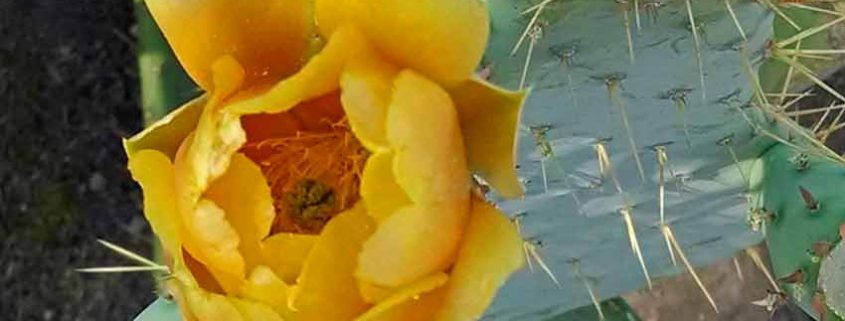
Las Vegas is often thought of for its glittering lights and heady atmosphere of the Strip. That’s exactly what lost me about its appeal, even though Cindy and I had visited numerous times for gardening trade shows along with a few personal trips.
A few times down the Strip and we started looking for something other than the glitz and glam.
We found Ethel M and its unique botanical garden that focuses on cacti and species from the Southwest US and other countries with a similar climate. Cindy searched for something interesting and relaxing after the bustle and noise of a garden trade show and came across this treasure.
Ethel M chocolate factory – as in Ethel Mars – is part of the Mars family with the factory store housing the botanic garden in Henderson, NV just a few minutes south of Las Vegas. The self-paced tour runs along the dedicated viewing aisle next to the factory floor, then we sampled some excellent chocolates and had an unexpectedly good cup of espresso. Afterwards, we were ready for some botanic garden exploration.
We visited during an afternoon in early May with temperatures hovering around 100°F – not the best light for photos and I had left my usual camera at home, not anticipating a photo opportunity. Armed with my trusty cell phone and a couple of bottles of water, we ventured out into the garden, not quite knowing what to expect.

Bee in Prickly Pear Flower – Ethel M Botanic Garden
Over 300 species of cactus, desert-adapted ornamentals and succulents are spread over 10 acres. Artfully arranged in intriguing and enticing groupings, the pull from flowers to cactus to trees made us feel something like the numerous bees and hummingbirds we saw.
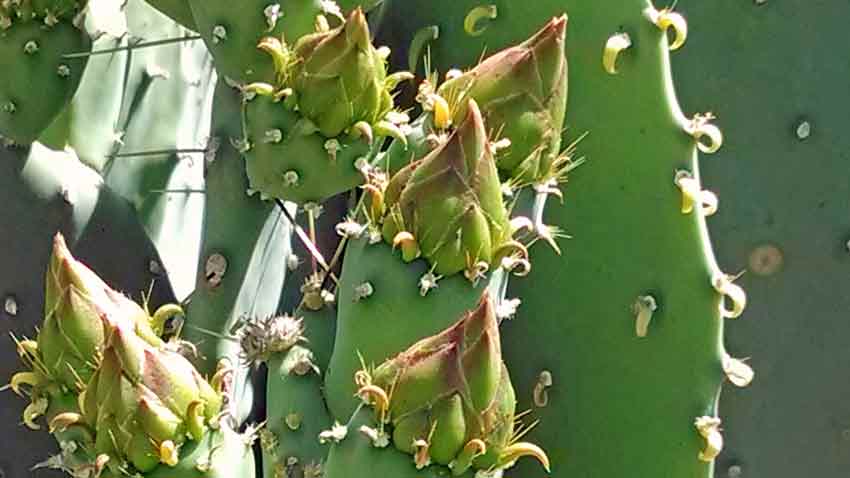
Prickly Pear Detail – Ethel M Botanic Garden
The peace and quiet after the noise and crush of crowds was a very welcome respite. Plantings are slightly elevated, inviting an easy look into the details of the life growing there.
These early prickly pear cactus buds are mathematically gorgeous in their symmetry, blushing with an indication of their rich colors to come.
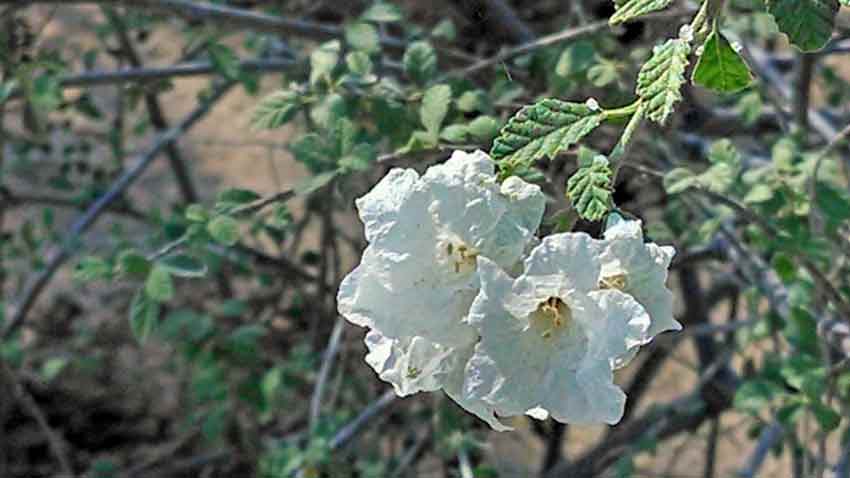
Flower Closeup – Ethel M Botanic Garden
Abundantly blooming flowers were generously spread across the entire garden, with some reaching out with colors and others beckoning with aromas from 20 or 30 feet away.
We weren’t paying attention to the nameplates or descriptions of the flowers or plants but focused instead on the experiences of colors, textures, and aromas drawing us in.
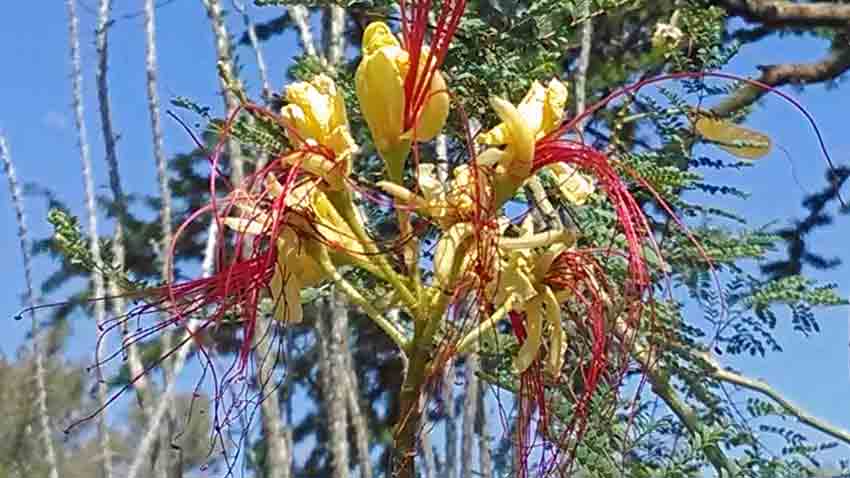
Blooms – Ethel M Botanic Garden
Some plants and their flowers seemed as though they would be right at home as an attraction on the Strip, such as this one!
Given how close the I-515 freeway is the quiet and peace were impressive. The garden had a number of people in it but it never felt crowded.

Flower Blooms – Ethel M Botanic Garden
This flower group had a sweet, perfumed aroma drawing us in from two plantings over. The trumpet-shaped flowers had dozens of small flying insects and bees attending them.

Flower Blooms – Ethel M Botanic Garden
Colors ranged from white to purple with a lot of orange and reds represented. It was high season for blooms as very few plants lacked flowers.

Ethel M Botanic Garden
The surrounding city disappeared from certain viewpoints, giving the illusion of a private estate garden or an undiscovered, undeveloped patch of exotic forest somehow forgotten.
We came away relaxed and refreshed, completely surprised by how wonderfully juxtaposed the experience was from the busy city just down the street. The rest of the day was just as enjoyable, and we realized that this was the best trip to Las Vegas we remembered, simply because of a visit to a garden.
We’ve learned to search a bit deeper for those unexpected garden treats like this!
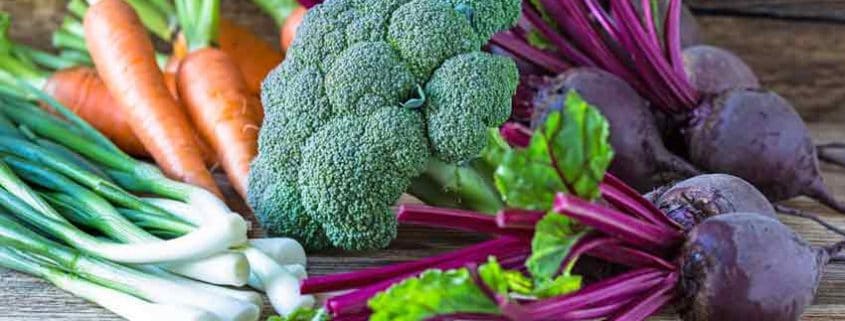
Gardeners are sometimes baffled when thinking about a cool season garden – either Fall and Winter or early Spring. We’ve put together this quick checklist to help you see the abundance that can be grown both before and after the traditional Summer garden.
Spend some time browsing these and making notes on what you like to eat and what varieties do well in what dishes you like to cook – pretty soon you’ll have a mouth-watering list to plant!
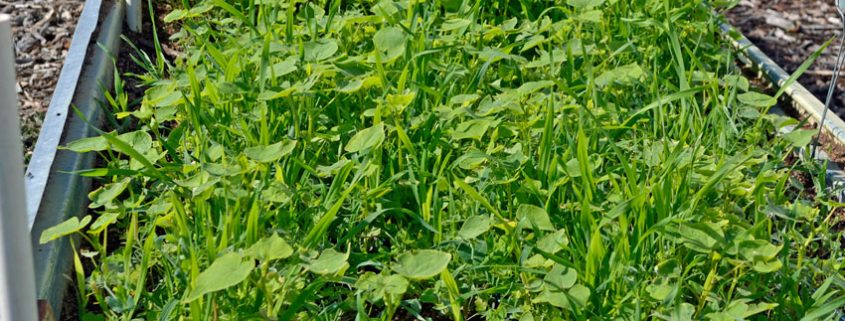
Both of our cover crop mixes give you multiple benefits in the soil and above it. You can’t go wrong with either one. The Garden Cover Up mix is a general use cover crop, while the Soil Builder mix is more specific toward improving the overall condition of your soil.
Cover crops improve soil in a number of ways. They protect against erosion while increasing organic matter and catch nutrients before they can leach out of the soil. Legumes add nitrogen to the soil. Their roots help unlock nutrients, converting them to more available forms. Cover crops provide habitat or food source for important soil organisms, break up compacted soil layers, help dry out wet soils and maintain soil moisture in arid climates.
It’s always a good idea to maintain year-round soil cover whenever possible, and cover crops are the best way.
Let’s look at how cover crops work overall, then we’ll see the differences of each mix.
Most cover crop mixes are legumes and grains or grasses. Each one has a different benefit to the soil. Legumes include alfalfa, clover, peas, beans, lentils, soybeans and peanuts. Well-known grains are wheat, rye, barley and oats which are used as grasses for animal forage.
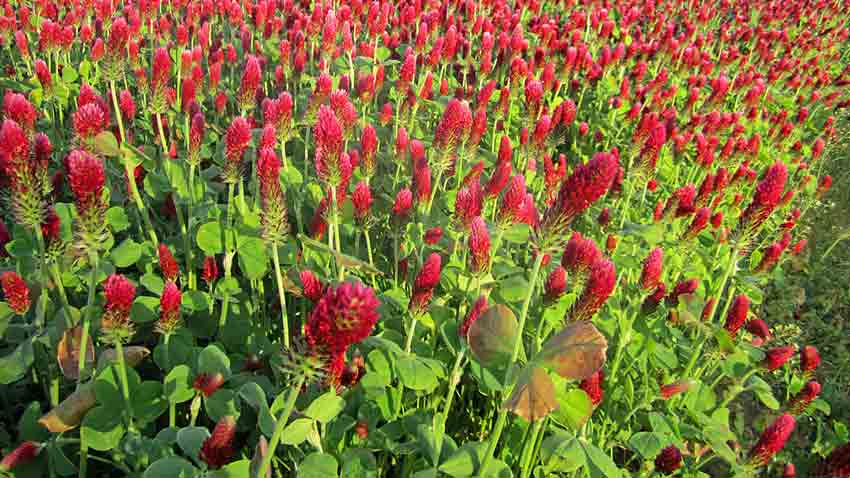
Crimson Clover
Legumes help reduce or prevent erosion, produce biomass, suppress weeds and add organic matter to the soil. They also attract beneficial insects, but are most well-known for fixing nitrogen from the air into the soil in a plant-friendly form. They are generally lower in carbon and higher in nitrogen than grasses, so they break down faster releasing their nutrients sooner. Weed control may not last as long as an equivalent amount of grass residue. Legumes do not increase soil organic matter as much as grains or grasses. Their ground cover makes for good weed control, as well as benefiting other cover crops.
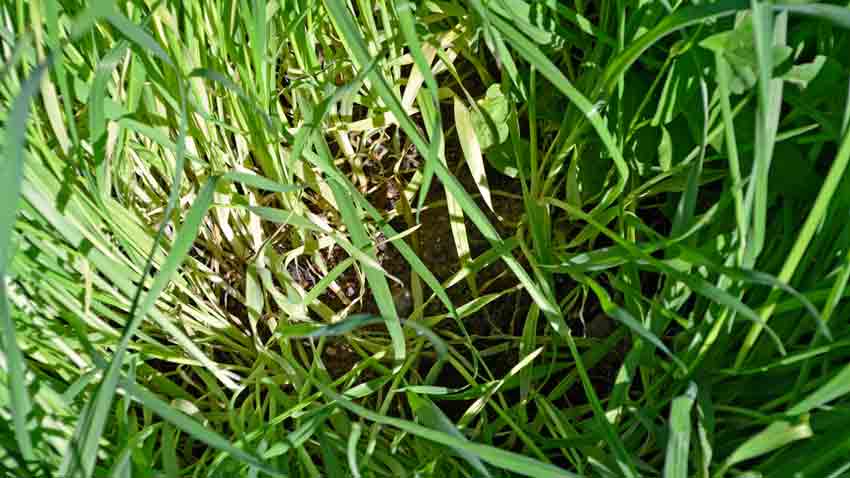
Rye Cover Crop
Grain or grass cover crops help retain nutrients–especially nitrogen–left over from a previous crop, reduce or prevent erosion and suppress weeds. They produce large amounts of mulch residue and add organic matter above and below the soil, reducing erosion and suppressing weeds. They are higher in carbon than legumes, breaking down slower resulting in longer-lasting mulch residue. This releases the nutrients over a longer time, complementing the faster-acting release of the legumes.
This pretty well describes what our Garden Cover Up mix does, as it is made up of 70% legumes and 30% grasses.
Our Soil Builder mix takes this approach a couple of steps further in the soil improvement direction with the addition of several varieties known for their benefits to the soil structure, micro-organisms or overall fertility.
For example, the mung bean is a legume used for nitrogen fixation and improving the mycorrhizal populations, which increase the amount of nutrients available to each plant through its roots.
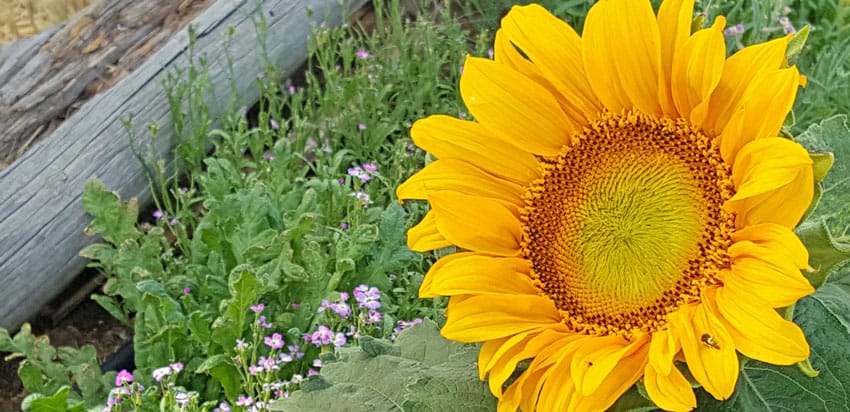
Spring Sunflower
Sunflowers are renowned for their prolific root systems and ability to soak up residual nutrients out of reach for other commonly used covers or crops. The bright colors attract pollinators and beneficials such as bees, damsel bugs, lacewings, hoverflies, minute pirate bugs, and non-stinging parasitic wasps.
Safflower has an exceptionally deep taproot reaching down 8-10 feet, breaking up hard pans, encouraging water and air movement into the soil and scavenging nutrients from depths unreachable to most crops. It does all of this while being resistant to all root lesion nematodes. Gardeners growing safflower usually see low pest pressure and an increase in beneficials such as spiders, ladybugs and lacewings.
Now you see why you can’t go wrong in choosing one of our cover crop mixes! Both greatly increase the health and fertility of the soil, along with above-ground improvements in a short time. Even if you only have a month, the Garden Cover Up mix will impress you for the next planting season.
For a general approach with soils that need a boost but are still producing well, the Garden Cover Up mix is the best choice. Our Soil Builder mix is for rejuvenating a dormant bed or giving some intensive care to a soil that has struggled lately. Both will give you a serious head start in establishing a new growing area, whether it is for trees, shrubs, flowers, herbs or vegetables.
Let one of our cover crops go to bat for you and see what happens when you play on Mother Nature’s team!
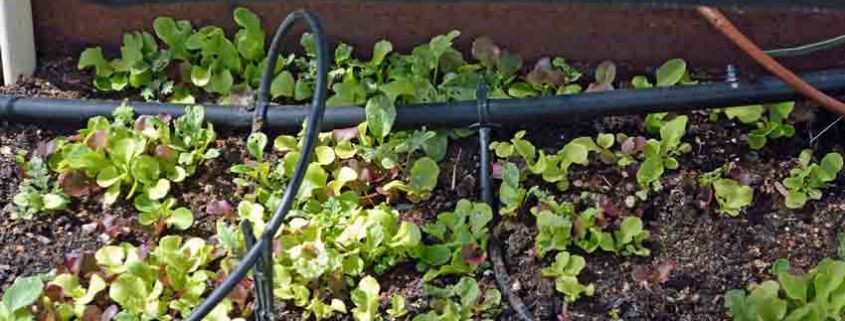
With a little knowledge and a tiny bit of preparation, you can grow lettuce throughout the summer without bolting. Imagine serving your own fresh-harvested, garden-grown lettuce throughout the summer!
Lettuce is a cool-season vegetable, meaning it grows best in temperatures around 60 – 65°F. Once temperatures rise above 80°F, lettuce will normally start to “bolt” or stop leaf production and send up a stalk to flower and produce seed. The leaves become bitter at this stage.
This is because the mainstay of our beloved salads is not a North American native, but an ancient part of our dinner table. Belonging to the daisy family, lettuce was first grown by Egyptians around 4,700 years ago. They cultivated lettuce from a weed used only for its oil-rich seeds to a valued food with succulent leaves that nourished both the mind and libido. Images in tombs of lettuce being used in religious ceremonies show its prominent place in Egyptian culture.
The earliest domesticated form resembled a large head of Romaine lettuce, which was passed to the Greeks and then the Romans. Around 50 AD, Roman agriculturalist Columella described several lettuce cultivars, some of which are recognizable as ancestors to our current favorites. Even today, Romaine types and loose-leaf lettuces tolerate heat better than tighter heading lettuces like Iceberg.
Two factors cause lettuce to bolt and become bitter – temperature and sun exposure.
The temperatures you are concerned about are both air and soil, as a lettuce plant (or any garden plant for that matter) tolerates a higher air temperature if the soil around its roots is cool and moist. Ensuring a cool and damp soil gives you more air temperature leeway. Because lettuce has wide and shallow roots, a drip system on a timer teamed up with a thick mulch keeps it happier in warm weather.
Shade is the third part to keeping lettuce growing vigorously later into warm weather. Reducing sun exposure lowers the heat to the leaves, but also to the soil and roots – creating a combined benefit. Deep shade isn’t good, but a systemallowing sun during the morning while sheltering the plants in the afternoon keeps your salad machines going much longer than you thought possible.
One last bit of knowledge. Most lettuce seeds become dormant (won’t germinate) as temperatures rise above 80°F, a condition called”thermo-inhibition”. This trait is a carryover from wild lettuce in the Mediterranean Middle East, where summers are hot with little moisture. If the lettuce seeds sprouted under these conditions, they would soon die out and the species would go extinct.
Thanks to research, there are some easy techniques to germinate lettuce seeds in warm weather – our article Improve Lettuce Seed Germination shows you how. Now you’ll be able to start lettuce when no one else can!
The three most effective elements in keeping your lettuce producing during warm weather are a drip system on a timer, a good bed of mulch and shade. Let’s look at each one and how they help.

Lettuce growing with mulch, shade & drip system
A drip system on a timer maintains moisture levels much more evenly than hand watering, and the timer can be set for how much and how often water is needed. Checking the soil moisture levels is easy – just push your finger into the soil up to the second knuckle. If the soil feels moist and spongy the moisture is perfect for lettuce. Adjust the number and length of watering each time up or down to maintain this level. From experience, we usually start the timer once a day for 10 minutes in the spring and go to 2 and sometimes 3 times a day for 10 minutes during the heat of the summer. As the weather cools down, we decrease the amount of water accordingly.
This minimizes water stress on all your garden plants, not just lettuce. When the roots have moisture, they can withstand the heat and drying effects better without losing health and slowing production.
A thick bed of mulch reduces moisture loss at the surface of the soil from heat and breezes. Here in central Arizona, it’s not uncommon to have a 15-mph breeze with 90°F+ with 5 – 10% humidity levels. Basically, we garden in a giant hair-dryer!
We use two inches of wood chip mulch, but straw also works well and some gardeners have good success with well-aged compost. With mulch, the soil moisture levels are at the top of the soil where it meets the mulch. Without it, the moisture doesn’t appear until you’ve dug down at least two inches, with three inches having the same amount of moisture as the surface does with mulch. Another benefit of wood chip mulch is it provides needed nutrients to the soil and encourages earthworms and other beneficial soil life as it decomposes. The beds where we’ve put wood chips down have three times the amount of earthworm activity as those that have only compost or nothing at all.
The third element is shade, which might seem daunting but is surprisingly simple to provide. Shade can be from various sources – a living trellis of cucamelon, vine peach or Malabar spinach; a row of tall sunflowers on thewest side of the bed; a container garden on the east side of the house or garage to capture afternoon shade, or a shade cloth structure on the west side of the bed or over a container or raised bed. Trees can also give partial shade – grow on the east side to take advantage of shade during the hotter, more stressful afternoons.
You might be thinking – this all sounds great, but does it work?
Here are two examples showing that it does:
The first example is a study conducted by Kansas City area growers in cooperation with Kansas State University and the Organic Farming Research Foundation.
This project was conducted to test practical methods for extending the production of cool season leafy greens into the hot summer months in Kansas City, where high temperatures normally terminate production of these crops from June through August.
We used high tunnels covered with 40% shade cloth, combined with drip irrigation and were able to produce crops of lettuce (10 cultivars) and Asian greens (5 types) throughout the summer. Trials were conducted at three locations, two of them working organic farms, and the other an agricultural experiment station in order to produce statistically valid experimental results.We produced higher yields of marketable quality lettuce and greens over multiple harvests throughout the summer compared to outside plots, which produced lower yields of poorer quality crops.
As a result of this project, both growers have continued with summer greens production, recognizing that adapted warm-season vegetables may be more profitable under hot summer conditions. *1
The second example is a two-season grow-out test by the Sacramento County Master Gardeners at their Fair Oaks Horticulture Center during the summers of 2015 and 2016.
Grow loose leaf varieties that are heat-resistant or slow-bolting, rather than varieties that form heads.
Provide shade. Use shade cloth or plant on the shady side of taller vegetables.
Don’t skimp on water. Keep lettuce growing fast to prevent wilting, premature bolting, and bitterness.
Mulch lightly with an organic mulch to retain soil moisture.
Use cut-and-come-again harvesting of outer leaves.
Make successive plantings with transplants to replace spent plants.
During the season, replenish soil nitrogen to encourage growth. We used a mild liquid fish emulsion fertilizer.
Inspect plants for insects and diseases. Hand pick and destroy destructive insects. Remove diseased leaves or plants.
Merlot- 42 days to bolting – Dense heads of ruffled red leaves
Jericho – 73days to bolting -Romaine variety from Israel. *2
Here’s a quick and easy way to shade any container, raised bed or row in your garden:
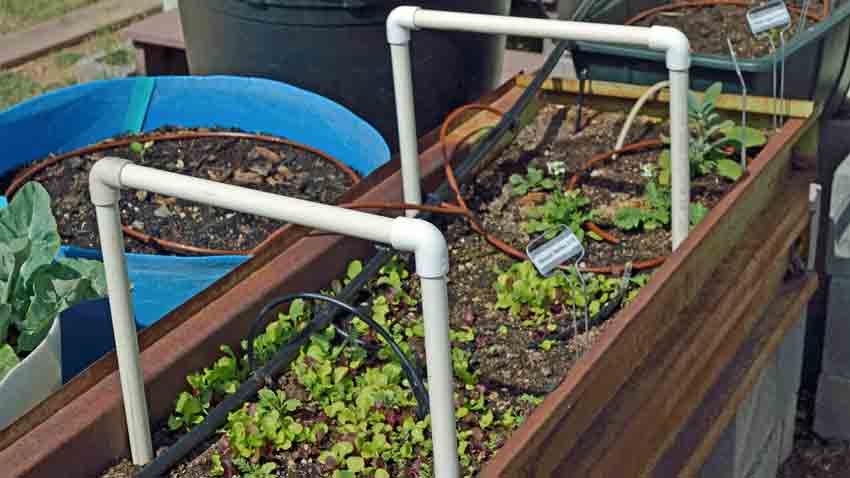
Simple lettuce shade structure
Use 1/2 inch PVC pipe from any hardware store. 1/2 inch is the least expensive and easiest to work with for this use.

Shade structure detail
Using PVC elbows, simply insert the tubing into the elbow and push the uprights into the soil at the edge of the planter or raised bed. No glue needed, so they can be taken down and re-used next season.
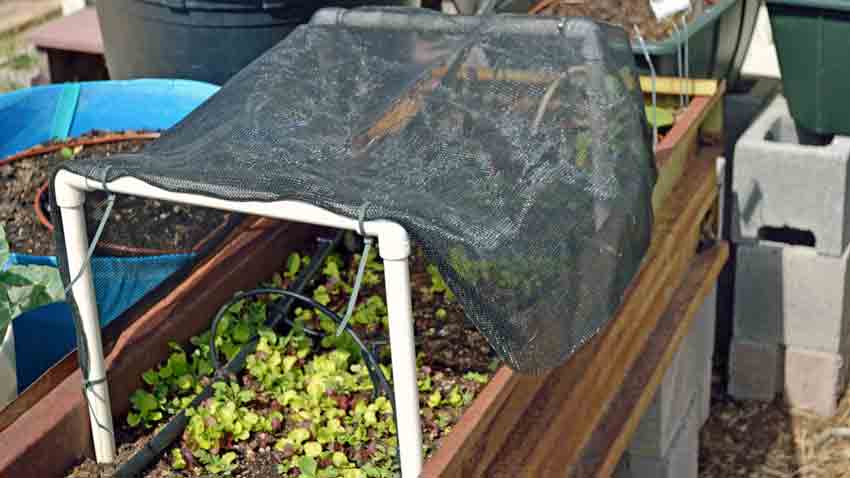
Planter with shade system
We used some leftover shade cloth from another project and cable ties to secure the shade cloth to the PVC tubing.
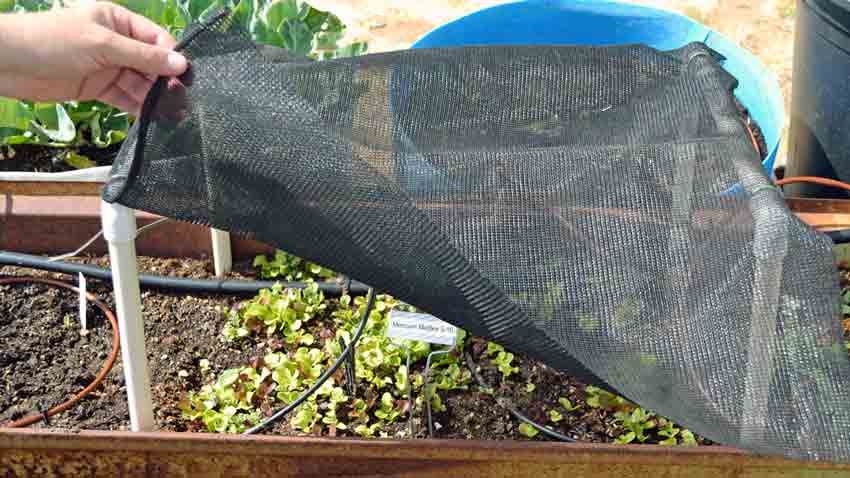
Shade cloth canopy
The front of the shade canopy is left loose so we can harvest easily.

Lettuce shade detail
The right half of the lettuce is shaded, with the left half getting shade as the day progresses.
Now you have the tools and knowledge, so plan on successfully growing lettuce after everyone else has given up this season! As your accomplishments are recognized and compliments roll your way – make sure to share your tools and spread the success.

Lettuce after 3 weeks of heat
Our lettuce looks amazing, considering we’ve had continuous temperatures above 95°F for the past 13 days and above 100°F for the past 9 days. The Sweet & Spicy Mix hasn’t slowed down and is robust, crunchy, and still sweet with no bitter flavors. The growth is easy to see, comparing to the above photos.
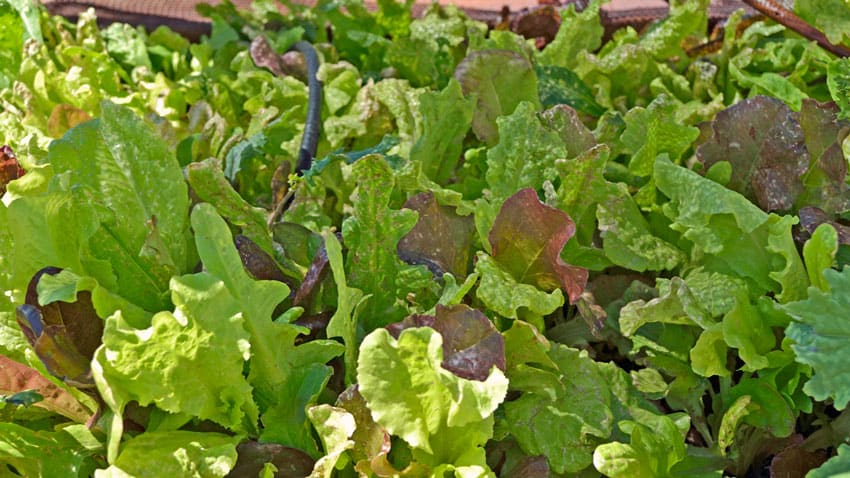
Lettuce after 3 weeks of heat – detail of leaves
Looking closer, it isn’t perfect. There are some small holes and some of the leaf edges are a little toasty, but these conditions are so far outside of lettuce comfort zone, it’s like growing on Mars!
Lettuce normally starts to bolt at 80°F, but this has not only survived, but thrived at over 100°F for more than a week and more than 90°F for almost two weeks, this is a technique you should try.
References
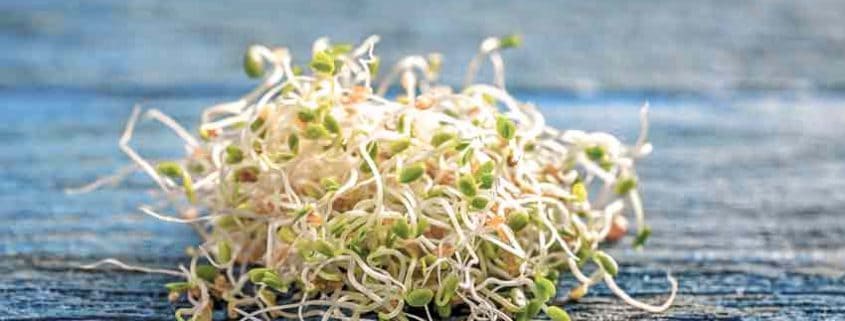
We’ve greatly enjoyed our own homegrown sprouts for the past several years. There’s just something about their fresh taste and crispy crunch that can be enjoyed any time of year, no matter the weather.
As with all our seeds, we make sure we know who our growers are and where our seeds come from. This is even more important with seeds used for sprouting as they are eaten directly as a food.
We chose our sprouting seeds supplier because of their commitment to the safest and healthiest seeds possible. They showed us their safety standards and testing protocols and we want to share them with you.
Growing your own sprouts at home is much safer than buying them off the shelf at a supermarket, and we’ll show you why.
-The safest sprouts are those you grow at home in a glass jar from a trusted, reliable source that screens the seed and tests both the irrigation water and sprouts for contamination.
-The next best is fresh sprouts from a local, trusted grower who buys their seed from a similar source as above.
-The least safe sprouts are from the supermarket where they have most likely been grown in a different state and trucked in. These sprouts are usually more than a few days old when they are first put on the shelves.
Sprouts are healthy, nutritious and are rich in vitamins, minerals, proteins, enzymes, bioflavonoids, antioxidants, phytoestrogens, glucosinolates and other phytochemicals. They are an excellent alternative to meat, especially for vegetarians and vegans.

Fresh Homegrown Sprouts
There are two main hazards associated with sprouts – E. coli and Salmonella. Both of these terms are used a lot, but what do they really mean? What are they and where do they come from?
From the CDC website:
“Escherichia coli (E. coli) bacteria normally live in the intestines of people and animals. Most E. coli are harmless and actually are an important part of a healthy human intestinal tract. However, some E. coli are pathogenic, meaning they can cause illness, either diarrhea or illness outside of the intestinal tract. The types of E. coli that can cause diarrhea can be transmitted through contaminated water or food, or through contact with animals or persons.”
From the USDA website:
“Salmonella is an enteric bacterium, which means that it lives in the intestinal tracts of humans and other animals, including birds. Salmonella bacteria are usually transmitted to humans by eating foods contaminated with animal feces or foods that have been handled by infected food service workers who have practiced poor personal hygiene.”
The best and surest method of reducing the risk of sprout seeds carrying bacteria is making sure the seeds are never contaminated. This starts with an ethical grower using good agricultural practices and organic standards. The next step is conducting rigorous testing, both in-house and independently.
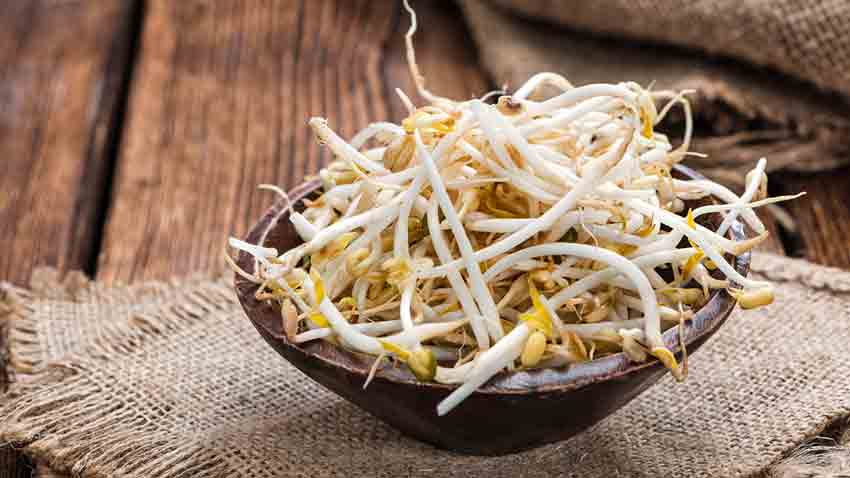
Mung Bean Sprouts
The testing done on our sprout seeds is different than any other testing protocols for food. There is no acceptable “percentage of contamination”, as is often the case with other foods. If any bacterial contamination is detected, testing is stopped and the entire lot is rejected – sometimes 40,000 pounds or more.
To ensure the sprouting seeds we offer are as safe as possible, our supplier extensively tests both the sprouting water and the seeds to verify if any bacteria is detectable after harvest. Our supplier and an independent lab both do multiple tests to safeguard our health safety.
Current pathogen tests are considered to be 97% accurate in detecting contamination. Duplicate testing at both 48 and 96 hours brings the accuracy and confidence up to 99.91% each time, for a final accuracy of 99. 999919%!
As of early 2017, our supplier is the only company doing these extensive screening and testing protocols. The FDA is studying this protocol and has begun advocating its adoption by sprout companies for testing.

Initial Sprouts Screening Results
Screening includes inspecting the bags for any urine or feces contamination, any holes in the bags, insect larva or other contamination. Afterwards, the seed is carefully inspected with both a magnifying glass and microscope.
Each and every bag is screened – this particular lot had 860 bags, each one weighing 50 lbs. for a total of 43,000 lbs.

In-House Lab Spent Irrigation Water Contamination Test
A small sample of seed is taken from each bag and added to the overall lot sample. The entire sample is sprouted for 48 hours, increasing any potential bacteria level approximately 1,000,000 times over the starting amount, substantially increasing the probability of detection.
Next, the sprout runoff water is sampled and tested by the in-house lab. This is called “spent irrigation water”. A sample of the sprouts is crushed and tested for contamination also. These tests are done in accordance with government food safety and industry accepted protocols.
The lab tests for both Salmonella and E. coli 0157:H7 after 48 hours and again after 96 hours of culturing the irrigation water.
Both bacteria do most of their growth in the first 2 days or 48 hours. This is when the first test is performed, with the second test at 4 days or 96 hours. The second test catches any late developments that might be missed on the first.

Independent Lab Spent Irrigation Water Contamination Test
A separate, larger sample of spent irrigation water is sent to an independent lab for more extensive testing. The independent lab performs a more in-depth analysis on a wider range of pathogens than the in-house lab because of their higher level of equipment.
Notice that the independent lab tests for the top seven strains of E. coli, where the in-house lab tests for the most common one. The lab uses a food microbiology genetic detection system.
This is possible because the specific genes or DNA of the different strains of E. coli have been mapped, so they are specifically targeted during this testing. This gives better accuracy, repeatability, and confidence in the testing than any previous methods.

Independent Lab Sprouting Test
Next, the independent lab tests four pounds of randomly obtained sprouting seed from the shipment. Having an independent, third-party lab analyze the sprouting seeds gives an additional measure of confidence.

Storage Confirmation
Finally, the storage facility is inspected and documented. This ensures the cleanliness and food safety of how the seed is stored to avoid insect or rodent infestation or damage.
In a home environment with only one person in contact with the sprouting seeds, cleanliness and food safety is much easier. Here are a few tips for sprouting safely:
Now you know the steps taken to ensure the highest quality sprouting seeds are available so you can enjoy the taste and nutrition of sprouts with peace of mind.
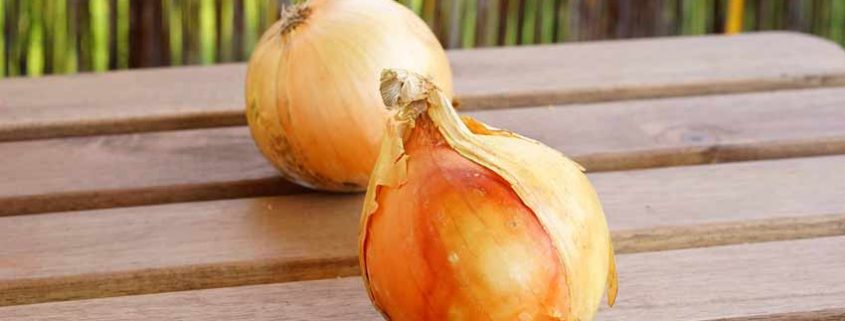
Spring onions have been grown for a long time – Egyptians grew them along the Nile during the time of the Pharaohs. One of the easiest vegetables to grow, onions sometimes confuse home gardeners as to the best type for their garden.
Three forms of spring onions can be planted: seeds, transplants and bulbs (or sets):
We recommend using onion bulbs, which can be planted without worry of frost damage and have a higher success rate than transplants. Bulbs are perfect for the home gardener as they guarantee onions for use or storage within a few weeks after planting.
As a member of the allium family they are a natural pest repellant to most foraging animals in the home garden.
Note: These details are for growing onion bulbs, not green or bunching onions. To grow green onions, simply plant the seeds and harvest when they are an appropriate size for your use!

Red Wethersfield Onions
Spring onions are usually sorted by the amount of daylight hours they need to grow bulbs; these are known as day-neutral and long day onions. Day-neutral onions form good size bulbs with 12 – 14 hours of daylight, while long-day onions need 14 – 16 hours.
The map above shows the approximate latitudes where long-day onions need to be grown. Day-neutral onions will also grow well in the more northern states in spring and summer.
Day-neutral onions are usually sweeter and juicier than their long-day counterparts. Their higher sugar and water content make them best suited for cooking and immediate use instead of storage. They are best planted from early spring to mid-summer in northern states and early spring to late fall in southern ones.
Candy is our day-neutral onion, being adapted to a wide range of day-lengths from north Texas to Maine. 12 to 14 hours of daylight will produce a good bulb. These can be grown in Zones 5 to 9.
Long-day onions are just the opposite with lower sugar and water content but higher sulphur, making them best for storage and cooking. These are planted in early spring in mid to northern states for fall harvest.
Growing long-day onions in the southern states will give small bulbs, more like scallions than full onions.
Our long-day selections include Yellow Stuttgarter (in the header photo), White Ebenezer and Red Wethersfield onions. They do best with 14 to 16 hours of daylight to form a good-sized bulb and are typically grown in colder winter areas. Zone 6 and colder is a good rule.
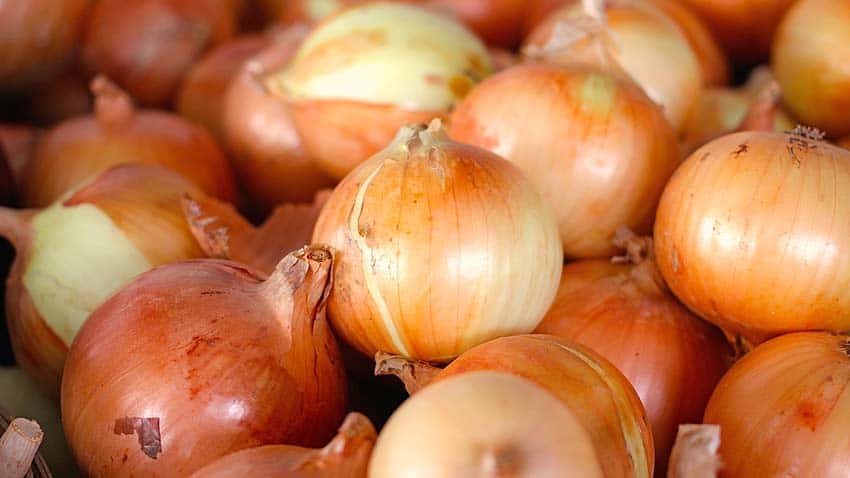
Sweet Candy Onions
Spring onions prefer abundant sun and well-prepared, healthy soil with good drainage.
While onions will grow in nutrient poor soil, they won’t form good bulbs or taste as good. If possible, till in aged manure the fall before planting. Onions are heavy feeders and need constant nourishment to produce big bulbs. If needed, add a natural nitrogen source when planting, such as fish emulsion or aged compost.
Plant onions as soon as the ground can be worked in the spring, usually March or April. Make sure overnight temperatures aren’t forecast to drop below 20°F.
Plant the bulbs about an inch deep and four inches apart. Plant no more than one inch deep, otherwise bulb formation can be restricted.
Feed every few weeks with nitrogen rich fish emulsion to get good sized bulbs. Synthetic nitrogen fertilizer will grow larger bulbs at the expense of flavor. Stop fertilizing when the onion starts pushing the soil away and the bulbing process begins. Do not put the soil back around the onions; the bulb needs to emerge above the soil.
Onions have short roots and need about an inch of water per week, including rain water to avoid stress from lack of moisture. Mature bulb sizes will be smaller if they do not receive enough water. Raised beds and rows are good growing locations.
It is important to keep onion rows weed-free until they become well established. Mulching helps protect them from weeds competing for water, as well as preventing moisture loss from sun and wind.

Stuttgarter Onions
Spring onions are ready for harvest when the bulb has grown large and the green tops begins to brown and fall off. The plant should be pulled at this point, but handle them carefully as they bruise easily, and bruised onions will rot in storage.
Onions need to be cured before storing. Cure them with their tops still attached, in a dry location with good air circulation – they can hang on a fence or over the railing on a porch to cure if there is no rain in the forecast. During curing the roots will shrivel and the tops will dry back sealing the onion and protect it from rot. After 7 – 10 days clip the tops and roots with shears, then store them in a cool, dry environment or use for cooking.
With a little experimenting and succession planting, you will find it easy enough to grow most of your own onions throughout the year. After tasting home-grown onions, you won’t want “store-bought” anymore!
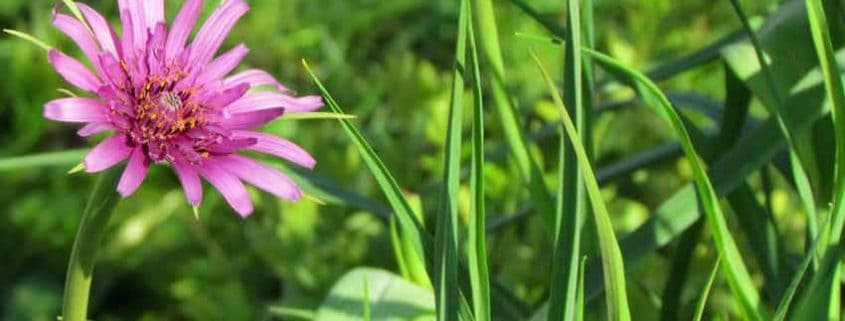
Salsify, also known as Oyster plant or vegetable oyster, was popular with the ancient Greeks who called it “the billy goat’s beard” for the silky filaments adorning the seed. The Romans increased it’s status, depicting it in frescoes in Pompeii. The famous Roman gourmet Apicius developed several recipes dedicated to Salsify and Pliny the Elder mentions it several times in his writings.
Europeans know the more common and darker scorzonera, meaning “black bark” in Italian. Salsify is regaining popularity with market and home gardeners for the delicately tasty roots and chicory flavored leaves.
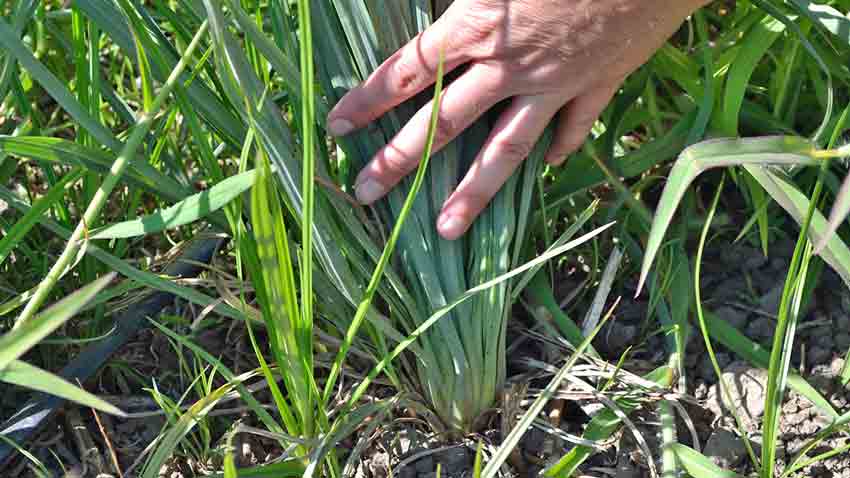
Salsify Plant
This cold hardy biennial herb has a moderately thick taproot covered by a light brown skin. It has a purple flower, distinguishing itself from scorzonera by its black root and yellow flowers.
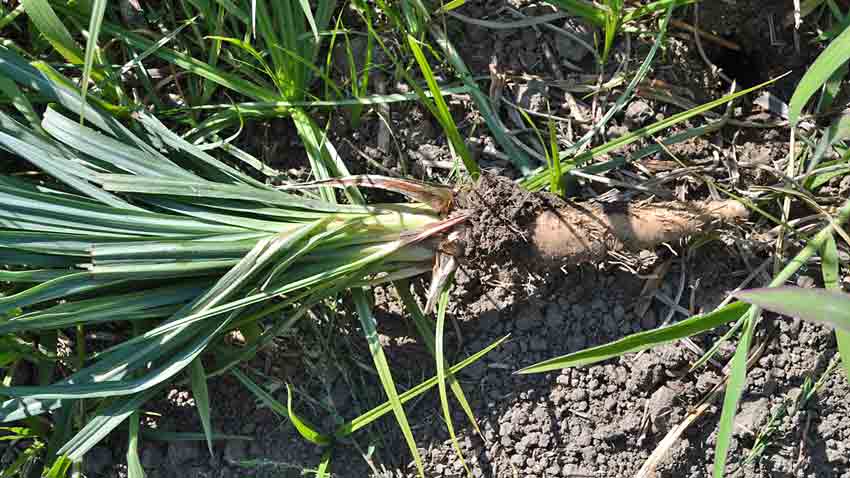
Salsify Root
The entire plant is edible when young and the root is eaten after maturing.
Young roots are eaten raw in salads, or are boiled, baked, and sautéed once mature. They are added to soups or are grated and made into cakes. The flower buds and flowers are added to salads or preserved by pickling. Young flower stalks are picked, cooked, dressed and eaten like asparagus. The seeds are sprouted and eaten like alfalfa sprouts for a refreshing and unique flavor addition.

Salsify Fritter
Cooked and puréed roots coated in egg batter and flour then pan or deep-fried to a crispy golden brown make Salsify fritters.
The Salsify root stores its carbohydrates as inulin instead of starch, which turns to fructose instead of glucose during digestion. This is ideal for diabetics as it reduces their glucose load. Most enjoy the flavor of the cooked roots over the raw.
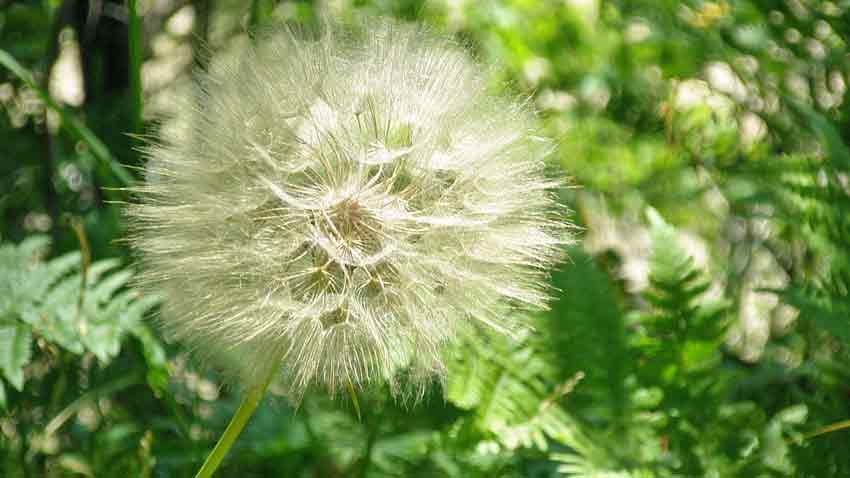
Salsify Seedhead
Seeds are direct sown in early March to April then harvested in October. The slender, grass-like leaves normally grow to about 3 feet tall and one purple petalled flower per stalk. As the seeds mature, the flower heads turn into fluffy white puff-balls like dandelion heads and scatter on the wind.

Young Salsify Root
The root is ready for harvest in the fall when the leaves begin to die back. Flavor improves after a few frosts. Dig the roots out whole with a garden spade or fork to avoid breaking them. Only dig what you need at one time, because the roots are best fresh. Salsify will overwinter, tolerating hard frosts and even freezes.
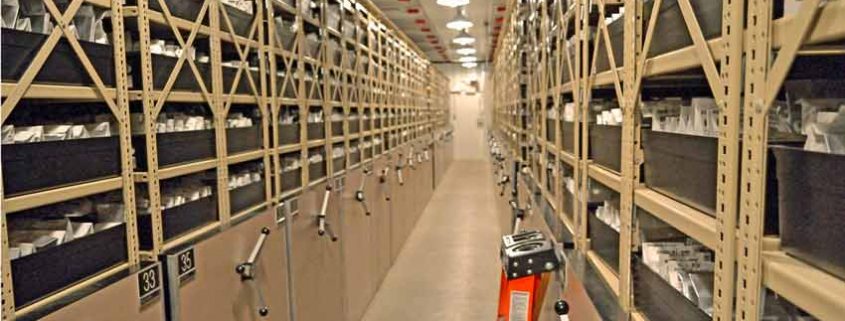
Stephen was invited to provide an article on seed quality for Acres USA’s January 2017 issue that focuses on seeds. This is the article that was published in that issue.
Everyone wants higher quality seed – from the seed company, seed grower, breeder and home gardener to the production grower. Even people who do not garden or grow anything want better seed, though they may not realize it.
Education and quality seed is the focus of our company – Terroir Seeds. We make constant efforts to continue learning and educating our customers about how seeds get from the packet to their garden. We recently had the opportunity to visit several cutting-edge seed testing laboratories and the USDA National Center for Genetic Resources Preservation to learn even more about seed testing and preservation. We want to share an insider’s look into a side of the seed world that the average person may not know exists.
Let’s look at this need for higher quality seed from a different perspective.
Everyone is a participant in what can be called the “seed economy”. Everyone, that is, who eats or wears clothes!
Anyone who eats depends on seed of some sort for their daily food – from fruits and vegetables to grains, beans, rice and grasses for dairy and meat production. Seed is intimately tied into all these foods and their continued production. Without a continued, dedicated supply of consistently high quality seed there would be catastrophic consequences to our food supply.
Cotton, cotton blends, wool, linen, hemp and silk fabrics all come from seed. Cotton comes from a cotton seed, wool from a sheep eating grass and forage from seed, linen from plant stalks grown from seed, hemp from seed and silk from silkworms eating leaves that originated as a seed.
Even those who grow and cook nothing need better seed! They still eat and wear clothes.

Chile de Agua for sale at market
The Chile de Agua pepper from Oaxaca, Mexico is a prime example of how seed preservation works. A well-known chef specializing in the unique Mexican cuisine of Oaxaca needed this particular chile for several new dishes. This chile wasn’t available in the US, so we were contacted through friends to work on sourcing the seed.
We found two sources in the US of supposedly authentic Chile de Agua seed and another in Oaxaca, Mexico. After the Oaxacan seed arrived, and those from Seed Saver’s Exchange network and the USDA GRIN station in Griffin, GA we sent them to our grower for trials and observation. All three seed varieties were planted in isolation to prevent cross pollination.
Authentic Chile de Agua has unique visual characteristics, the most obvious being it grows upright or erect on the plants, not hanging down or pendant. Both seed samples from the US were pendant with an incorrect shape. Only the Oaxacan seed from Mexico was correct. We then pulled all the incorrect plants, keeping only the seed from the correct and proper chiles.
The next 3 seasons were spent replanting all the harvested seed from the year prior to build up our seed stock and grow a commercial amount sufficient to sell. This process took a total of four years to complete.
There are two major approaches to improving seed quality – seed testing and seed preservation. One verifies the current condition of the seed, while the other works to preserve previous generations for future study and use.
There are several different methods of seed testing, from genetic verification and identifying DNA variations to diseases to the more traditional germination and vigor testing.
Likewise, approaches to preserving the genetic resources of seed are varied – from a simple cool room to climate and humidity controls for extended storage to cryogenic freezing with liquid nitrogen.
At its most basic, testing of seed simply verifies the seed’s characteristics right now. Whether testing for germination, vigor, disease screening, genetic markers or seed health, the results show what is present or absent today. Changing trends in important characteristics are identified by comparing with previous results.

Seed germination testing
This trend analysis is a perfect example of seed testing and preservation working together, as previous generations of seed can be pulled for further testing or grown out and bred to restore lost traits.
Modern seed testing labs perform a staggering array of tests and verifications on seed samples.
Germination, vigor and physical purity are the standard seed tests for agricultural crops, flowers, herbs and grasses.
These three tests are critical for determining a seed’s performance in the field, and satisfy the US seed labeling law showing germination, physical purity and noxious weed percentages.
Seed health testing screens for seed-borne pathogens like bacteria, fungi, viruses and destructive nematodes. Seed for commercial agriculture and home gardens are often grown in foreign countries and shipped into the US, and vice versa. Seed health testing verifies the incoming or outgoing seed is free of pathogens that could wreak havoc.

Seed vigor test
Plant breeders use the healthiest seed stock possible that is free of any pathogens which would compromise breeding efforts. Agricultural researchers use tested pathogen-free seed to avoid skewing results or giving false indications from unforeseen disease interactions.
Hybrid seeds need to be tested for genetic purity, confirming their trueness to type and that the hybrid crossing is present in the majority of the seed sample. Traditional open pollinated breeders will use genetic purity testing to confirm there is no inadvertent mixing of genetic variations, verifying the purity of the parental lines.
It is common to test heirloom corn for GMO contamination – called adventitious presence testing. This test identifies any unwanted biotech traits in seed or grain lots. This is an extremely sensitive DNA based test, capable of detecting very low levels of unwanted traits in a sample – down to hundredths of a percent. This relatively expensive test demonstrates the absence of GMO contamination, an important quality aspect in the heirloom seed market.
Genetic fingerprinting, also called genotyping, identifies the genetic make-up of the seed genome, or full DNA sequence. Testing with two unique types of DNA markers gives more precision and information about the genetic diversity, relatedness and variability of the seed stock.

Computer graph of DNA testing
Fingerprinting verifies the seed variety and quality, while identifying desirable traits for seed breeders. This testing identifies 95% of the recurrent parent genetic makeup in only two generations of growing instead of five to seven with classic breeding, saving time and effort in grow-outs to verify the seed breeding. Genotyping also accelerates the discovery of superior traits by their unique markers in potential parent breeding seed stock.
Using established open pollinated seed breeding techniques, genetically fingerprinted parents help produce the desirable traits faster and with less guessing.
To be clear, these are not genetically modified organisms – GMOs – they are traditionally bred by transferring pollen from one parent to the flower of another, just as breeders have done for centuries. No foreign DNA is introduced – a tomato is bred to another tomato, or a pepper to another pepper.
The difference is how the breeding is verified, both before and after the exchange of pollen from one plant to another. The genetic markers identify positive traits that can be crossed and stabilized, and those markers show up after the cross and initial grow-outs to verify if the cross was successful. If it was successful, the grow-outs continue to stabilize and further refine the desired characteristics through selection and further testing. If it wasn’t successful, the seed breeder can try again without spending several years in grow-outs before being able to determine the breeding didn’t work like expected.
There are several different types of seed preservation, just as with seed testing. The foundational level is the home gardener, grower or gardening club selecting the best performing, best tasting open pollinated varieties to save seed from. Replanting these carefully selected seeds year upon year results in hyper-local adaptations to the micro-climates of soil, fertility, water, pH and multiple other conditions.
Seed preservation work also happens with online gardening or seed exchange forums, regional and national level seed exchanges such as Seed Saver’s Exchange and governmental efforts with the USDA.
Many countries around the world have their own dedicated seed and genetic material preservation networks, such as Russia’s N.I.Vavilov Research Institute of Plant Industry. It is named for Nikolai Vavilov, a prominent Russian botanist and geneticist credited with identifying the genetic centers of origin for many of our cultivated food plants.
The Millennium Seed Bank Partnership is coordinated by the Kew Royal Botanic Garden near London, England and is the largest seed bank in the world, storing billions of seed samples and conduct research on different species. Australia has the PlantBank, a seed bank and research institute in Mount Annan, New South Wales, Australia.
The Svalbard Global Seed Vault on the Norwegian island of Spitzbergen is a non-governmental approach with donations from several countries and organizations. AVRDC – the World Vegetable Center in Taiwan has almost 60,000 seed samples from over 150 countries and focuses on food production throughout Asia, Africa and Central America. The International Center for Tropical Agriculture (ICIAT) in Colombia focuses on improving agriculture for small farmers, with 65,000 crop samples. Navdanya in Northern India has about 5,000 crop varieties of staples like rice, wheat, millet, kidney beans and medicinal plants native to India. They have established 111 seed banks in 17 Indian states.
It has been estimated there are about 6 million seed samples stored in about 1,300 seed banks throughout the world.
Seed banks aren’t the only ways to preserve a seed. Botanical gardens could be called “living seed banks” where live plants and seeds are planted, studied, documented and preserved for future enjoyment and knowledge. Botanical gardens range from established and well-supported large city gardens to specialized and smaller scale efforts to preserve a single species or group of plants.
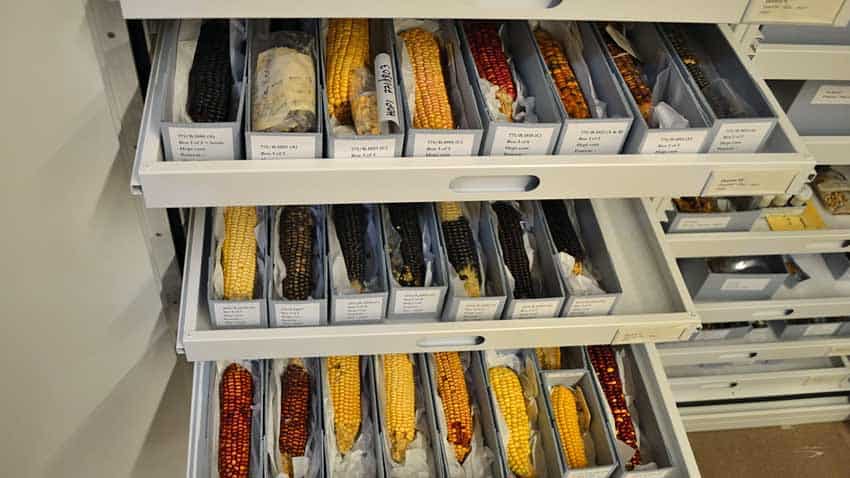
100 year old Native American corn in herbarium
An herbarium is another form of seed bank with a single purpose of documenting how a plant looked at a specific location at a specific time. Herbaria are like plant and seed archeological libraries with collections of dried, pressed and carefully preserved plant specimens mounted and systematically cataloged for future reference.
An herbarium can show what corn grown by the Hopi tribe a century ago looked like, or how large the seeds and leaves of amaranth were 50 years ago. Different herbaria focus on certain aspects such as regional native plants or traditional foods grown by native peoples during a specific time.
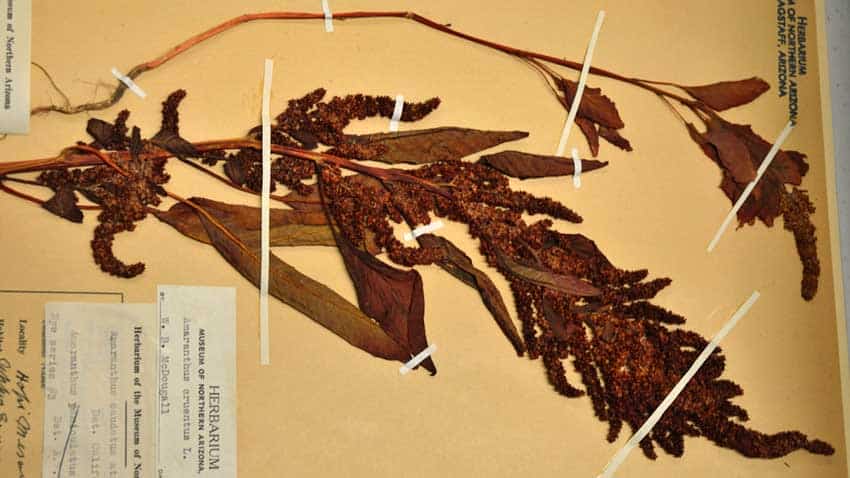
50 year old Amaranth in herbarium
The USDA plays two important roles in seed preservation that is little understood outside those in the seed industry.
The first is the Germplasm Resources Information Network or GRIN for short. It is also known as the National Plant Germplasm System. This collaborative system works to safeguard the genetic diversity of agriculturally important plants. Congress funds the program but it partners with both public and private participants. Many of the seed banks are on state university campuses with private sector breeders and researchers using the available seed resources.
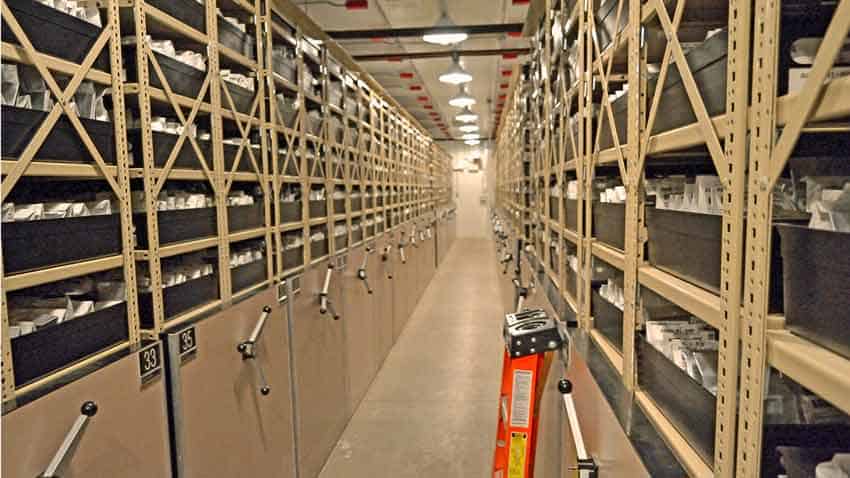
USDA National Center for Genetic Resources Preservation cold vault
There are 30 collection sites that maintain specific seed stock and conduct research on them. Some are dedicated to a single crop like the Maize Genetic Stock center in Urbana, IL which collects, maintains, distributes and studies the genetics of corn. Potatoes are maintained and studied in Sturgeon Bay, WI and rice is kept in Stuttgart, AR. Others maintain regional varieties like the UC Davis location that focuses on tree fruit and nut crops along with grapes that are agriculturally important in the central valley of California.
The second role is the USDA National Center for Genetic Resources Preservation (NCGRP) in Fort Collins, CO. This is the “back-stop” for the GRIN system as well as other private, public institutions and government programs around the world. They store the foundational collections of all the GRIN locations while also working with organizations such as the International Maize and Wheat Improvement Center in Mexico, the International Rice Research Institute in the Philippines and the International Plant Genetic Resources Institute in Rome.
Founded in 1958, the NCGRP maintains, monitors and distributes seed and genetic material samples from their long-term backup storage. After receiving seed samples, they test, clean and condition the seed for the proper long-term storage environment.

USDA NCGRP’s liquid nitrogen vault
Two long-term storage methods are used. One is a traditional low temperature/low humidity storage and the other is liquid nitrogen storage. The traditional storage is kept at 0°F and 23% relative humidity. Seeds are kept in heat sealed, moisture proof foil laminated bags.
Before seeds are stored in liquid nitrogen a sample is given a liquid nitrogen test to ensure the extreme cold won’t damage the seeds. The sample is exposed to liquid nitrogen for 24 hours, then germinated after coming back to room temperature and evaluated for any germination issues.
If the test results are normal the seeds are stored in clear polyolefin plastic tubes that are barcoded and sealed. The filled tubes are arranged in metal boxes, labeled and stored in liquid nitrogen tanks.

USDA NCGRP’s liquid nitrogen vault sample straw
The vault housing both storage areas is completely self-contained and separate from the adjoining buildings. It has its own backup generator, can withstand up to 16 feet of flooding, tornadoes and the impact of a 2,500-pound object moving at 125 miles per hour. It also has a full suite of electronic security.
If these approaches and techniques seem extravagant, it is with good reason. Our food availability and security increasingly relies on intensive production of fewer variety of crops that are very similar genetically. Along with increased production is increased vulnerability on a larger scale to pests, diseases and other stresses.
By collecting, preserving, testing, studying and distributing seeds and genetic materials immediate food system challenges can be met along with solutions and adaptations for future needs. Changes in growing conditions due to population growth, weather variability, transitions in land use and economic development all make the need for quality seed more important.
All the players in the seed economy support and advance the knowledge and quality of our seed used today. Just as the home gardeners and garden clubs preserve local seed varieties, seed companies are a “back-stop” for them. Seed banks and research facilities back up the seed companies and provide material for seed research.
Would you like a fresh food that grows in any climate, at any time of year and needs no soil or sunshine? One that you only spend 5 minutes a day with, matures in about a week and has more nutrients per calorie than any other type of food?
How about one that has no waste in preparation for eating and is tasty?
Welcome to the incredibly diverse, tasty and nutritious world of sprouts.
Whether it is well known leafy sprouts like Alfalfa and Red Clover, or the loved Mung bean sprouts used extensively throughout Asian cooking, sprouts are tender, crisp tiny plants that have flavors from mild and nutty to sweet, tangy and peppery. Their crunchiness and texture vary as well from the delicate Alfalfa and Clover to the thick and hearty Mung bean sprouts that hold up well to the heat of stir-frying.
Sprouts don’t require any sort of “Green Thumb”, just pay attention to the rules above.
Rinse a couple of times a day to keep the seeds/sprouts moist. This also flushes away carbon dioxide and metabolic wastes that could cause spoiling. Use cool water when rinsing to ventilate and cool the sprouts to prevent overheating. Sprouts generate warmth as they grow. The optimum room temperatures are between 70 – 85°F.
Using the sprouting lid helps maintain proper drainage, preventing excess moisture that can cause mold. Young sprouts are very tender, so keep the sprouting container away from cold drafts, direct heat or light.
Sprouts expand 6 – 10 times their initial volume in just a few days, so give them plenty of room to grow. The 1 1/2 tablespoon volume of seeds grows to almost fill the quart jar!
Sprouts are very light sensitive and should be covered until the final day or two of the sprouting cycle.
Now you know the rules, here’s how easy it is to grow your own sprouts! It only takes about 5 minutes each day.
The tools and ingredients are super simple! You need a sprouting lid, a tablespoon measure, a glass quart jar and a towel to cover the jar.
What you sprout is up to you – we offer several different sprouts and mixtures to suit different taste buds.
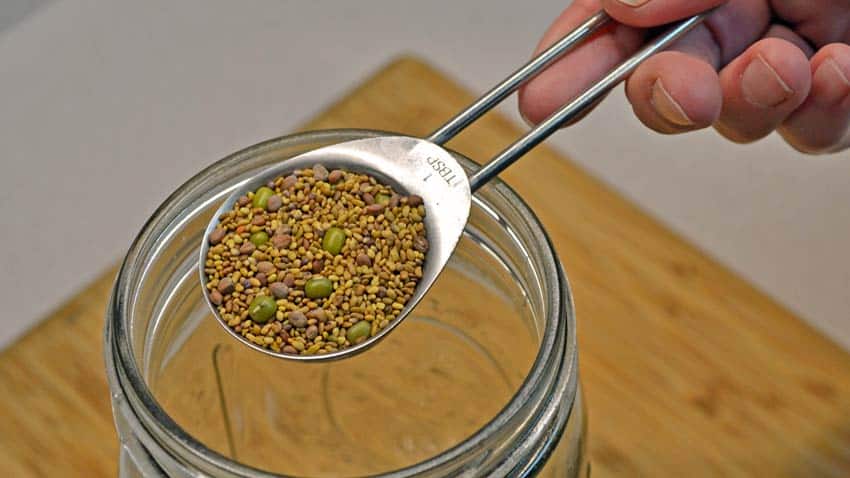
Start by measuring out 1 1/2 tablespoons of sprouting seeds into a glass quart jar.
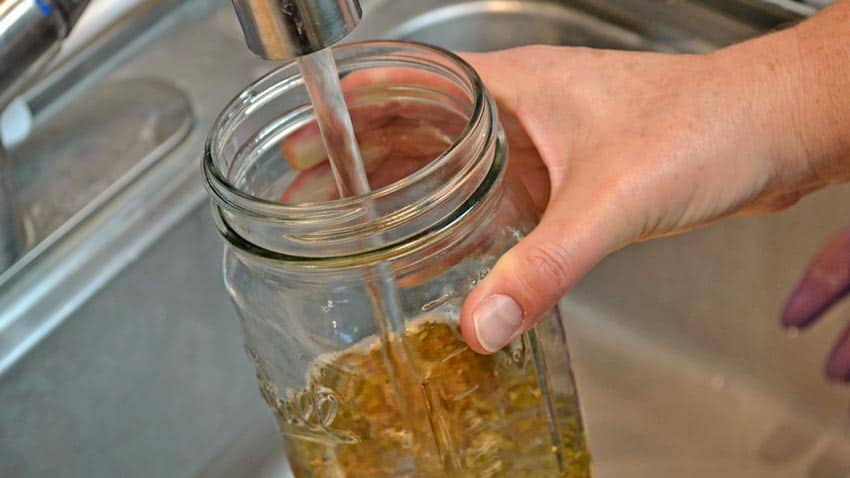
Fill the jar with warm water – not hot! This is the only time you will not use cool water in the sprouting process. The warm water helps start the sprouting process and speeds up the softening of the seed coat.
After the jar is full of warm water, screw the sprouting lid on, swirl the seeds well for several seconds and pour out the water through the lid.
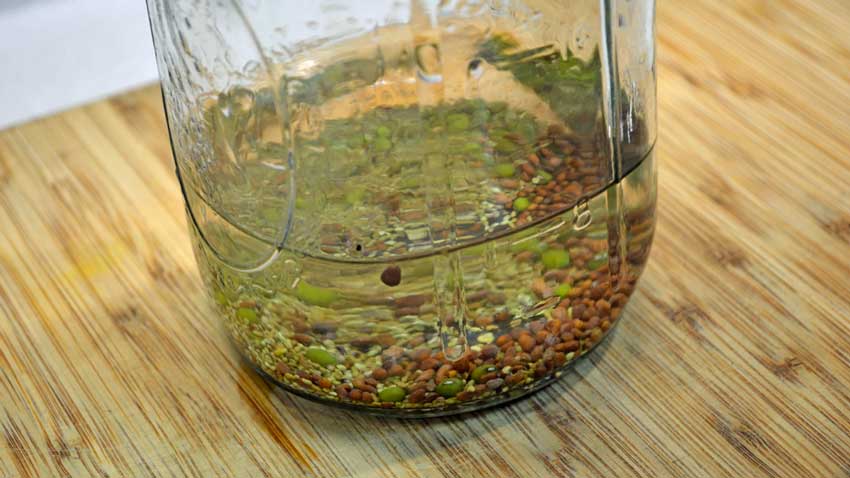
Refill with warm water to cover the seeds about 3 times their depth. Let soak overnight and keep away from light.
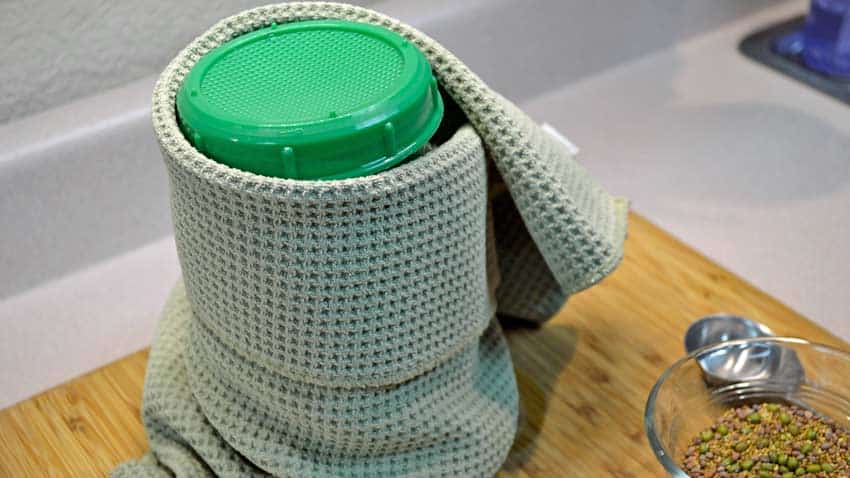
The easiest way to keep the sprouting seeds away from light is covering them with a towel. The sprouting process does not need light.
Let the jar and seeds sit overnight.
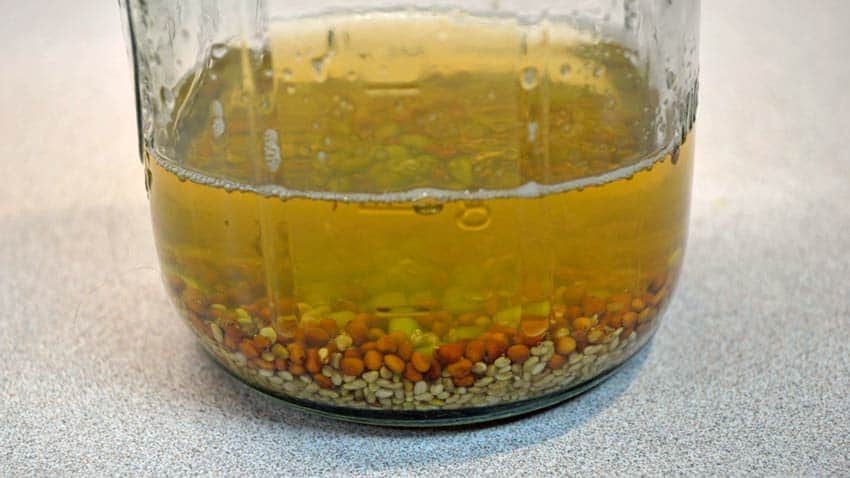
The next morning, this is what you should see once the towel is removed. The water will be slightly darker than yesterday and the seeds will be noticeably larger from absorbing water.
Dump the water out,
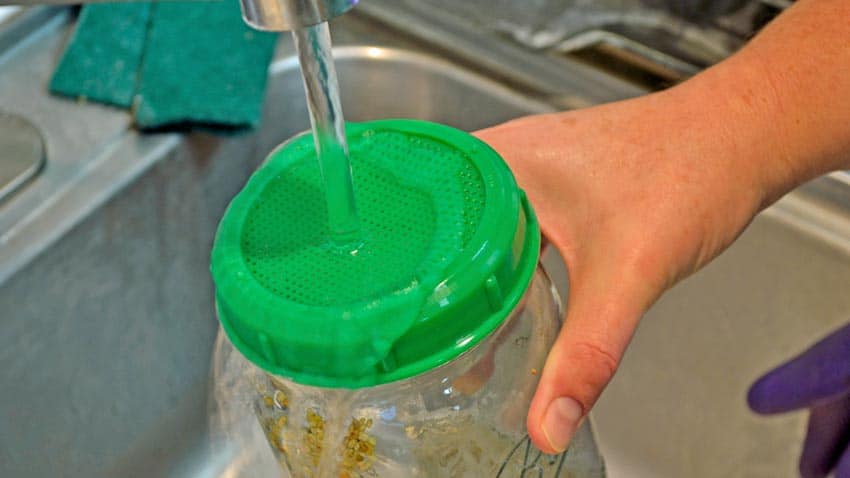
rinse with cool water, fill to about 3/4 full and swirl to separate any seeds stuck together,

then pour the water out again.

The sprouts look like this on the first day – still seeds! The sprouting process has started, and you’ll see the results on the second day.

After rinsing and draining, cover the jar with a towel and put in a convenient place where it is in a steady temperature with no cold drafts where it can drain without causing problems.
This place is often the kitchen dish drainer. We like to tip the jar lid downward to drain excess moisture off easily. Our duck eggs comfortably share the space!
This is the process you will repeat a couple of times each day. Rinse with cool water, pour out, cover with a towel and tip the jar lid downward to drain excess moisture.
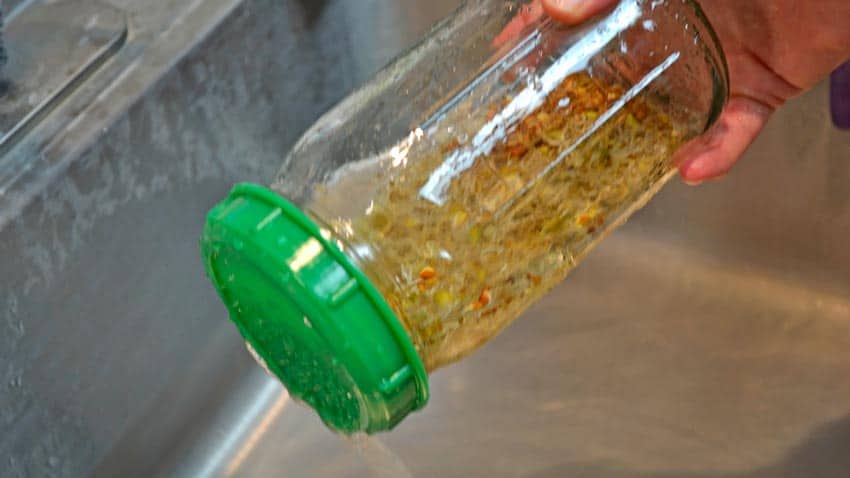
At two days, the sprouts were just beginning to split their seed coats, with a few showing a small sprout tip peeking out here and there.
This is the third day. We rinsed and drained the sprouts and inspected them.

Sprouts at three days. Most of the sprouts have split the seed coats and have started growing.
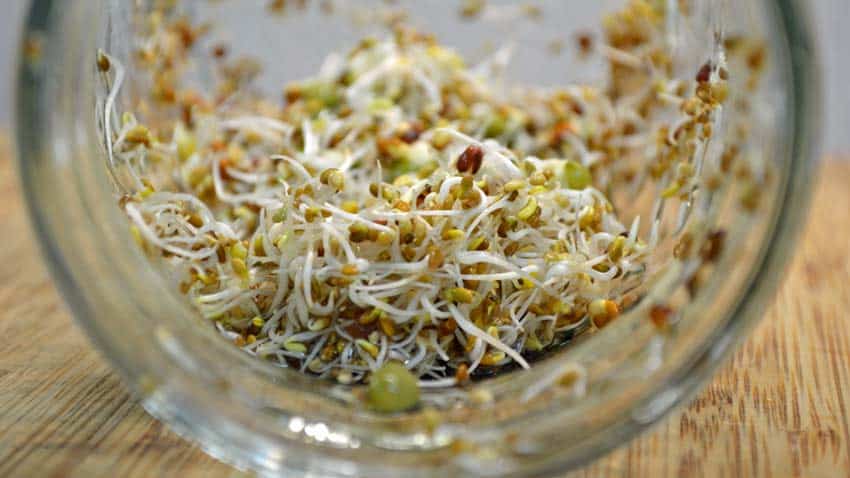
A closer view shows how dramatic the change is from seeds to sprouts in just three days. Most of the sprouts have long “tails” or roots, long enough to make the seeds look small in comparison. There are only a few seeds that have not sprouted at this point.
The growth continues over the next few days.
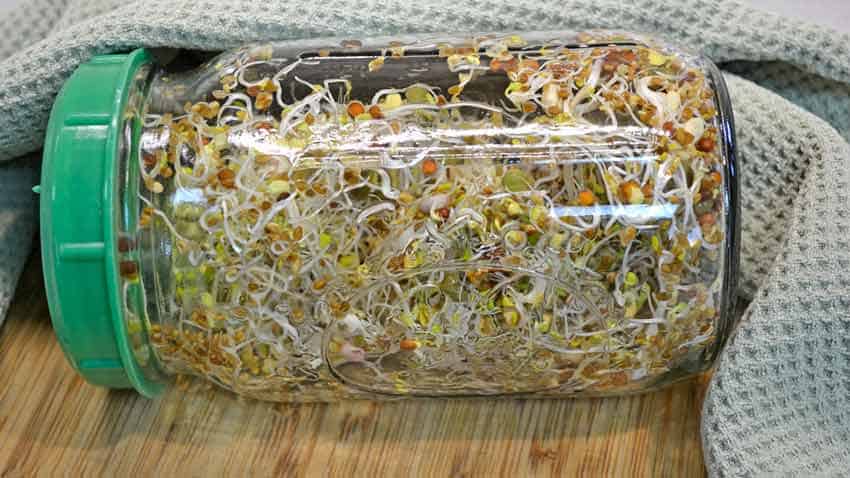
Sprouts at five days. There has been lots of growth in the past two days, compared to the day three photos above. The jar is almost filled now.
Each day we rinse, drain and cover the jar with the lid pointed downward to encourage good drainage.

The close-up view shows the difference in growth and volume over the past two days. At three days, they had filled almost 1/3 of the jar opening, while today they almost fill the jar opening.
The growing phase is finished, the sprouts need some ambient light to green up and boost their nutrition. You can eat them now – this is what is sold in the stores, but a couple of days with the towel off starts the production of chlorophyll and seriously increases the nutrition content!
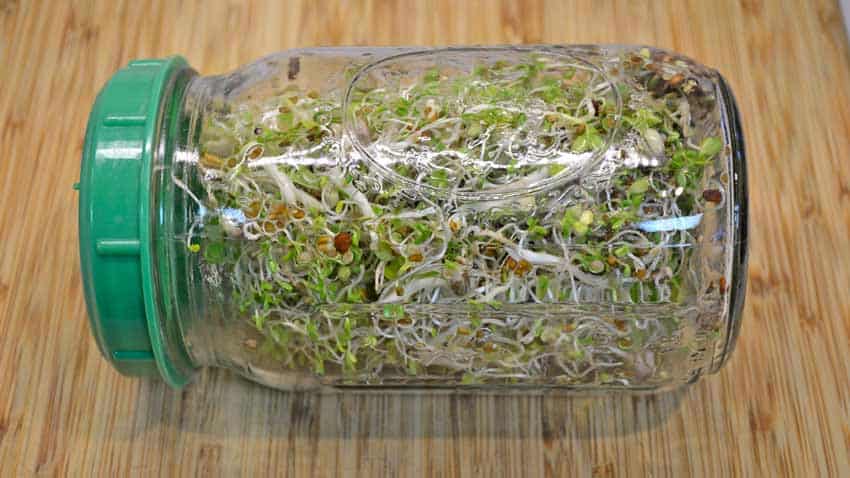
Sprouts at seven days. The growth has slowed down, but the sprouts are much greener now. We’ve left the towel off after day five. We continue the rinse and drain routine each day.
The young, tender cotyledons have turned from a pale light green to a richer, deeper green. This color indicates nutrition – amino acids, protein and carotene, among others.
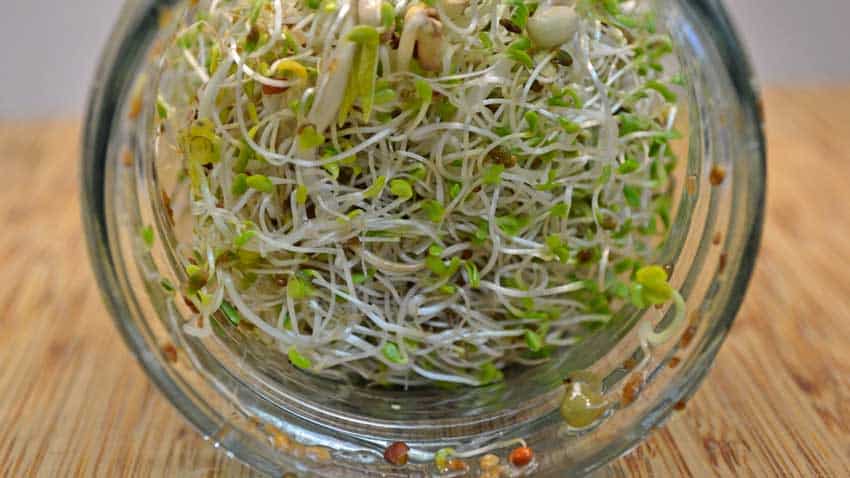
The close-up view shows how the sprouts have expanded a little more, but the colors are much greener.
The sprouts are almost ready to eat!

After the sprouts have greened up a bit, they are ready for harvesting. This just means a good wash in a colander or large bowl of water to remove the seed hulls.
There are two methods of doing the harvest wash – in a colander and in a large bowl of water.
If you use the bowl of water method, make sure to start with a bowl about twice the size of the sprouts so you have enough space to work. Gently dump the sprouts into the bowl and add cool water to almost fill the bowl.
Work your fingers into the sprouts, opening them up and releasing the spent seed hulls. Some will float to the top, while others will sink to the bottom. Skim the floating hulls, then remove the sprouts and drain the water and hulls.
Replace the sprouts and repeat the process until there are very few hulls left.
We show the colander method in our photos.
Gently dump the jar full of sprouts into a colander. It may take some gentle shaking or a chopstick to loosen the sprouts if they’ve grown to fill the jar.

Gently but thoroughly wash the sprouts with a running stream of water. We alternate between a solid stream and a spray and use our fingers to work the sprouts around to release the hulls. Some are visible at the bottom of the colander.
It usually takes a couple of cycles of wash/rinse with finger agitation, then lifting the sprouts out and washing the hulls out of the colander. Once you have very few hulls left the sprouts are ready to eat or store in the fridge.
Store sprouts in the refrigerator using the glass jar and sprouting lid as they still need to breathe and be rinsed once a day. Just make sure to set the jar lid down to drain for about 15 minutes before putting back in the refrigerator. They will last about a week, but usually will be eaten in just a couple of days!

Once the sprouts are cleaned they are ready to eat! We love our fresh sprouts on sandwiches of any kind – or on a fresh burger of locally raised heritage beef with homemade mayonnaise! Sprouts bring a fresh crunch and taste of fresh growth no matter what time of year it is.
If you find sprouts as delicious as we do, try succession sprouting. This is the same concept as succession planting in your garden but with sprouts.
Depending on how much you and your family eat, start a batch every third or fourth day to keep a fresh supply of sprouts on hand. You will need a sprouting lid for each batch, so you might need 2, 3 or 4 lids. With simple care the lids will last several years.
Now you see how simple it is to grow your own home-grown sprouts, saving you time and money while having delicious fresh greens any time of year! If you have a spare 5 minutes a day and enough room for a quart jar, you can grow sprouts.
Once you’ve sprouted a couple of times and have the timing down it will feel second nature to always have fresh sprouts on hand.

One sure way to improve your garden next year is to increase your garden knowledge during the slower season. This is easier than you might think.
Do a high-level flyover of the season either in memory or with notes.
If you took them, look at the notes in your garden journal and see what did well and what didn’t.
If you could learn one thing for next season that would make a positive difference, what would that be?
It helps in keeping track of what happened, what went well and what didn’t.
You don’t need to document everything, and some notes are much better than none. You will see this especially a few years down the line when you can’t remember what you did that worked that one year!
Now is the perfect time to start learning, sharpening your skills and expanding your knowledge for next season. We are talking about this early, as it is much too easy to think that there is enough time left to do it later. Ask us why we know this…
“What do you get when you don’t get what you want? That thing is called experience.”
There are two ways to gain experience – directly and indirectly.
Direct experience is your mistakes and missed opportunities that you learn from. Indirect experience is learning from other’s mistakes and knowledge.
Everyone learns directly, but smart people focus on learning from other’s lessons. This greatly shortens the time needed to gain that knowledge.
We hope this will boost your learning curve!
Pumpkins are an important fall mascot, from jack-o’-lanterns to home decorations to delicious foods. After all, what says Fall more than pumpkin spice lattes, pumpkin cookies, pies, soups and pancakes?
We love our pumpkin – farmers grew about 1.3 billion pounds in 2014, a 17% increase from the year prior. They aren’t the largest grown crop commercially, but pumpkins are still an important crop. Illinois grew over half of all commercial pumpkins with 745.8 million pounds, far outpacing California at 192.2 million pounds. Most are “processing pumpkins” going into pie fillings or other canned pumpkin uses.
Pumpkins are part of the gourd family along with summer and winter squash, cucumbers, melons, cantaloupes, watermelons, and zucchini. They originated in Central America and southern Mexico. Now they are grown in almost all parts of the world.
We’ll share tips to be more successful in areas with insect or disease pressures.
Planting high quality seed into warm fertile soil at the right time is the beginning of a successful harvest.
This takes a little bit of planning but isn’t difficult. Pumpkins like a loose, fertile loamy soil with a pH range of about 6.0 – 7.5 as an ideal condition. Well-aged compost added to the soil will improve flavor and production. They will grow in less than ideal conditions but may need extra nutrition or care to produce well. A drip system on a timer provides consistent soil moisture, important for good production and flavor. A good layer of surface mulch helps.
Planting two or more seeds then thinning the smaller seedlings used to be standard practice with growers and gardeners. High-quality seed makes that unnecessary now, saving time, effort and energy when planting. You normally only need to plant one seed per hill.
Get the most out of your seed by planting flat or with the pointed end down. This saves energy for the roots and shoots, giving them a head start in the right direction.

Aurora inspects a Connecticut Field Pumpkin
Pumpkin is a warm-weather crop – the seed is sensitive to soil temperature and won’t germinate in cold soils. Young seedlings are also easily frost damaged, making a later planting often more successful. The seed won’t start germinating until the soil temperature reaches 60°F and can rot in cold and moist conditions.
A pumpkin seed will sprout in about a week at 70°F soil temperature but can take 2 weeks or more at 60°F.
Traditional planting times are mid-June to early July in the Northeast. The Midwest sows mid-May to late June, depending on the weather. A June 15 planting date gives enough time for most pumpkins to mature for a mid-October harvest.
Read soil temperature with a simple digital thermometer accurate from 50°F to 90°F. Insert the probe just slightly deeper than how deep the seed will be planted – about an inch – and get the reading.
Most pumpkins need 90 to 120 days to maturity. This means they take 3 – 4 months of warm weather to grow, flower and produce pumpkins before a hard frost.
Here are a few tools to help boost your success:
The first is knowing when the first hard frost arrives in your area. This makes sure you’ve got enough time to get a good crop. Use the First and Last Frost Dates tool discussed in our How to Plan for Fall and Winter Gardening article.
The second is choosing a variety better suited to your growing season. Choose a smaller pumpkin or a faster-growing one when limited on time.
A third option is using pumpkin transplants you’ve started indoors – much like tomato transplants. This gives you more time in a shorter season as you’ve started the “clock” on a 90-day pumpkin 14 days earlier by starting it inside.

Australian Butter Squash
The large shade canopy from the leaves controls weed growth, but some weeds will still get a foothold.
Spraying for weeds doesn’t work well!
Pumpkins are sensitive to most herbicides for home gardeners, producing fewer and smaller pumpkins.
It is more important to keep on top of weeds early in the season than worrying about them later. Weeds steal nutrients and stunt growth with young pumpkin seedlings than with more mature plants.
Manual weeding with a hoe or by hand is the most effective but also most labor intensive. Early cultivation with a weeding tool when the weeds have just emerged is very beneficial. Slide your hoe just below the surface of the soil to slice the weed stems.
Very young weeds emit powerful plant hormones called auxins. One particular auxin delays other seeds in the immediate area from germinating for about 4 – 6 weeks.
Harness this time delay by cutting the weeds before they grow their second set of true leaves. This gives your pumpkins time to get up and running.
Black plastic mulch limits weed growth around the pumpkins. It needs to be put down just after the seedlings emerge and removed at the end of the season. Commercial growers commonly use this method, and some home gardeners have found it to be worth the effort in high weed areas.
Planting into cover crop residue also works well. Especially spring planted cereal rye that has been mowed or weed whacked and let dry down for 2 weeks. Open up a small space around the seed mound or transplant when planting.
Pumpkins need well-drained soil, good airflow and room to soak up the sun. Wet and humid climates contribute to disease attacks. Space plantings 5 – 6 feet between hills and at least 10 feet between rows of pumpkins. This ensures good ventilation and sun exposure to control humidity under the leaf canopy, decreasing disease potential.
Mold and mildews can wreak havoc on a pumpkin patch if left unchecked.
Use a 20% solution of milk and water to fight them while boosting the soil biology. Milk and Molasses – Magic for Your Garden has the full details!
The same insects that love squash also love pumpkins – including squash bugs, squash vine borers, cucumber beetles and aphids. Squash bugs are a major pest problem with any squash. We’ve shared a recipe that seems to help in Squash Bugs and Ways to Deal with Them. Recent research shows inter-planting buckwheat supplies food for the tachinid fly. This fly is a parasite of the squash bugs.
Improve your pumpkin production with crop rotation, removing and composting plant residue in the off season and increasing the beneficial insect populations.
One technique the home grower has is growing pumpkins or squash in large containers. Move them to a new area each season away from insects and disease. Use a planter witha good soil volume and keep plastic mulch under the vines to reduce insect pressures.
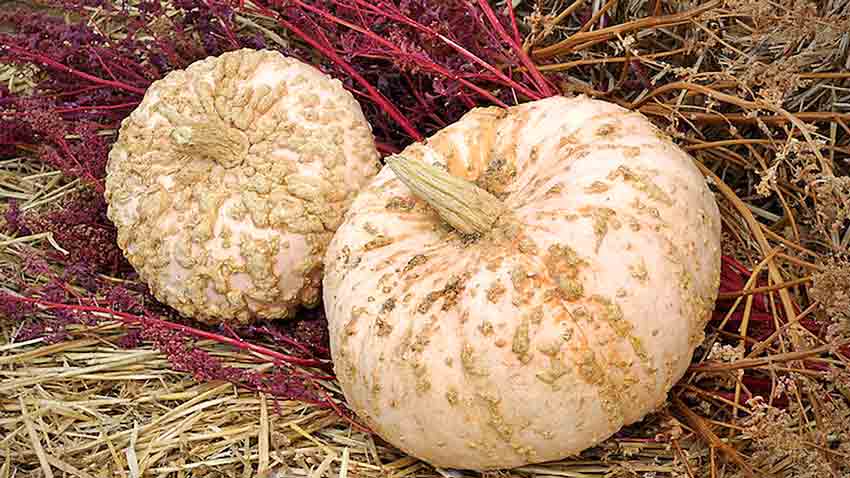
Galeux d’Eysines Pumpkins
Pumpkin and squash need to fully ripen on the vine to avoid tasting bland and watery. The leaves and vines will start dying back and the shells will become harder as the squash ripens. They will resist indentation when you press your thumbnail in.
Pick all the ripe fruits before the first frost, otherwise, the storage life is shorter. Mulch unripe fruit heavily with straw or a tarp in the garden as the first frost approaches. Pick when ripened.
Harvest in dry weather, using pruning shears or a sharp knife to cut the vine. Leave two to three inches of stem attached. Do not pull the vine off of the squash when harvesting, as this will damage the stem or fruit and lead to early rotting.
If you have had any diseases or insects – mildew, mold, blight or squash bugs – clean the shears or knife between each cut to prevent spreading diseases between fruit. A dishcloth soaked in a 10% bleach solution works well.
Dry or cure pumpkins in the sun until their stems shrivel and harden. If you harvest in rainy weather, cure them out of the rain in a well-ventilated area. Move them into the sun when it returns.
Handle the fruit carefully to avoid bruising the flesh, even though the pumpkin may look and feel tough. Bruised flesh leads to shorter storage and can ruin other squash stored nearby.
Store in a cool, dry area. Ideal temperatures are between 45 – 50°F with 65 – 70% humidity if possible. The temperature is more important than the humidity, so if you have a cool but drier location, that will work.
Check the fruit regularly, as one bad pumpkin can ruin several others or possibly the whole lot!
See how to make the most from your home-grown pumpkin with our Roasted Pumpkin Puree and Pumpkin-Orange Cheesecake!
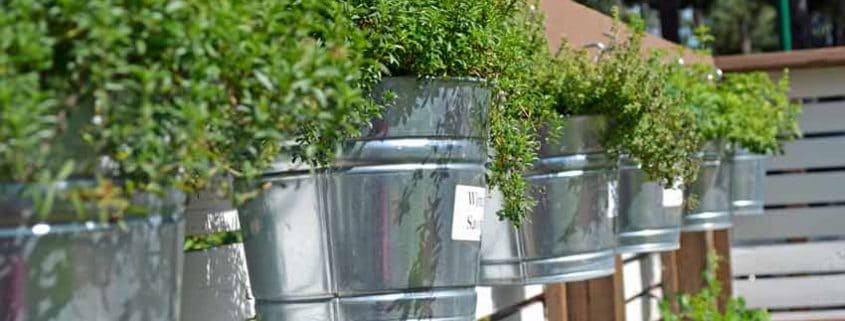
Cindy and I recently visited the kitchen garden at the Forest Highlands Meadow Clubhouse. Forest Highlands was established in 1987, with the original raised bed concrete forms poured shortly afterward.
We don’t know how long they were garden beds. They were filled in and covered with sod for a children’s play area and family picnic grounds.
In 2015 the kitchen staff uncovered half of the original concrete terraced raised beds. They kept the upper part in sod, using it as a reception area for weddings or parties with 4 large raised beds.
This kitchen garden is just south of Flagstaff, AZ in a very short season climate. Some years they have less than 60 days of growing time, while others are just over 70 days.
This limits what they can grow. Creative use of existing advantages helped them be successful in their first year. The result has been a surprising amount of fresh vegetables and herbs for the kitchen.
They grow unique and unavailable varieties showing the chef’s talents with heirloom flavors.
Let’s look at some of the techniques used to create a successful kitchen garden in a challenging climate!

This uphill shot shows the concrete forms of the original stepped landscape garden beds giving way to the remains of the sod used for the children’s play area and picnic area. Four raised beds grow vegetables needing a deeper soil and host a reception area.
The raised bed soil is rich and fertile while the terraced beds need improvement. Rains left standing water in the beds on the lower right which made growing difficult this season. The staff is planting our cover crop mix to help. The mix will open up the moderate clay soil and improve drainage, soil structure and fertility.

The terracing is harder to see from this angle, but the size of the raised beds is clearer. Each raised bed is about three feet deep, giving plenty of water drainage and depth for root crops.
The semi-intensive planting has gone well with a successful harvest considering it is the first full year of growing there.
The concrete retaining wall topped with solid fencing is at the far end of the garden, providing wind protection as well as shelter from hungry critters ranging from rabbits to deer.

Carrots, beets and radishes are growing in this raised bed. After harvest the bed is mulched with straw and left dormant until early spring. The mulch protects the soil from temperature extremes, allowing earthworms to be more active.
The raised beds are full of earthworm activity. If you create the proper environment the earthworms will appear!

This left side view shows how different the soils are just 10 feet apart from the right side. The growth is lush and full, unlike the right side beds holding water with struggling plants.
There may only be 2 – 3 weeks of growth for our Garden Cover Up Mix before the frosts kill them. This is enough time to establish a root system and mulch cover, starting improvement for the soil.
Next season they will interplant cover crops among the root vegetables. The cover crops go in once the vegetables are a month old so they don’t compete with each other. This gives more time for better soil improvement.
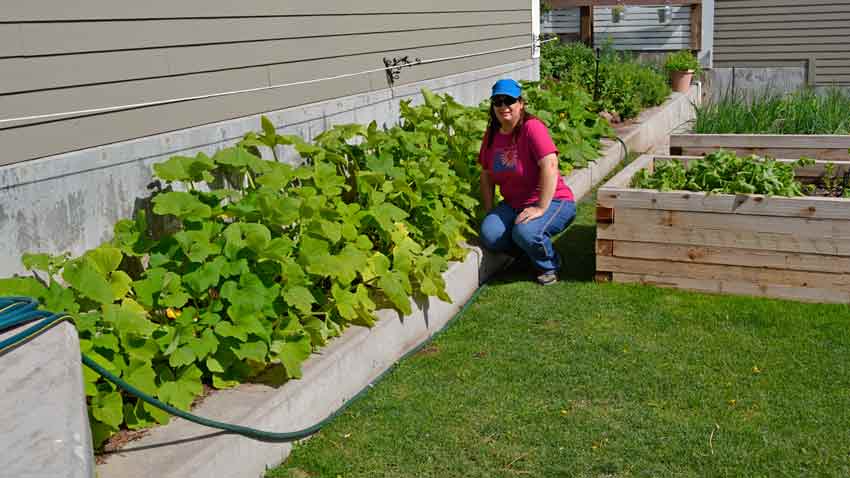
Cindy next to a long bed of pattypan squash. These summer squash are very cold sensitive and love warmth. This planting bed takes advantage of the concrete walls thermal mass, effectively moving this bed two or three zones south. It is unusual to see such vigorous and healthy growth in a colder climate.
This thermal mass technique has been used just outside Paris, France for over 300 years. Farmers grew extensive fruit tree and grape orchards in the cold climate of Paris.
Thick south-facing brick walls kept fruit trees and grape vines warm. Horticultural books showed why these orchards were so productive and grew such delicious fruits.
There are still remnants of these horticultural walls still standing outside of Paris today. Many of the current residents do not know why the walls are there, or what function they served!

When we looked in the bed, sure enough there was a large pattypan squash ready for harvest! This is about 2 – 3 weeks prior to the first expected frost.

The same concept is used for the tomatoes and basil, for different reasons.
This east facing retaining wall supports the pool and is not a traditional thermal wall. This growing spot is unique because the pool provides the moderating temperature. The pool has a lot of thermal mass, maintaining a steady temperature to the concrete.
In the summer, the wall absorbs warmth during the morning and gives shade during the hot afternoons. The water temperature is cooler than the air, so the wall’s effect is shading and cooling.
During cooler weather, the pool temperature is warmer than the air, warming the bed. The sun warms the bed during the first part of the day.
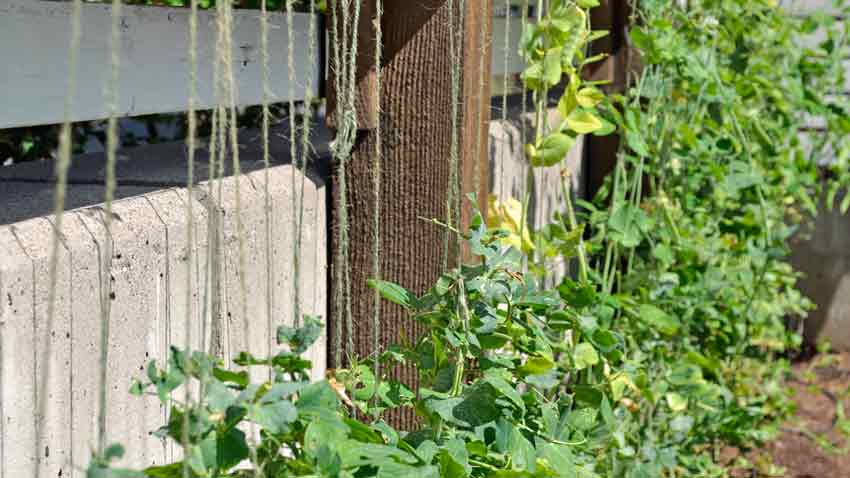
Up at the top of the herb garden section, the same technique is at work helping the snap peas have a good second season. They are climbing twine strings in front of the south-facing driveway retaining wall. The gardeners use this spot for an early planting of peas using the warmth as a jump-starter, transitioning to herbs later in the spring and back to peas in the fall.
Pretty clever to coax three plantings out of a 60 day growing season!

A different angle gives another look at the upper herb garden section. Notice the peas don’t extend past the warmth of the concrete retaining wall.
Some of the herbs are in pots, while others grow as annuals in the beds.
Notice the high fencing, which acts as walls for wind breaks and critter proofing. The garden is protected from chilling and drying winds and breezes, allowing more vigorous growth than if it were more exposed.
The hanging buckets are at the top right, seen in more detail at the top photo of the article. Individual herbs grow in each bucket, giving more fresh herb variety to the kitchen.
Now you see how simple techniques are used in creating a successful kitchen garden, no matter the size.
Take a close look at your garden to see if some of these approaches would work for you, or with a smaller container garden close to the house!

Cover crops – also called green manures – have improved soil for thousands of years. 3,000 years ago Chinese agriculture began planting horsebeans and sesame for soil improvement. Much later the Greeks and Romans sowed special crops to increase soil fertility.
The past 60 – 80 years has seen an incredible amount of knowledge emerge from small farmers experimenting with planting different cover crops and learning from what resulted. This knowledge was built on a foundation of several hundred years of European trial and error.
We now have access to detailed information about how to use cover crops for the maximum benefits in our gardens, pastures and fields.
Our Garden Cover Up Mix was developed from research into the specific benefits we wanted to bring to the home garden soil, as well as what species supported each other.
This photo essay is a look at what one month – 4 weeks – of growth provides in an average raised bed.
After sowing we began watering with our drip system, but the monsoon rains provided a good amount of water over the month. This helped the plant growth along, so your results may be a week or two behind these photos.
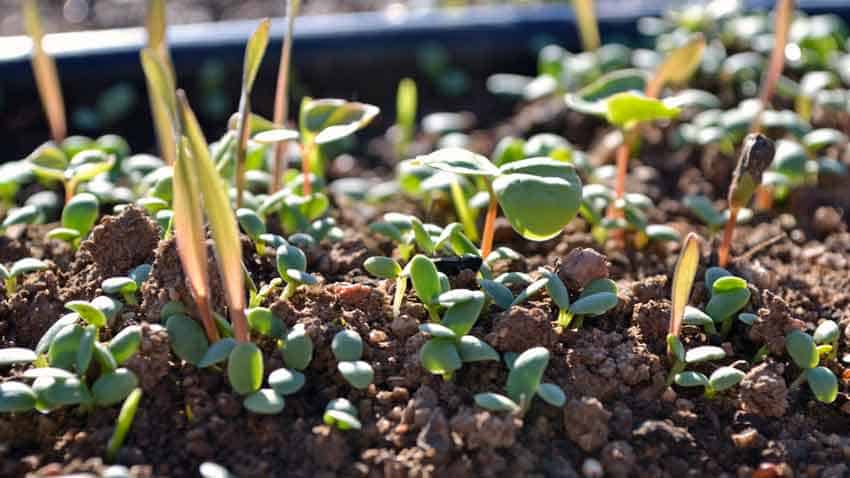
At one week, the mix has almost all sprouted and shown vigorous growth. The oats and rye are shooting up, looking like grass while the buckwheat spreads its leaves and the clover hugs the soil. The peas were just beginning to show up, as they took a few days longer to absorb moisture and begin germinating.

We planted the different parts of the mix separately to get an idea of how they grew by themselves and with other species in support.
The rye and oats both shot up rapidly, germinating within 3 – 4 days and showing good soil coverage.

The crimson clover was also up fast, creating a fluffy green blanket over the soil with its tiny green leaves. Even with only an inch of growth it was easy to feel the temperature differences between the tops of the leaves and the soil temperature – it felt like 15°F difference!

The buckwheat was a couple of days slower coming up than the oats or rye. Once the sprouts appeared they immediately opened their leaves and really started growing.

After three weeks the mix has almost completely covered the raised bed. The root system is about 3/4 of the top growth at this point, so the root density below the soil is almost as much as seen here. This is why cover crops are so beneficial to soil fertility.

A closer look shows how much shade the soil has and how thick the mix is growing. This out-competes most weeds above the soil while the roots choke out weeds below.
The young seedlings have just finished emitting auxins, a natural root hormone that inhibits other seeds from growing.
This mechanism gives the cover crops a head start over any other weeds for the next 2 – 3 weeks. When weed seeds can’t germinate, they will often rot as the soil fertility improves.
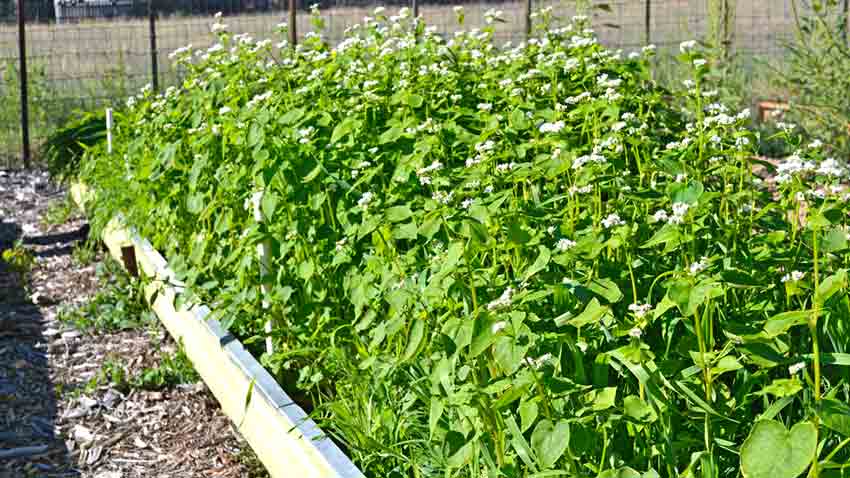
The growth accelerated going into the fourth week, as these photos show. The white PVC stake is about 14 inches tall. Last week the growth was about 3 – 4 inches, but this week it shot up above the top of the stake.
Besides putting on a lot of height, the mix also completely filled in the raised bed. Weeds have no space to grow and we could only find one or two after searching for them.
The soil is much cooler than the surface of the leaves. It is also moister, but that could be due to the amount of recent rains and not the cover crop. The buckwheat is starting to bloom and is attracting bees as seen in the top photo detail.

The buckwheat is the tallest of the mix at about 21 inches tall. The mix is extremely full and thick up to about 16 inches, completely choking out any weeds. The root system is still about 3/4 of the height of the plants, so there is an amazing amount of roots below ground! This shows why planting cover crops does so much to improve the physical structure of the soil.
As the roots die and decay they add organic matter to the soil, open up moisture and air pathways where the roots grew and increase the carbon content – all at the same time!
Pretty good for a few minutes spent planting the seeds and a months’ worth of growth!
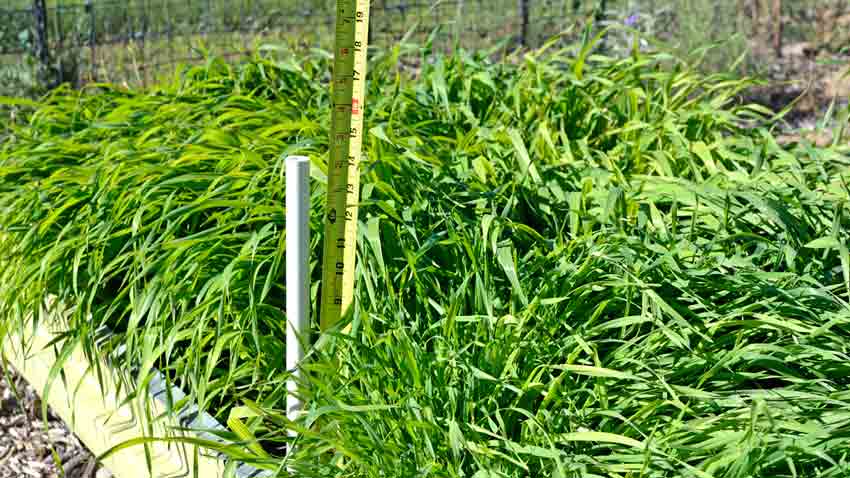
Both the rye and oats look like really lush grass. They completely cover the soil and top out at just over 15 inches at one month. We couldn’t find any weeds in this test plot.
Looking closer at the density of the rye planting, it is easy to see why weeds don’t stand a chance. There is no room for anything other than the rye with this dense seeding rate, which is the point.
If a killing frost happened tomorrow there is enough growth to create an excellent mulch while the root system will feed the soil and its microbial populations.
Our first frost is still several weeks off so the cover crops will keep growing both above and below the soil level. The flowers need watching to prevent setting seed and creating another crop next season. We will clip or mow the flower heads as they develop if there isn’t a frost soon enough.
If the rest of the mix can develop before mowing or a killing frost, it gives more nutrition and benefits to the garden bed.
Cover crops will increase the bio-available nutrition in your soil for next season, even if you use a well-aged compost. Both approaches have benefits but if used together support each other and create a better, more fertile soil sooner than if only one is used.
You don’t need a lot of time to grow a good cover crop and seriously improve your garden soil – a month will do! Even if you only have 2 – 3 weeks you will be better off with a shorter planting than none at all.
Go plant some cover crops. Your garden will reward you handsomely next season!
Growing fall onions is sometimes confusing – should you choose the long day or day-neutral ones? When should you plant? Does the color of the onion matter? How to avoid growing non-bulbing onions again this year?
Most questions come down to, “What onions can be grown this fall?”
The short answer is the sweet onions will do best in almost all locations, but there is more to the answer!
Most gardeners can successfully grow the sweet Candy onions for cooking.
There are three conditions fall-grown onions need – day-length, time to mature and temperature.
Candy is a day-neutral onion, meaning it forms a bulb with 12 – 14 hours of daylight. The map above shows approximately where the Candy onion will grow. The southern limits are short day length and the northern are too cold too early for a sweet onion in the fall.
Our grower has had excellent results in almost all regions of the US. The exceptions are south Florida, south Texas and the extreme northern states bordering Canada. Even parts of Maine have been able to grow good sweet onions in the fall!
Our sweet onion needs about 90 – 100 days to mature into good sized bulbs ready for harvesting. This is just over three months, so check your freeze dates to see if you’ve got enough time.
Light frosts aren’t a concern with onions as they continue growing until the first hard freeze.
If you aren’t sure of your medium frost dates, take a few minutes to read our article on understanding your frost dates. How to Plan for Fall and Winter Gardening will get you up to speed!
You are looking for the Fall 24°F date (the orange circle) from your local historical weather data.
This brings us to temperature…
Onions are remarkably tolerant of frosts and even moderate freezing weather. They go dormant and then resume growth when favorable conditions return. Winter temperatures down to the early 20’s won’t damage onions if mulched and protected.
An old grower once told me some of the sweetest onions he ever grew were over-wintered ones.
He planted bulbs in the early fall, let them grow and mulched heavily 6 – 8 inches deep just before the first frosts. They went dormant in the winter and when spring came he removed the mulch. The onions resumed growing as spring warmed up. He had the earliest harvest of incredibly sweet, delicious onions.
He would never sell these, as they were too special! He shared them with family and close friends.
Knowing these 3 factors, you will be more successful growing your onions this fall.
As the famous radio host Paul Harvey used to say, “Now you know the rest of the story!”
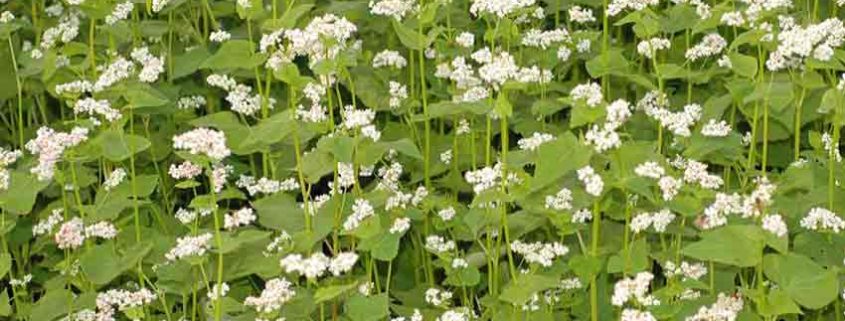
Our cover crop mix has generated lots of questions on how to use it. This means we need to share more information with you. It is fantastic seeing so much interest about improving your soil and your garden!
I’ve taken the most frequent questions and condensed them into a Q&A format below.
“I want to order cover crop seed. I don’t know how much I need, how to prepare the garden before sowing the seeds and when to plant it.”
The Garden Cover Up mix page lists the coverage rates for each variety.
1 lb will seed 200 square feet, or a 10×20 garden bed or 2 5×10 beds. 8 oz will seed 100 square feet, or a 10×10 garden bed. This gives you a thick planting, boosting soil fertility and decreasing weed pressures.
Ideal planting times are early August through mid-September, depending on your growing season. Plant around mature garden vegetables or in spaces left from the removal of older plants.
Preparation is easy. Broadcast the seeds and rake them into the top half inch of moist soil, or cover with 1/2 inch of mulch or compost. Water equal to 1 inch of rainfall per week until seedlings become established.
The best time to plant is 6 – 8 weeks before your first frost date. If you don’t know your expected first frost date, use the First and Last Frost Dates tool from the National Garden Association.
Enter your ZIP code and find the weather station closest to you.
The first frost date is the intersection of the vertical 50% column and horizontal Fall 32°F line.
Count back 6 to 8 weeks to determine when you should sow the cover crop seed. By planting a few weeks early you’ll have bigger growth, but may need to clip the spent flowers to prevent re-seeding.
“Can/should cover crops be used in raised beds? Approx 3-4′ X 6-8′. Do they need to be turned in the spring? Do they go to seed and become intrusive?”
Cover crops are good for any sized garden larger than a container garden where it is easier to change the soil out. Your raised beds would benefit from our cover crop mix.
If you get a good freeze, the mix will “winterkill”, meaning they will die after a hard frost of around 24°F or so. Then the plant matter will fall down to become mulch for the soil, while the roots decompose. You can turn them under, but I don’t recommend it as tilling or turning disturbs the soil structure. You can plant right among the mulch in the spring.
The cover crops will set seed and scatter those seeds if you let them. Plant cover crops 6 – 8 weeks before the first frost so they get good growth and flower but usually don’t have the chance to set seed. If you see seed forming, just clip those seed heads off and throw them away.
This way the cover crop can’t be an unwanted guest next spring!
“I would like to start a cover crop on a small portion of my property and put in a garden next year. What do I have to do to prepare the soil to put in a cover crop. Also, when do I turn over the cover crop?”
You have a great thought in using the cover crops to help establish and improve the garden soil for next season.
This is the exact method used by organic farmers and growers to prepare fallow soil for a crop. Growers will plant cover crops in succession, or they allow the flowers to re-seed themselves.
Rake to loosen the top inch or so, broadcast the cover crop seed and rake again until just covered. Water the area equal to 1 inch of water per week until the seeds sprout and the plants establish themselves.
Let the plants flower and start setting seed, then clip the heads to prevent them from re-seeding. Allow the plant matter to die in the frost, creating its own mulch. The roots and topsoil mulch decompose over the winter, giving you with an excellent start to next gardening season!
“I am slowly working toward taking my area back from prairie dogs and building a garden plot on 4 acres that are usually dry and sandy. Do you have a general ground cover seed mix to assist in soil health and holding my sand back from flowing away during the monsoon season?
I keep chickens with portable netting so something edible for them would be good.”
Our Garden Cover Up Mix provides plenty of nutritious forage for your chickens. Plant a test plot close to where they are. Water the area equal to 1 inch of water per week until the seeds sprout and the plants establish themselves. Then you can trim some as fodder for the chickens as it grows and develops.
Our Backyard Chickens collection is another option. It has a variety of tasty edibles like sunflower, corn, Swiss chard, mustard and kale.
For erosion control, I would plant a straight (50/50) mix of buckwheat and cereal oats. Both are fast growing with good root systems that hold the soil in place. They provide good mulch after the plant dies off. You might test plant a strip about 3 – 5 feet deep crosswise to how the water flows during monsoon season. This acts as a catch strip, slowing the water down and reducing the amount of soil moved. It also creates a berm for future moisture retention. The roots create a “sink” for the water flow which diverts the water into the soil and away from flowing across it. This starts to build up the shallow soil and water reserves on your property.
I would not mow or kill this planting but allow it to re-seed and establish itself well. If the test works, you can replicate this downstream of where the water flows as many times as needed.
Once the initial berm starts to form, plant the Garden Cover Up mix up stream. This takes advantage of the extra moisture to reclaim and build some good soil!
This will only take 2 or 3 seasons to establish some excellent berms fully and then you can plant more.
“I have celiac disease and therefore cannot be around wheat, and am also sensitive to oats. Do you have any other recommendations?”
Buckwheat is not related to wheat at all, as it is in the Rhubarb family – if you can believe that! You should not have any reaction to buckwheat. You can avoid the oats by ordering the individual cover crop varieties. The Crimson clover and hairy vetch are strong nitrogen fixers, where the Buckwheat and Rye are fast growing ground covers.
You can make your own mix by ordering the smaller amounts of the individual cover crops, avoiding what you are sensitive to.
“After the cover crop dies or you kill it – should you till it into the ground?”
The cover crop mix will die after a couple of hard frosts. It becomes a mulch insulating and protecting the soil over the winter. During that time the roots decompose and increase the soil fertility. Depending on your climate over the winter the mulch should almost dissappear by next spring’s planting time.
I don’t recommend tilling a cover crop, it disturbs the soil you spent the winter improving. When planting, open a small space in the mulch. Then it continues covering and protecting the soil while smothering weeds.
If you do feel the need to till, raise the tines to only till the top 2 – 3 inches of soil and don’t disturb deeper layers. This will work the decomposed vegetative matter into the soil where it will be used quickly.
The process is to plant a fall cover crop, let it die and overwinter to improve the soil. Next spring, plant another after the garden crops are in and up. This covers the soil and shades out most weeds. Repeat this cycle yearly and the soil becomes incredibly fertile after a year or so.
In fertile soil weeds aren’t as much of a problem because they just don’t germinate as well. Fewer weeds leads to fewer insects, as many insects “partner” with specific weeds for habitat or to lay eggs on. Increased soil fertility means healthier plants which do not attract predatory insects.
“I planted clover one fall as a cover crop, and found that in spring it had formed such a dense mat of roots I had to use a pickax, and it never DID die back in winter! (Living in a warmer winter climate.)
I have clay in my soil and have been amending it for several years now. Wouldn’t tilling the soil deeply (about 12 inches) be beneficial for breaking it up and making it more accessible to my garden plants’ root systems? It’s really solid and unfriendly down there in the root zone!”
Thanks for your question! That’s why you need to kill the cover crops manually if the weather doesn’t freeze cold enough to kill them. Mowing or weed-whacking is the easiest way to do this. Otherwise, the plants don’t die, the roots don’t decompose and you struggle to plant your garden.
If you kill the cover crops from late October to mid-November, they will benefit the soil!
There are a couple of ways to open up the soil, especially with a clay component.
1 – You can deep till the soil. Realize you are destroying many micro-organisms as you are completely changing where they live. This is ok once or maybe twice when first establishing the garden, but is detrimental to the soil health if done often.
2 – Use a broadfork or other mechanical means to open up the soil without disturbing the layers. This is often done by hand, so will only work in a smaller garden. Because you won’t be able to drill down deep in a hard soil, this might need to be done a few times over a couple of seasons.
3 – Plant cover crops or aggressive root crops such as sunflower, wheat, sesame or Daikon radishes which drill down and open up the soil. This isn’t a one time, fix-all solution, but with replanting in spring and fall the cover crops can continue building and improving the soil.

Beat the heat with your own second chance garden. Let’s look at why Fall gardening can be so much better!

Do you have extra space opening up in your garden right now? As you harvest crops think about replanting something in its place that does well in cooler weather. Now is the time to think about these planting techniques, to get the most from your garden!
Always have seeds or transplants ready to plant when you harvest. Filling the space of a harvested plant means less weeding and less moisture loss. A little planning goes a long way, pay attention to days to maturity for a cool season variety and you can stagger your plantings to get a bigger, longer harvest.

Plant a few spinach seeds every week from August to October, and you will have a continuous supply as the weather cools off into late fall. The same goes for many cool season crops like lettuce, carrots, beets and cabbage.

Do you know about growing onions over the winter? Fall planted onions yield a very sweet onion come next spring. Plant the seed in mid to late summer, then mulch heavily with straw just before the first frost. In the spring, the onions will continue growing and give you an early harvest of delicious onions.
Does your climate allow for some types of vegetables to easily grow through the winter, even if it needs some temperature protection? Is your climate conducive to year round tomatoes, with a little planning and frost protection?
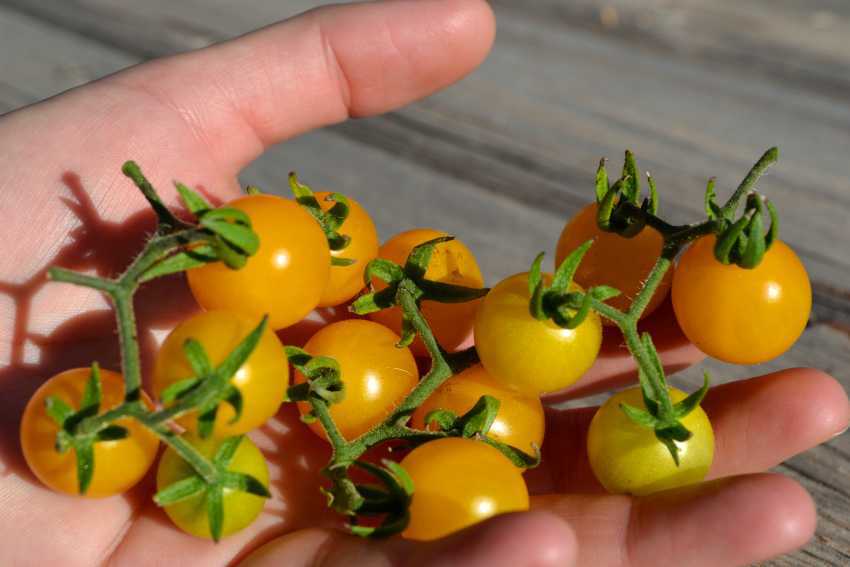
Save space for garlic, which is planted in the Fall and harvested early the next summer. Think about where you would want spring flowers to appear next season, attracting pollinators that help your garden. Many flower seeds enjoy being planted in the Fall and magically appear in the Spring.
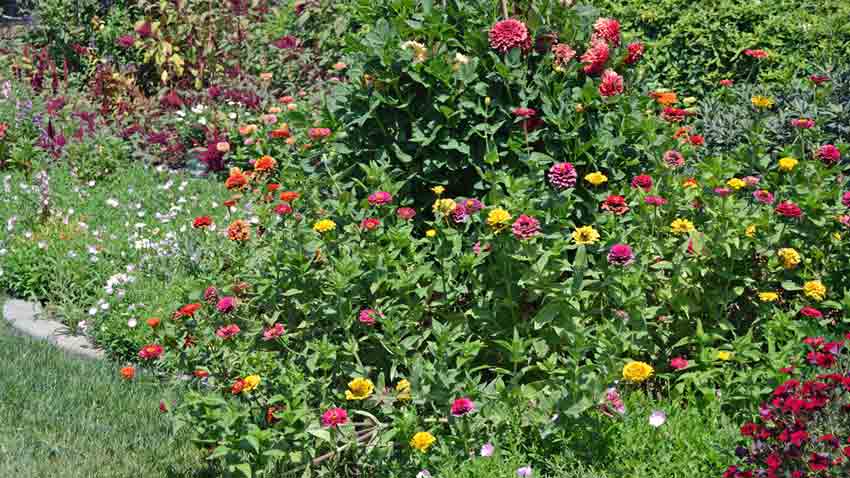
Turnips, radishes, carrots and beets can all be planted in late summer and early Fall. They grow quickly in the warmer weather, then turn really sweet as the nights cool off.

Plant some Fall lettuce, it will thrive in cooler temperatures. Mustards, kale, chard and spinach also thrive in the Fall. Try a second planting of sweet peas, as they will love the cooler weather. We love the versatility of Spinach Beet-Greens as they grow through our 100°F+ summer days and continue until hard frost stops them. They are one of the first greens to re-start early next season!
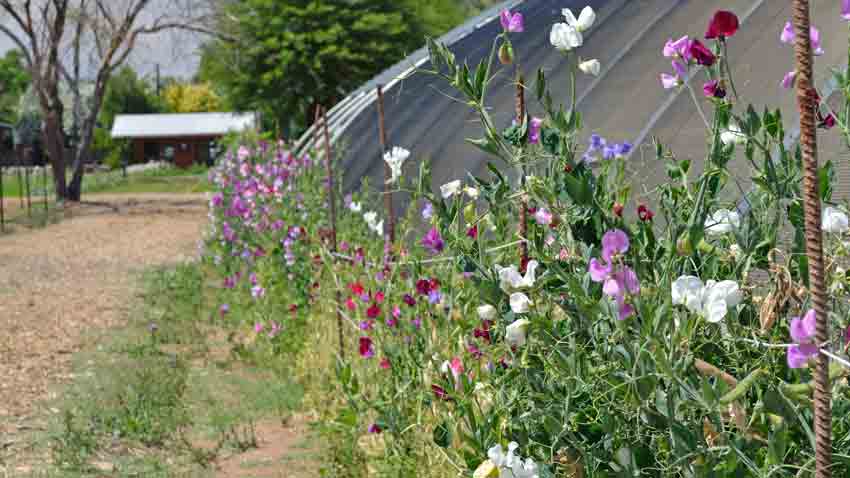
Parsley and chives are great year-round and planted in early Fall, they can last into early winter. Depending on your climate they might die back with the first strong freezes, but can be the first to reappear in the spring. Think about planting herbs in pots now and you can bring them inside during the winter and enjoy their flavors year-round!
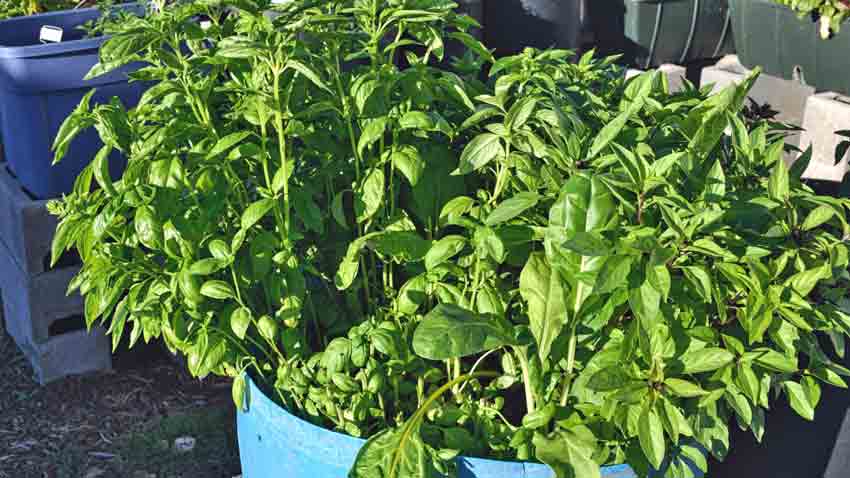
Enjoys these tips, the days may start to shorten as summer progresses but the cooler weather allows for so much more garden activity!

Biting insects are often the bane of our gardening lives – just when the weather is the best to be outside enjoying the garden those annoying biting insects join the party. Due to our long co-existence with insects, many approaches exist to make time in the garden or outside more enjoyable.
Most modern solutions don’t recognize the difference between beneficial and pest – such as bug zappers and sprays or lotions – and their effectiveness over a wider area (such as a garden) decreases drastically.
A more visually and aromatically pleasing approach is planting herbs or flowers which naturally deter biting insects, or cultivating plants which attract beneficial insects to prey on the unwanted or destructive pests. This provides multiple benefits; less costly with unwanted insects repelled better, longer lasting effects while attracting beneficial insects and humans in both color and aromas.
The natural essential oils in these plants are the key to repelling those unwanted biting insects, but they are not a silver bullet. Simply planting these herbs can’t guarantee a bug-free garden or patio.
Insects bite people due to a number of factors; the unique chemistry of an individual, how the environment encourages or deters pest insects, beneficial insect population and the flowers they depend on, to landscape maintenance such as how often grass is mowed or weeds removed that can harbor sizable populations of pesky, biting insects.
It may take a bit of experimenting and close observation to see what is truly going on, but once you start to discover the specific factors that reduce and deter the unwanted insects, you will soon be enjoying lots more time outside!
Let’s look at some plants proven to be strong and effective deterrents to biting insect, while are also attractive to people and useful as medicinal or culinary ingredients.
Overall, the easiest way to use these plants is in planters, containers or in beds along the garden gate, entryway or border of the garden, or around the front and back doors of your home or anywhere you want to have fewer biting insects. Some of these plants will naturally repel mosquitoes, flies and such, but brushing with a hand or crushing a few leaves releases their powerful aromatic compounds and scents.
All of these plants can be used just as they are in the garden, but if you want to increase their insect repellent properties they can be made into extracts, dilutions or tinctures and combined to make very strong and effective sprays.
You need to do your research on this, as concentrating them can make them more effective but sometimes dangerous or toxic.
Please don’t blindly or ignorantly experiment! If you are in doubt, simply use them as they are – crushing or bruising the leaves releases their aromatic oils at a safe level and gives you protection.
Here are eight easy to grow herbs for you to plant, some of which you may already have in your garden! Some are annuals which will re-seed themselves if left alone, while others are perennials that will live and fill out their areas over several years.
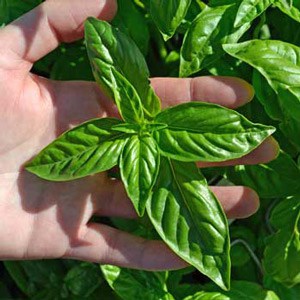
Basil (Ocimum basilicum) – This much-loved center point of many cook’s gardens has a secret: the aroma which attracts us repels biting insects, making basil effective against mosquitoes, chiggers, gnats, fleas, ticks and houseflies. Plant-based insect repellent sprays are made by crushing fresh leaves, releasing their natural aromatic oils.
Lemon basil leaves can be picked, lightly crushed or bruised in the hand and rubbed on exposed skin as a repellent while smelling lemony and fresh. The Journal of Entomology has shown Sweet basil oil is an effective alternative to synthetic pythrethrums as a mosquito repellent.

Calendula (Calendula officinalis) – More commonly known as Pot Marigold, this hardy annual is multi-talented with healing and nutritional qualities, in addition to repelling biting insects.
Most insects avoid it, confirming its historic uses as a base ingredient for insect repellents. Interplanting among cabbage reduces aphid, cabbageworms and diamondback moth problems in Poland. On a different note, the tachinid fly uses calendula as a host plant and attacks pest insects such as cabbage loopers, Japanese beetles, cutworms, codling moths and squash bugs, among others.
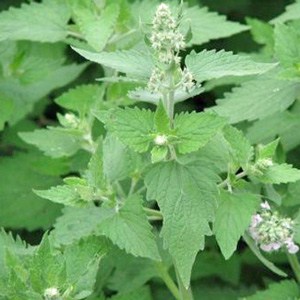
Catnip (Nepeta cataria) – Famous for attracting cats with its pungent earthy-minty aroma, its most powerful and active volatile aromatic compound is nepetalactone which repels mice, rats, mosquitoes, cockroaches and numerous other household insects. An Iowa State University study from 2001 showed nepetalactone to be 10 times more effective than DEET – the common synthetic biting insect repellent – and was effective in concentrations as low as 1%.

Chrysanthemum or Feverfew (Tanacetum parthenium) – An ancient medicinal plant long used for the treatment of fevers, migraine headaches, toothaches and insect bites. Recent studies have discovered there are more than 30 naturally occurring plant based chemical compounds called sesquiterpene lactones. In addition to being medically effective, they are also very potent insect repellents, as most garden and house pest insects will not go near its fragrance.
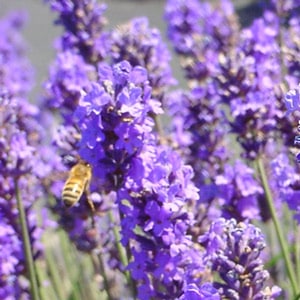 Lavender (Lavandula angustifolia) – Another highly enjoyable aromatic for people, but detested and avoided by biting insects. Moths, fleas, many flies and mosquitos are repelled, even while it’s been added to homes, sachets and clothes closets for its soothing scent. Growing a bunch or two close to the door and brushing or lightly rubbing it helps keep insects out of the house. Rub the freshly crushed leaves on exposed skin.
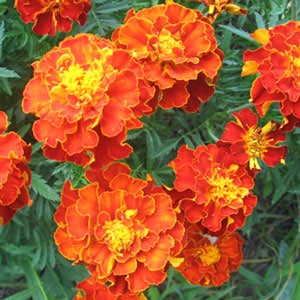
Marigold (Tagetes patula) – The common, pretty and colorful marigold repels blowflies and safari ants in Africa and India, and also effectively deters aphids while being a beneficial companion plant for many garden vegetables.
There are three active aromatic compounds which studies have shown to be as effective against mosquitoes as DEET.
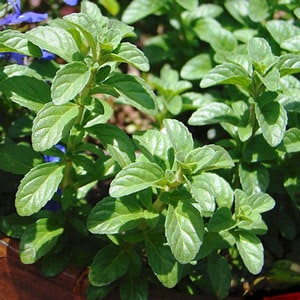 Pennyroyal (Mentha pulegium) – This is the most pungent and powerful of the mint family and is known as Mosquito Plant and Tickweed. Crushed leaves have a very strong fragrance similar to spearmint. Throughout history it’s been grown and valued as a multiple use herb for culinary, medicinal, flavoring and insect repellent for millennia because its pungent odor is attractive to us, but strongly avoided by insects. Both Greeks and Romans used it in cooking and healing.
 Rosemary (Rosmarinus officinalis) – Another herb whose scent is much appreciated by people but avoided by pest insects, especially mosquitos. Brushing or stroking the stems releases the volatile, aromatic oils and chases insects away. Rub the oils on exposed skin or clothing after brushing the stems to extend the repellent properties.
Try a few of these powerful allies in your insect repellent search, now you know more about them. Test plant a small grouping near a high-traffic area in a container that can be moved, then observe what insects are around.
With some testing, you should soon see positive results. You might find certain plants work best for different members of your family, so containers or planters in areas where they like to hang out can work wonders.
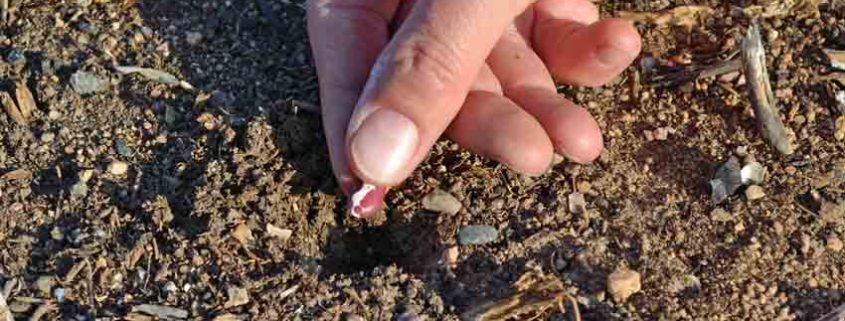
Direct sowing can be done almost any time of the year – in early to late spring for the summer garden, mid to late fall for the cool season garden, as well as succession planting a row after a crop has been harvested to grow something else delicious!
Direct sowing simply means planting the seeds directly into the garden soil, instead of starting them inside, nurturing and then transplanting into the garden once they are several weeks old and several inches tall.
If you are in doubt as to when your last frost date is, read Planning and Planting Your Spring Garden.
For more on cool season gardening, read How to Plan for Fall and Winter Gardening.
To discover how succession planting can help you grow more, read Succession Planting – Boosting Garden Production.
Some gardeners think they have no “luck” when it comes to direct sowing certain vegetables, while others are hesitant to try again after past challenges or outright failures. Inexperienced gardeners sometimes think their lack of experience dooms them to failure.
The root causes of most challenges, problems or outright failures can be traced to a shortage of good information, incomplete understanding of seed germination and a lack of patience.
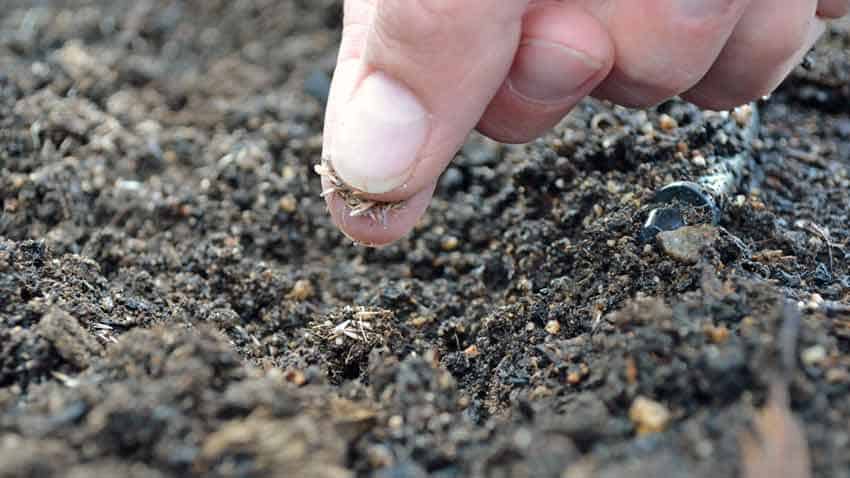
Direct Sowing Lemongrass Seed
All of these can be overcome, and we’ll show you how!
At its most basic, direct sowing is simply inserting a seed into the garden soil so it can grow. There are factors which affect how successful the results are, but they are easily understood so you can set yourself up for success by using them.
There are three main parts to direct sowing – preparation, sowing and care.
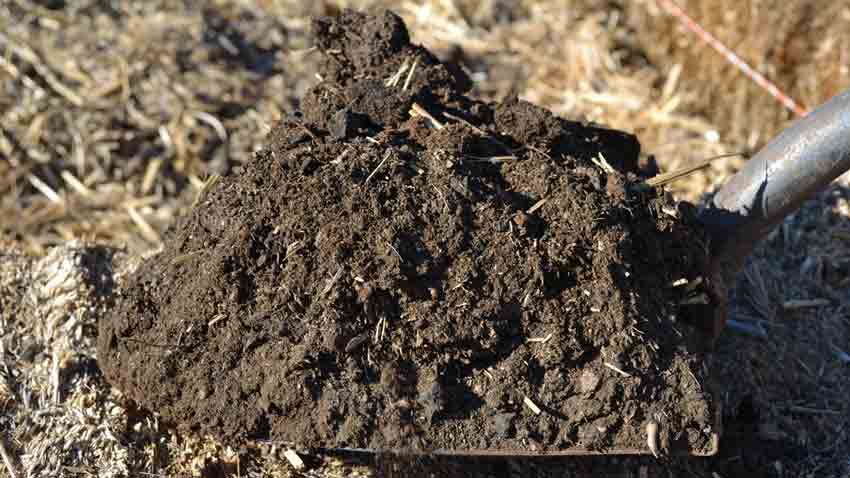
Well Aged Compost
Soil or bed preparation sets the stage for the seed and is usually done a couple of weeks to a month before direct sowing. This includes amending the soil with well-aged compost, minerals, fish emulsion, milk and molasses or anything else the soil needs.
“Amending” means to add the nutrients to the soil, then work them in with a garden fork or roto-tiller. If using a roto-tiller, make sure it is set to a shallow depth to avoid disrupting too many of the soil layers and the micro-organisms that live in those layers.
A comprehensive soil analysis can be extremely valuable here, as you’ll know exactly what the soil needs to be at its best. A simpler approach is to add the commonly used nutrients mentioned above and closely observe the plants to see if they are showing a lack of specific nutrients.
After amending the soil, wait a few days for the first weeds to sprout, then remove them with a small hoe just below the surface of the soil. Weeds thrive in disturbed soil, so you won’t wait long!
When the weeds have just sprouted, they will have released a very potent plant hormonal signal – called auxins – into the soil, signaling all of the other weed seeds to remain dormant. The soil has a tremendous amount of weed seeds in it, just waiting for the right conditions to sprout, and the first weeds up send this signal to keep other weed species from competing with them. This hormone lasts from 4 – 6 weeks, giving you a head-start with little competition for the seeds you want to grow!
Weeds have the most serious effect on garden production during the first week to ten days after sprouting – this is why it is so important to spend more energy and time up front in weeding than it is later in the season.
After your seedlings have sprouted, they add their own particular auxins to the soil, inhibiting other seeds from germinating for another couple of weeks. After the garden crop is a foot tall, weeds have much less affect on their growth and can’t as easily out-compete for water and soil nutrition.
Yet another way is to use a flame weeder to kill the young weeds, while damaging the uppermost, soon to germinate weed seeds in wait. No hoe is used and this method is quite fast.
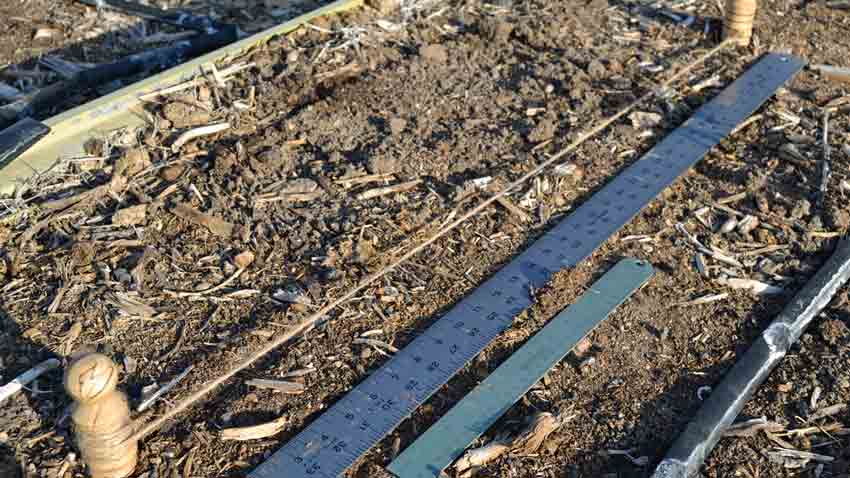
Row Marking Tools for Direct Sowing
Some gardeners prefer to create furrows to sow their seeds in, while others use a garden row marker – two pegs with string attached – to lay out where they will direct sow their seeds.
There are several different approaches, and there is no one “right” way. If you are growing a smaller garden a row marker makes it easier to plant seeds closer together than creating rows. It’s also easier to do succession planting closer together with a row marker, as you plant the seeds along the line of the string without trying to open and then close a furrow and not disturb neighboring seeds or young plants.
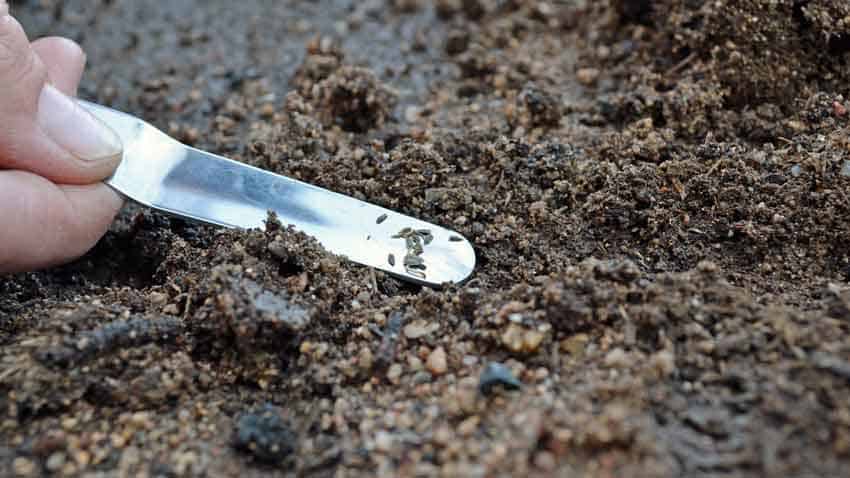
Direct Sowing Basil Seed with a Widger
Before direct sowing your seeds, consider how the vegetable will grow and be used. If you will be harvesting the entire crop for young greens, then plant fairly close together, as you want the most production possible. If the plant will be harvested regularly and allowed to mature, like leaf lettuce, spinach, kale or leafy broccoli, then give a little more space for the plant to mature without crowding.
Water the soil the day before planting to make sure it is properly moist to start the germination process.
Read the spacing recommendations on the back of the seed packets as a good starting point. If in doubt, plant two seeds at a time to ensure the best growth, as you can always thin once the seedlings are up. When thinning, never pull the seedlings out as this seriously disturbs the roots of the neighboring seedling – just snip off the unwanted seedling with a pair of small scissors.
One of the more important things in planting any seeds is to be aware of the proper depth to sow them. An excellent rule of thumb is no more then 2 – 3 times their diameter.
Seed orientation is also an overlooked, but equally important thing to be aware of when sowing. The radicle – or part of the seed that was attached to and fed by the plant or fruit – should be planted pointing down, as this is where the root will emerge from. Corn, pumpkin and squash are easy to see – just plant the pointed end down. Smaller or more rounded seeds don’t matter as much, as there is equal distance all around.
After sowing, gently press the seeds into the soil for small seeds, or press the soil on top for larger seeds. This allows for better moisture transfer to the seeds as they start the germination process.

Direct Sowing Okra Seed
After sowing, give the seeds a good drink. Make sure the soil is well moistened on the first watering, then wait about 24 – 48 hours to water again, depending on your climate. The most common mistake all gardeners of any experience do is to over-water the garden.
It’s simply a human trait to want to make sure the garden is watered!
Seeds need three things to germinate – moisture, temperature and light once they are up.
The soil moisture needs to be very damp initially, then slowly decreased after the seeds sprout until it is slightly moist. You won’t have much control over the temperature unless you can provide some weather protection such as a plastic row cover or black plastic on the soil a week before planting to warm it up. Light is needed once the seedlings are up, but the sun will take care of that!
After sowing care is pretty simple, but needs to be well-attended during the first month after the seeds start sprouting. Care can be split into three areas – weeding, re-sowing and weather protection.

Handmade Garden Row Marker
Keeping your emerging seedlings free from weeds when they are young will give them a serious boost, as young weeds can effortlessly out-compete your vegetables for needed nutrients and water. This severely limits their future growth, strength and production.
Removing young weeds is very easy, especially if using a sharp, thin hoe to slice them just under the surface of the soil. If you’ve allowed the initial crop to sprout and then removed them, you should have less weed pressure to worry about, but still keep on top of them!
Make sure to distinguish between the weeds and what you planted. If in doubt, wait a few days to see the shape of the leaves and how it matches (or doesn’t) the seedlings where you planted.
Due to the variabilities of weather outside, some of the seeds may not germinate, or do so very slowly. This may require some re-sowing in the thin spots to make up, but is easy and usually only needs doing once.
Keep a sharp eye on your young seedling crop, as they are absolutely tasty for wild critters – birds, mice and squirrels all love to munch on young, tender seedlings. If you see chewed or “disappeared” seedlings, look very closely to see if you can determine what ate them and take appropriate action – excluding them with netting or row cover or groundcloth, then re-sow.
You don’t have as much control the temperature and humidity of the garden, but you can moderate some of the temperature swings – all season long.
For cooler weather such as spring or later fall, row cover is a lightweight plastic sheeting which is easily spread over the seed bed, capturing some of the warmth from the sun and soil and raising the temperature for the seeds just a bit. As the seedlings grow, a small hoop house can be made from bent wire or 1/2 inch pvc pipe inserted into pvc elbows, creating a square hoop to support the row cover plastic.
Cooling in warmer weather can be done with shade cloth and the frames mentioned just above. Leave the ends open with shade cloth to allow for air circulation and so pollinators can get in.
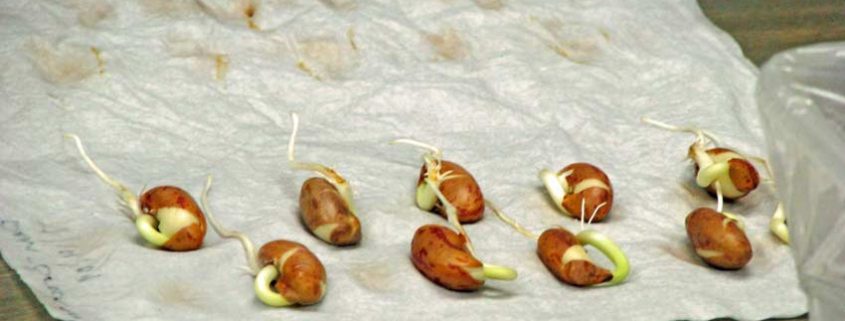
Do you have some old packets of seed around, with doubts about the viability; or have you saved seed for a few years and wonder if they will still sprout?
Do you know if those seeds will grow?
Have you ever wished for a way to make sure?
We will show you how to know for certain whether that older packet of seed is still good, or how long you can keep those tomato seeds around before needing to pitch them.
There is a way, it is easy and simple to do. It’s called a seed germination test and you probably have all of the supplies needed in your kitchen.
Germination Testing Supplies
You will need these 3 things, plus the seeds you want to test for germination –

Wetting the Paper Towel
The first – and most important – step is to thoroughly wet the paper towel. This is the first and easiest step, but most mistakes are made right here, leading to poor germination. Smaller seeds don’t need as much water for germination, but larger seeds do. The extra moisture will create a humid environment in the plastic bag, helping the germination process.
The dry towel is on the left, with the properly wetted towel on the right side. You should be able to see through the towel to the surface underneath – then it’s wet enough. If it’s drippy when you pick it up, it’s wet enough. If you wet the towel like on the middle left side – damp but not wet – there’s not enough moisture for the seed to absorb and begin the germination process.
If you want to learn more about what happens during a seed’s germination, read Starting Seeds at Home – a Deeper Look!
Folding Paper Towel
Next, after the paper towel is thoroughly wet, fold it in half. You can see just how wet the towel is by the amount of water left on the board after folding it over.
Unfolded Paper Towel
Open the towel back up, leaving a fold to mark the center of the towel.
Seeds on Paper Towel
Third, place the seeds along the fold, leaving room for them to sprout so they don’t become tangled up.
If you are doing a germination test use enough seeds to make the math easier, such as 10, 20 or 25 seeds. When we are doing a germination test, we follow established testing guidelines, but as a home gardener a smaller amount will verify if your seeds are viable and can sprout.
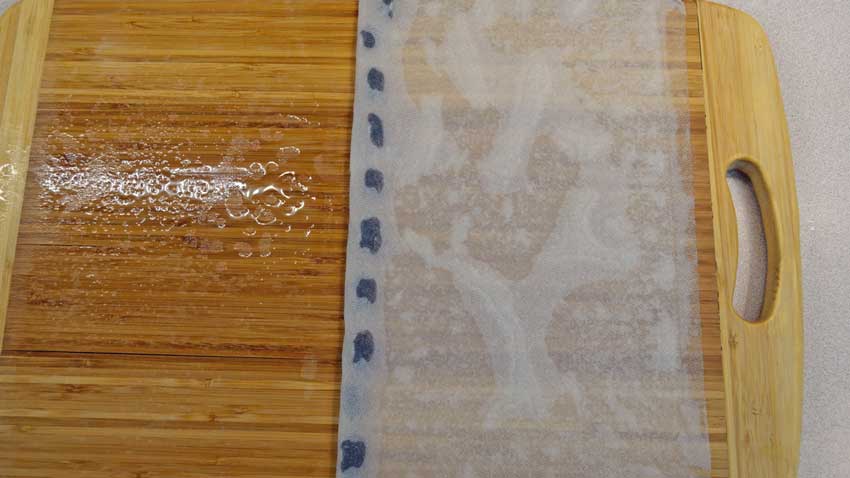
Folded Paper Towel
Re-fold the paper towel, enclosing the seeds.
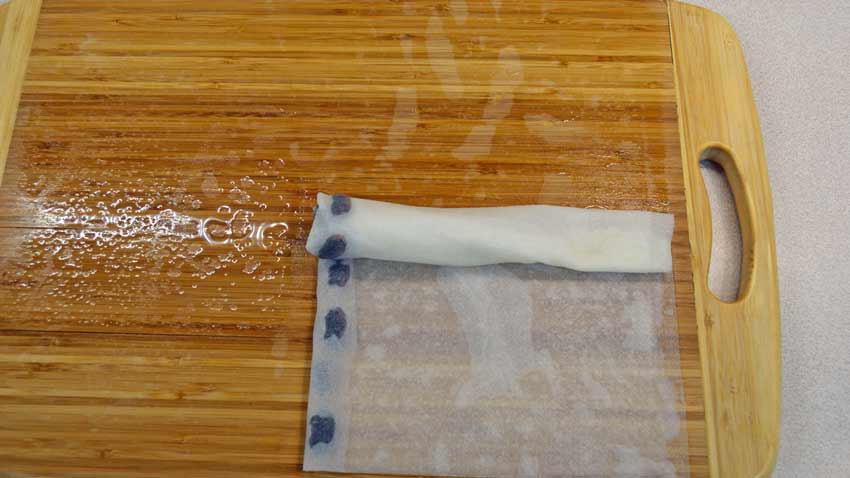
Rolling Paper Towel
Roll the paper towel up….
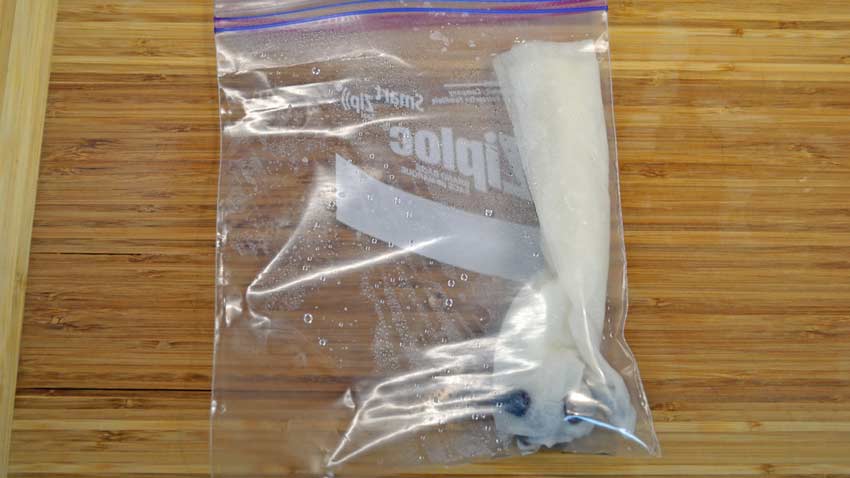
Paper Towel in Ziploc
…and place it inside the Ziploc bag. There should be a good amount of moisture in the bag to start the germination process, so if you don’t see moisture droplets inside after a few minutes, open the bag and give it a squirt of water.
Finally, place the bag in a consistently warm place – like the top of the refrigerator or in a warm window. Most vegetable seeds do not need light to germinate, so a darker place is fine to begin with.
Check every couple of days for moisture levels and the start of germination. If the moisture levels drop significantly – this is a good sign the seeds are absorbing the water and beginning to sprout. Add a spritz or squirt of water as needed, usually only once or twice a week.
Once the majority of seeds have sprouted, open the paper towel up, count them and do the math to get a percentage. For instance, if you started with 10 seeds and 7 sprouted, you have roughly a 70% germination rate. If 20 out of 25 seeds sprouted, there is about an 80% germination rate.
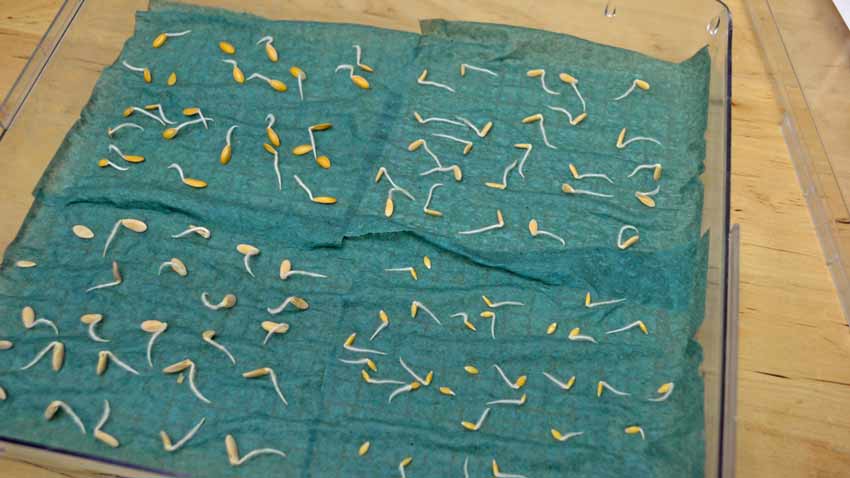
Germination Testing Results
This is what one of the germination tests we do looks like – pretty good! These seeds are viable with a better than 90% germination rate.
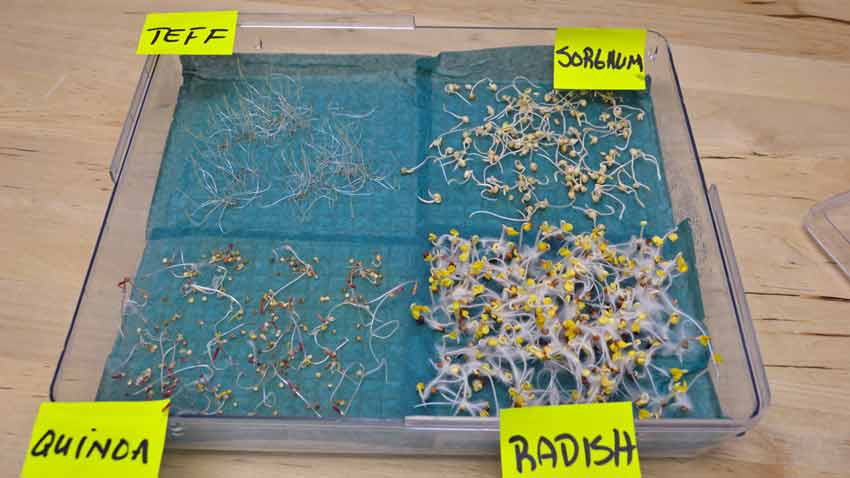
Multiple Seed Germination Testing Results
For smaller seeds, we will often divide the germination chamber into half or quarters to make the process more efficient. Some seedlings will mold faster than others, this is why you monitor the progress closely if you are pre-sprouting for transplanting.
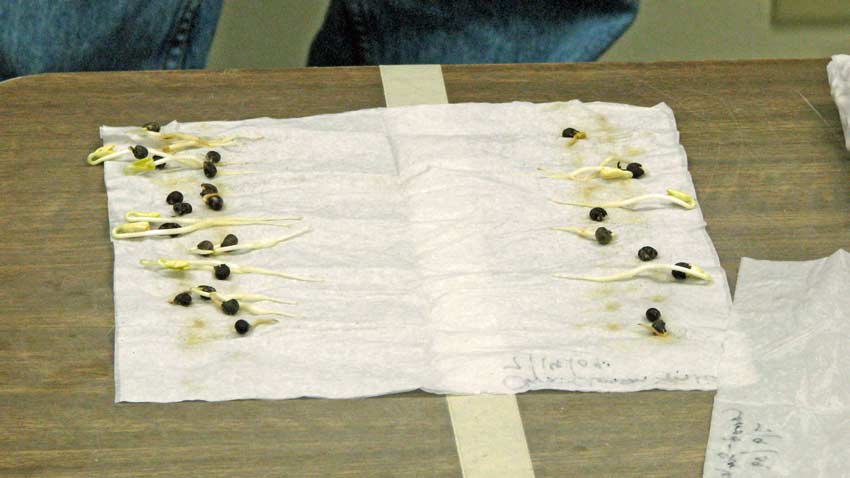
Seed Germination Testing at Seed Savers Exchange
The “Paper Towel Method” is almost universally used. Here are the results from a germination test at Seed Saver’s Exchange. Note the labeling of variety of seed and date the test was started. If you are keeping track of your germination percentages, like we do, it is important to keep clear notes and details!

Germination Results at Seed Savers Exchange
Please Note: Depending on the type of seed you are testing, you may see very different results and they may take more time than the average vegetable seed.
For instance, herbs and flowers usually take much longer – sometimes weeks – to germinate, and can have lower germination rates. This is normal and not something to be concerned with.
Learn more – Seed to Seed Book is our go-to reference for all things seed related, including germination times, needs and regional recommendations.

Do you know about the magic of milk and molasses in improving your garden? Yes, plain old milk of any kind – whole, 2%, raw, dried, skim, or nonfat – is a miracle in the garden for plants, soil, and compost. Molasses only boosts the benefits! Let’s see how and why they work.
Using milk on your compost and in your garden will probably come as a surprise to most.
Upon closer inspection, however, it starts to make sense. The amino acids, proteins, enzymes, and natural sugars that make milk a food for humans and animals are the same ingredients in nurturing healthy communities of microbes, fungi, and beneficial bacteria in your compost and garden soil.
Raw milk is the best, as it hasn’t been exposed to heat that alters the components in milk that provide the perfect food for the soil and plants, but any milk will provide nutrition and benefits. Using milk on crops and soils is another ancient technique that has been lost to large-scale modern industrial agriculture.
Milk is a research-proven fungicide and soft-bodied insecticide – insects have no pancreas to digest the milk sugars. Dr. Wagner Bettiol, a Brazilian research scientist, found that milk was effective in the treatment of powdery mildew on zucchini. His research was subsequently replicated by New Zealand melon growers who tested it against the leading commercially available chemical fungicide and found that milk out-performed everything else. Surprisingly, they also found that the milk worked as a foliar fertilizer, producing larger and tastier melons than the control group.
David Wetzel, a Nebraska farmer, completed a 10 year study on applying milk at different ratios to his pastures, and recorded the results with the help of a team made up of the local Agricultural Extension agent Terry Gompert , a university soil specialist, a weed specialist and an insect researcher.
What they found was amazing- the grass production was drastically increased; the soil porosity or ability to absorb air and water doubled; microbe activity and populations increased; cows were healthier and produced more milk on treated pastures; the brix or sugar level in the pasture tripled, indicating more nutrients were stored in the grass than before. Grasshoppers abandoned the treated pastures- the sugars are poison to destructive soft-bodied insects as they do not have a pancreas to process the sugars.
This also explains why damaging insects leave healthy, high-brix-level plants alone, as they contain more sugars than stressed and sickly ones. Read Milk Works As Fertilizer for the full article.
For the home gardener, the ratio can range from 100% milk to a mixture of 20% milk to 80% water, with no loss of benefits.
Use as a spray on the compost and garden soil before planting and as needed when insects appear. Spray directly on the insects and around the areas they inhabit. When combined with molasses, it becomes a highly beneficial soil drench.
A proven solution is 20% milk – 1 cup of milk to 4 cups of water, or 2 cups of milk to 8 cups of water for larger gardens. Whatever amount you need, the 20% ratio has been proven to give the most effective results with the least amount of milk.
David Wetzel’s experiments found that 3 gallons of milk per acre benefits pasture grasses most, so the costs are minuscule compared to the benefits!
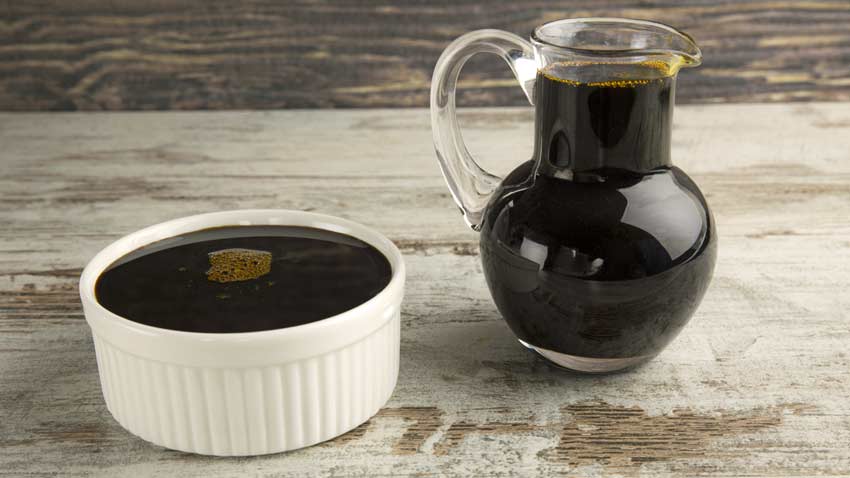
Molasses is a viscous by-product of the processing of sugar cane or sugar beets into sugar.
Sulfured molasses is made from young sugar cane. Sulfur dioxide, which acts as a preservative, is added during the sugar extraction process. Unsulfured molasses is made from mature sugar cane, which does not require such treatment.
There are three grades of molasses: mild or Barbados, also known as first molasses; dark or second molasses; and blackstrap. The third boiling of the sugar syrup makes blackstrap molasses. The majority of sucrose from the original juice has been crystallized and removed. The calorie content of blackstrap molasses is still mostly from the small remaining sugar content. However, unlike refined sugars, they contain trace amounts of vitamins and significant amounts of several minerals.
Blackstrap molasses is a source of calcium, magnesium, potassium, and iron; one tablespoon provides up to 20% of the USDA daily value of each nutrient. Not only do these nutrients do a body good, they are highly valuable in building up the soil!
Molasses is a very valuable addition to the compost pile, as well as to the garden itself. Unsulfured blackstrap is the preferred variety due to the mineral content, but any of the unsulfured ones will do fine. The benefits beyond the minerals are the natural sugar content that will feed the microorganisms in the compost or soil of the garden.
Use 1/4 to 1/2 cup of molasses to a gallon of water and spray onto the compost pile or garden, or add to the drip system for the garden. For soils that are poor, stressed, or need help, use 1 cup; for those that need a little “snack, “use 1/4 cup. The readily available sugar content will skyrocket the microbial activity.
Apply once or twice a month, but be careful not to overdo it – don’t train the microbes to expect you to feed them, only give them a boost when they need it!
Blackstrap molasses is also commonly used in horticulture as a flower blooming and fruiting enhancer, particularly in organic hydroponics. Use the before mentioned mixture in the drip system, or sprayed alongside the roots of fruiting vegetables as they start to flower to increase their flowering and fruiting.
Add 3 Tablespoons of molasses to the milk spray solution mentioned above and use to feed plants during the height of growing season. Hungry, high production plants such as tomatoes, peppers, eggplant, melons, and such will really benefit from the consistent feedings, giving you more production that is more flavorful.
A fringe benefit of spraying the milk and molasses mixture on the garden is biologically friendly weed population control. Many broadleaf weeds thrive on diets high in available nitrates and potassium diets, common with commercial fertilizers. Phosphorus is “tied up” or bound with calcium in the soil and needs biological activity to release it. The calcium in milk helps to compensate for what is unavailable in the soil, while the increased biological activity from both the milk and molasses releases unavailable phosphorus and creates soil conditions that are unfavorable to the germination of weed seeds.
The costs of applying the milk and molasses mixture are minimal, but when compared to any other fertilizer and insecticide regimen – even those that are organic in nature – milk and molasses have no comparison.
For instance, one acre has 43,560 square feet, and a gallon is 128 oz.
Doing the math, we find that 3 gallons per acre is 0.003 of an ounce per square foot!
Assuming a gallon of organic milk costs $8.00, that works out to 0.00055 dollars per square foot or 0.055 cents per square foot! Yes, that is right – when rounded up, it is six-tenths of a penny per square foot of garden.
So if you had a large garden – say 1,000 square feet – one application of the milk would cost a whopping $0.55 (55 cents), plus the expense of 2 – 3 tablespoons of molasses. What other biologically friendly soil fertility improvements would cost this amount?
Here’s the proof of the math:
1 acre = 43,560 square feet (ft²)
1 gallon = 128 ounces
128 oz/43,560 ft² = 0.002938 oz/ft²
3 gallons x $8 = $24
$24/43,560 ft² = $0.00055/ft² multiply this by 100 for cents = 0.055 cents/ft²
Who knew that something as simple as milk and molasses had such powerfully positive, far-reaching effects? Especially without any of the negative effects of petrochemical fertilizers?
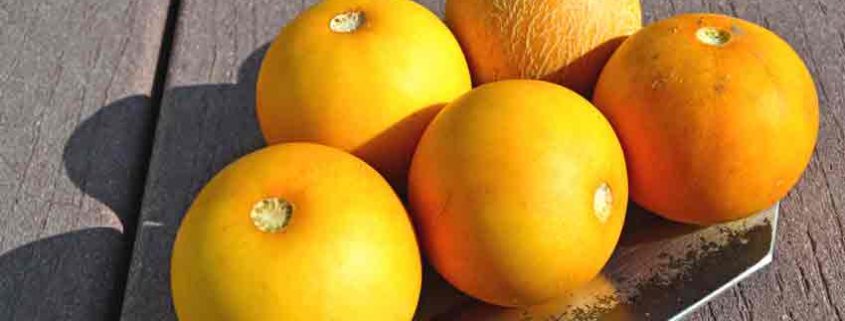
Vine Peach is a surprising melon of many names that is easy to grow, prolific and able to do several jobs in your garden. The small baseball size melons are highly aromatic with a mild flavor when grown in rich soil. The abundance of vines, leafy shade and fruit make an excellent trellis planting around the garden border providing shade and windbreak while acting as a decoy for thieving wildlife, who take the melons and often leave the rest of the garden alone. They are very hardy, drought tolerant and mostly insect resistant.
Their perfumed aroma will draw you in, sometimes from across the room or garden. Often mistaken for their kissing cousins – the inedible Queen Anne’s Pocket Melon – a couple of vine peaches in a bowl will perfume the room with their namesake scent – peaches and mangoes.
They are known by a wide variety of names, partially from their wide travels and partially from how they’ve been used over time. The most commonly used names today are vine peach and mango melon, but they’ve been known as Orange Melon, Vegetable Orange Melon, Melon Apple, Garden Lemon, Lemon Cucumber, Glass Melon, Melon Peach and Chito Melon – this last refers to the scientific name grouping – officially known as “Cucumis melo variety chito”.
As you might expect, these are planted and grown just like the cantaloupes and muskmelons everyone is familiar with. They need warm soil and good moisture to germinate with plenty of light once the seedlings are up.
These melons seem to have originated in China or ancient Egypt (or both) over 2,000 years ago from recorded evidence and travelled over the Silk Road through trade and migration to wind up in Turkey, where they have been identified through molecular variation testing. There is some mis-information floating around saying these were introduced to early settlers by Native Americans, which is not the case.
There is some discussion as to how they arrived in America, as William Woys Weaver shows Samuel Wilson, a seedsman in Mechanicsville (Bucks County), Pennsylvania, offered seed in the Farm Journal in February of 1889. Another source shows they were first describe in 1849 by Charles François Antoine Morren, a Belgian botanist and horticulturist, as well as the Director of the Jardin botanique de l’Université de Liège in the early to mid-1800s. He apparently obtained his trial seed from Cuba and brought them to Belgium for study. The vine peach became a well-known commercial variety in Europe soon after, where it might have come to America. Regardless of how vine peach arrived, in the early 20th century it was being commercially grown for pickled foods and preserves.
This brings us to the most common mistake made today with the vine peach. When complaints are made about them, the gardener is almost always growing in marginal soil and trying to eat them fresh. This is not their primary role – vine peach are much like a very mild honeydew, and then only if grown in nutrient rich soil. Throughout their long history, they have been recorded as being used as a cooking melon for pickles, relishes or preserves and jams – not eaten fresh as with most other melons. This is where they excel!
They have a naturally low sugar content, so there is no way possible they will be as sweet and juicy as a muskmelon or cantaloupe. Growing these for that reason only sets a gardener up for disappointment.
Our tasting experience was that of a mild honeydew – lots of sweetly scented aroma from the skin and flesh with a very mildly sweet flavor. We found them to be enjoyable – just a few bites to each half. Not nearly as bland or tasteless as some describe, but we also grew these in good fertile soil.
We were constantly surprised at the perfumed melon fragrance greeting us each time we walked into the house, even though the bowl of melons was in an adjoining room. For this reason alone, we feel the vine peach to be worth growing!
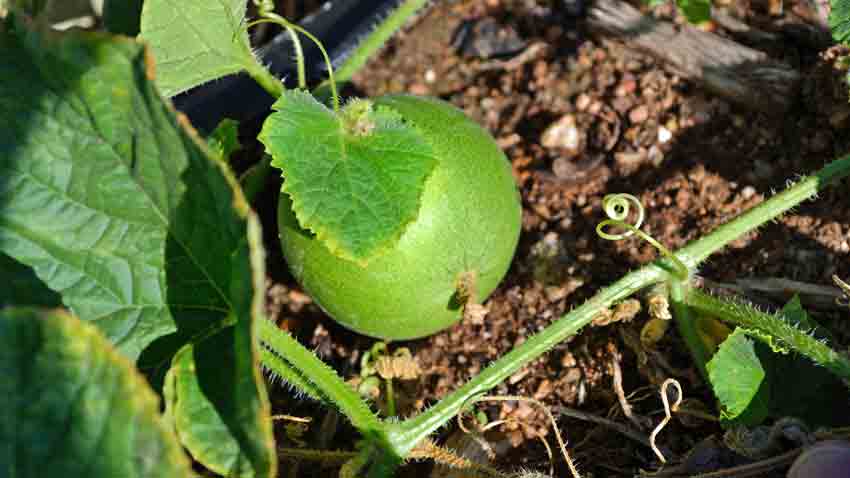
Maturing Vine Peach or Mango Melon
The young melons can be used just like cucumbers for pickling or relish. They won’t have as much scent yet, and make an excellent young cucumber substitute for bread and butter pickles or good old fashioned dill pickles. They must be peeled to remove the rind before pickling.
Gardeners who are experienced with growing and eating these tell us the real flavors only come through when cooking or preparing them and not fresh use. One gardener described them as “mediocre” when fresh, but as “superstars” when used with apples, peaches, pears or cantaloupe in jams. They describe the vine peach as enhancing the flavors, while adding a twist or boost to the overall flavor. There is a noticeable difference in jams made with and without the vine peach, as people will choose those made with them, even if they don’t know why the jams are different.

Vine Peach Blossoms
Once the plants are established they will start setting flowers. This is your sign to start researching and choosing jam and pickle recipes for the loads of baseball sized melons coming your way! It is common to have clusters of 5 to 7 flowers with almost as many melons ripening out. They will continually flower and ripen fruit until the frost stops them. One plant can easily produce more than a hundred melons over a season.

Vine Peach Flower Close-up
A close-up view shows the flower with the semi-soft spines of the vine, much like other melons. Small bees, flies and other pollinators love to visit the flowers and with so many flowers you’ll often hear a soft buzzing chorus as you walk up to the vines.
The leaf cover is extensive, and the vining tendrils are just seen at the top of the photo. This is what makes the vine peach such a good multi-purpose plant. It is rugged and hardy, easily tolerating 100°F+ with reasonable soil moisture. The plant will shade the soil, helping to preserve the moisture and keeping soil temperatures up to 15 or 20 degrees cooler.
When grown on a trellis, the melons are easier to spot and harvest. The heavy leaf canopy can provide shade and wind protection for more delicate plants or those needing less than full sun. The shape of the leaves moderates wind pressure by slowing the air movement through the leaves
Air movement through the leaves is slowed because the shape and texture of the leaves forces the air to move them from side to side, slowing the wind into a breeze and deflecting the harder gusts around the trellis as the leaves lock into place with higher wind pressures.
One of the more unusual jobs gardeners have given the vine is that of thieving wildlife decoy, or sacrificial food source. Because of their prolific production of fruit, wildlife will often steal the vine peach melons planted along the border of the garden and leave much of the rest of the garden alone. The melons are slightly sweet and crunchy, satisfying the wildlife while saving the rest of the garden’s production.
When cleaning out the garden at the end of last season, we found our Kunekune pigs had a very high preference for the over-ripe vine peach melons, going for them first while pushing and shoving each other out of the way to get more.

Ripe Vine Peach Melons
A double handful of ripe vine peach melons, ready to perfume the house or be made into pickles or preserves. The vine peach at the top of the photo shows some netting, leading credence to the theory that these have crossed with other types of melons during their travels, becoming what we know today.

Vine Peach Slice
When sliced open, the fairly large seed cavity with firm white flesh is seen. Because the vine peach was used almost exclusively in cooking and not eaten raw, the firmness and texture of the flesh was far more important than sweetness. One culinary use was to slice them in half, scoop out the seeds, peel and slice them into an apple pie, where the vine peach would absorb the flavors of the apple and spices while adding its unique flavors but not having a different texture than the apples.
They can also be sliced into rings for pickling after peeling and scooping out the seeds. A very excellent bread and butter pickle can be made, and if combined with young cucumbers will have an added flavor over using only one or the other.
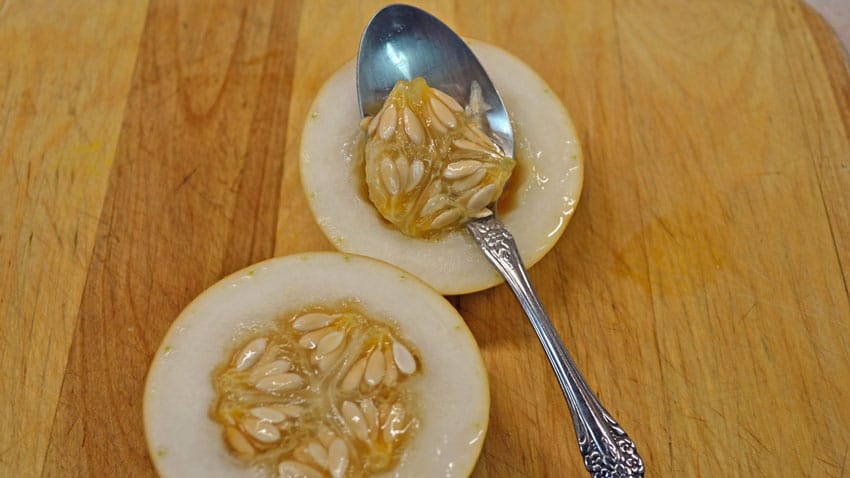
Scooping the seeds out
The size of the mature vine peach melon is seen with a regular size teaspoon used to scoop out the seeds.
The amount of seeds is also seen, something to be aware of at the end of the season. The vines and extra melons that have dropped to the ground need to be removed if you don’t want to find that area quickly becoming a dedicated vine peach patch! With as many melons are produced having this many seeds in each melon, it can happen in only a season or two!

Scoop of Vine Peach
The texture and firmness of the flesh is easily seen here, after using the teaspoon to scoop some of the flesh out. Some find the flesh a bit too firm when tasting it raw, but that firmness holds up very well when cooked as it does not become mushy or pulpy at all.
We found these are perfect as an edible dessert piece, being just the right size to hold a generous dollop of fresh made vanilla ice cream. To do this, simply cut in half and peel the rind, then slice a flat spot at the bottom so the open end will sit on a plate. Then gently slice down through the melon, leaving about a half inch of the bottom intact. This allows the ice cream to flow through the slits as it melts, flavoring the vine peach and perfuming the ice cream. Last, add a scoop of the best quality vanilla ice cream – fresh made is best – and add a mint leaf as garnish. Serve with a knife, fork and spoon for guests to enjoy all of the flavors and textures!
With all of the advantages the vine peach can bring to your garden – from windbreak and shade to wildlife decoy, home perfume and secret cooking ingredient – it make sense to try some and see what they can do for you!
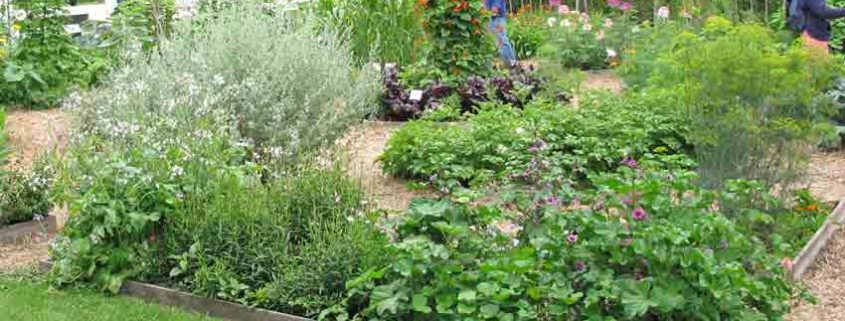
The word garden means many things to different people; flower gardeners immediately think of flower beds while vegetable lovers have an image of bushy, green-leaved plants loaded with fruit. Bird and butterfly watchers see pollinator attracting flowers and herbs in their mind’s eye while a novice may remember fantastic botanical or flower gardens they’ve visited and immediately feel intimidated or overwhelmed.
A garden can be easy and simple, whether it is for food, flowers, butterflies or just a spot with beautiful colors and relaxing, invigorating scents to relax after work.
We’ve visited a number of different gardens in our travels – from very simple and straightforward food production plots to professionally designed and maintained showcases.
Today is about seeing possibilities for your space, budget and time – large, small or somewhere in between. A highly pleasing garden needn’t be complex or difficult to create or maintain, in fact some of the most impactful and pleasing gardens are very simple.
Most of these aren’t really a complete garden by themselves, but are corners, nooks, crannies or otherwise difficult or unused spaces which lend themselves to delightful spots for a pause to enjoy their beauty.
The more formal or structured garden bed is very popular and is what has been featured countless times in gardening, home improvement and lifestyle magazines. This type of garden setting takes some planning and work to initially construct and plant, but can be an attractive center point for years to come. This stone pillar and background picket fence will anchor many different types of flowers or shrubs, giving built-in flexibility for future changes.

Seed Savers Exchange built a great example of a relaxed but engaging and visually interesting garden; with the corners defined and planted with multiple entry points and walkways. The use of different heights, leaf shapes, textures and colors creates a moving interest and eye-path to keep a visitor engaged.
If you don’t have a range of herbs and flowers in mind to start with – don’t worry. Choose some that you like and plant them as an experiment to see what develops. It’s not difficult to change a planting or two next season.
If you are not comfortable with the “try it” approach, research some of the numerous garden design or landscape design books and articles that are readily available for some ideas on where to begin. Browsing through photos of gardens on the internet is a very easy way to see what different designs look like, giving you ideas to try on your property.
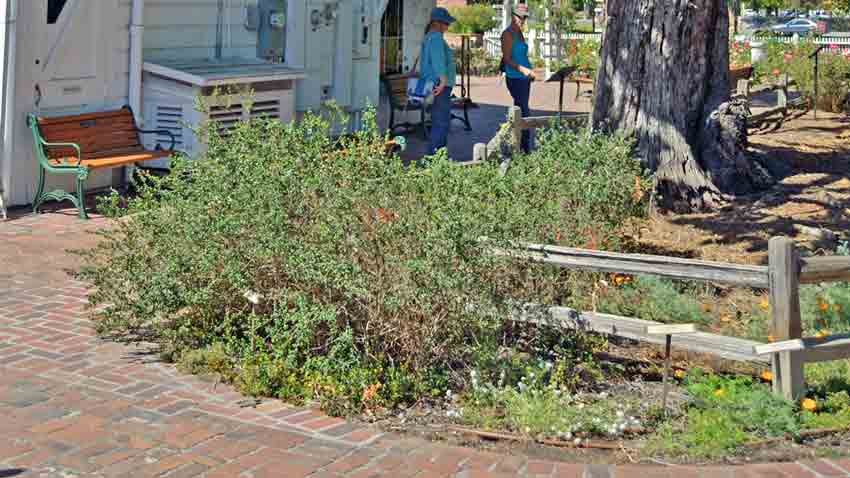
The Luther Burbank house had several examples which would be easy to try. A split rail fence gives visual interest and directs the eye to the bush and low flowers. The brick walkway is the border for the bed.

Further to the back of the Burbank property were these traditional structured flower beds, used to showcase and educate about different flower species as well as the pollinators visiting them. The beds themselves are very simple – just wooden timbers pinned in place with garden soil filling them to create the bed. Aged logs would give a more rustic feel if they are plentiful in your area.
A bed of this size could easily support both annual and perennial flowers and herbs, depending on how close to the house you placed it. Using taller and more robust flowers like sunflowers would create a privacy break as well as a windbreak when used upwind of a more delicate part of the vegetable or flower garden.
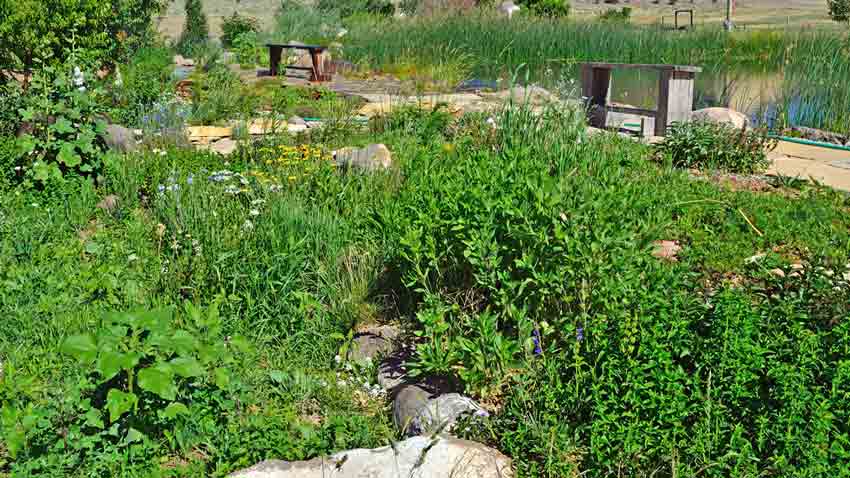
A flower or herb bed can be concealing as well as useful and attractive, such as this treatment of a slightly swampy area at Hell’s Backbone farm in Boulder, Utah. It is very informal but highly useful and productive as well as appealing.
The catchment pond is at the upper right, with the dam underneath the two benches. Over the years it has become slightly more permeable, resulting in this perennially messy and muddy area. To encourage less traffic, a mix of annual and perennial flowers as well as commonly used and thirsty herbs were thickly planted. This had two benefits – it kept traffic down, lessening the spread of a muddy mess and the abundance of plant growth absorbed much of the moisture so there was no standing water, fewer mosquitoes and a large harvest of flowers and herbs for the restaurant.
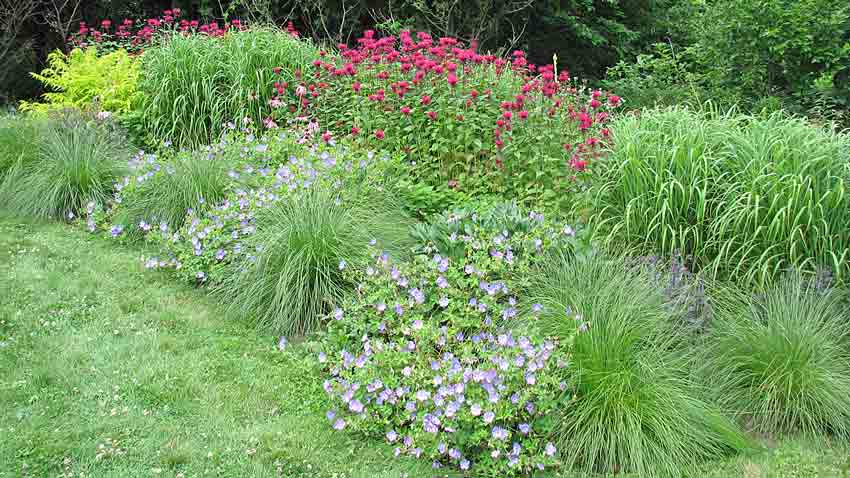
Another informal but well-designed approach uses annuals and perennials amongst different height grasses to attract different pollinators and create a sense of lushness without adding much if any additional work after the initial planting is done.
This area is very serene and soothing with the sound of the different grasses swaying in the breeze, while the multiple aromas drifting from the flowers greets you. After just a few moments, you notice the different butterflies, hummingbirds and bees among the flowers and take a seat on the stone bench just out of the photo at the bottom left.

On a trip to a farm in Phoenix, we saw this living shade structure with the lattice work trellis next to it and small herb garden behind it. The structure is old telephone poles buried in the ground with a heavy creeping vine providing the living shade. There are several possibilities here, without needing this heavy of a structure if you plant a fast-growing vining plant such as achocha, cucamelons, vining petunias, ivy or morning glory that are also lightweight. A structure to support the vines would still be needed, but wouldn’t need to be as expensive or heavy duty.
The lattice work trellis is a good idea, being quick and simple to put together while giving some initial privacy until the vines fill in and creating a border or separation of spaces.
The small herb garden behind the structure is simply made from recycled chunks of concrete dry stacked into a circle about a foot high and filled with garden and potting soil, then heavily planted.
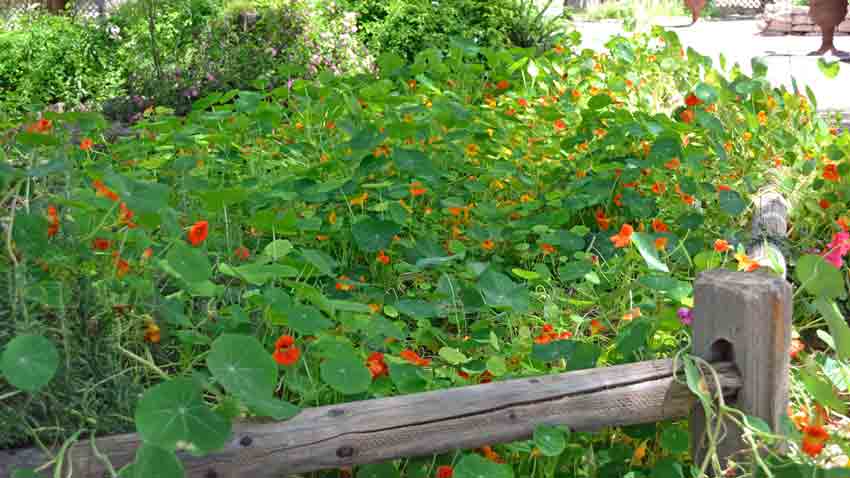
Something as simple as a large bed of nasturtiums can be attractive and engaging at the same time. These are planted outside of an upscale dinner restaurant where the flowers, leaves and buds are used as garnish on the dishes and table decorations. Another use would be to pickle the buds, as in our recipe Pickled Nasturtium Pods, to have a locally produced caper-like ingredient.
Sweet peas on a very basic, quick to make trellis lining the edge of a greenhouse creates a rustic authenticity as well as bringing beautiful colors and wonderful scents to the immediate area.
This was also on the Phoenix farm in the middle of April, so the sweet peas can be a source of shade for a longer time in a less heat soaked climate. Using this concept for a living shade on the south side of a greenhouse with heat tolerant vining plants or tall sturdy plants such as sunflowers would be another functional and inviting solution.
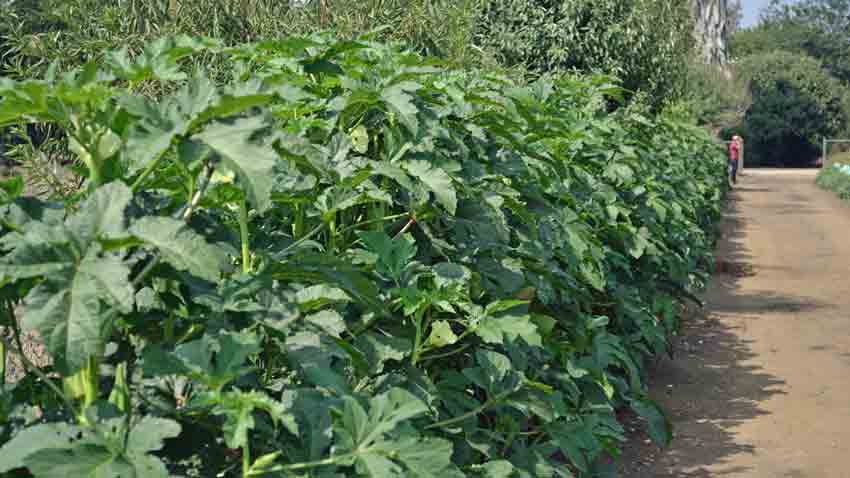
How about growing an annual living hedge which gives you multiple benefits of additional privacy, windbreak and fresh food? Not to mention colors and scents, depending on what you choose to plant along your property fencing.
Okra is being used in just this way here. The plants were above six feet tall in the middle of August, with enormous amounts of fresh okra for the picking. That is a five foot fence in the background, so you’ve got a good indication of just how tall this hedge grew.
Other choices for this approach are thickly planted strips of tall sunflowers, sesame, hollyhocks, pole or vining beans, hibiscus, vining petunias, poppies and peas or sweet peas. Your climate and situation along with what you like to grow or eat will help determine what works well for your property.
What about your garden, do you have a success story or photos to share and brag about? Please, let us see and hear about them! Your successes will help inspire others, and just might answer a question someone has.
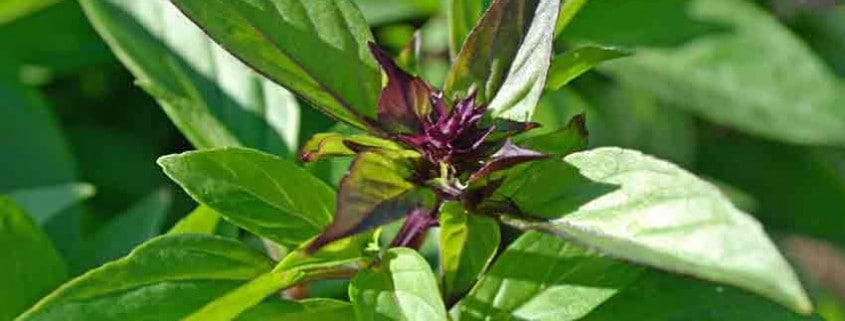
Basil is most often thought of as an herb for Italian pasta sauce and pesto, but it has so much more to offer. From holy uses and sacred traditions to medicinal, herbal and culinary uses, along with healing tea from its leaves and repelling biting insects, basil has a lot going for it. Add in that it’s extremely easy to grow, and there’s no wonder basil is at the top of the list for must-have herbs for the home gardener and kitchen chef.
Basil is a Mint?
Basil is a member of the mint family, which helps to explain its exuberant and sometimes aggressive growth habit. Combine this with its prolific seed production and ability to easily re-seed itself and you should never be short of basil in your garden.
By some estimates, there are over 150 different species, or cultivars of basil worldwide. The basil plant is characterized by square, branching stems with leaves growing opposite each other from the stem and brown or black seeds in groups of four in pods or nutlets at the top of the plant where the flower spike first blooms.
Ancient Roots
Basil is one of the older herbs cultivated and valued for its aromatic, medicinal and culinary properties. It is commonly thought to have been brought to ancient Greece from Asia by Alexander the Great. From there it spread through seed trade and consumption to India, then on to England by the 1500s, arriving in America by the early 1600s.
Many American gardeners know the herb for its culinary uses and are most familiar with the Italian varieties Sweet and Genovese basil, but there is much more to basil than only these two famous cultivars.
A Few Varieties to Try
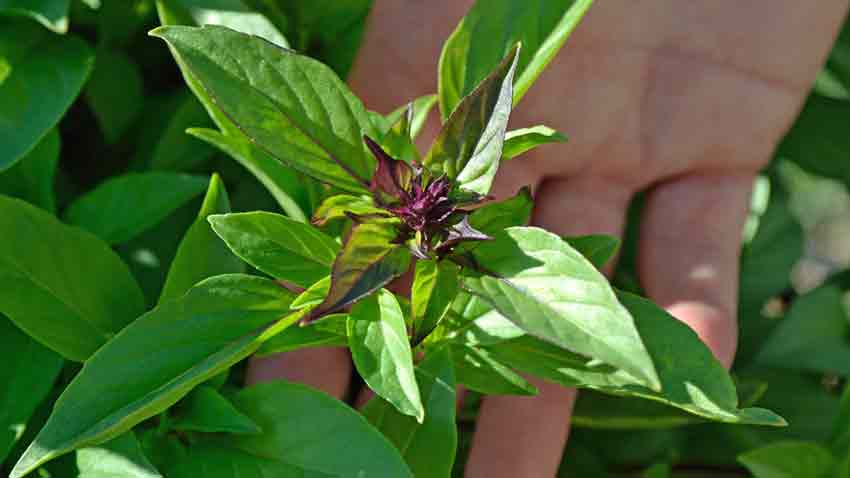
Thai Basil
For instance, Thai basil has a similar leaf shape as sweet basil, but packs a more aromatic punch along with a very pleasant and unique anise-like flavor. They are initially a bit sweeter than their Italian cousins before the anise flavor appears, and they hold up to cooking a bit better due to their stronger flavors.

Holy Basil
Holy basil or Tulsi originated in India, where it is considered to be one of the most sacred plants in the Hindu religion. In Hindu mythology the plant is an incarnation of the goddess Tulsi. It is used as a medicinal plant for its essential oils and as an herbal tea. It is considered to be an elixir of life, considered to be beneficial for the mind, body and spirit. There are two main types grown in India, a green leafed and a purple leafed cultivar.
Genovese Basil on left and Lemon Basil on right
Some basil varieties have a strong citrus aroma and flavor, such as the lemon and lime cultivars. Although they both have a citrus scent, they are completely different species. The lemon basil has a high essential oil content, boosting its aromatic properties while the lime cultivar is a bit more subdued in both scent and flavor.
More Benefits of Basil
Besides using the leaves in cuisine and as a tea, basil has other traits which make it very valuable for the home gardener.
Due to the aromatic nature, most basils are very effective at warding off biting and annoying insects. Having a planter on the back deck or porch, as well as a bush at the garden entrance allows the passive deterrence as well as being able to pull off a leaf, crush it and rub it on clothes to keep the biters at bay. When the flowers are in bloom, simply pulling the flowers through your hands and inhaling the heavenly aroma works wonders for relaxation and clearing the mind for a few minutes.
Too often, home gardeners think when a basil plant “bolts” or starts setting flowers that it is done for the season. This is not true at all! The flower stalks can simply be pruned at the base of the first flower, re-setting the leaf production mechanism for another round if the weather is still warm enough and the days long enough. Some cultivars, such as the Genovese variety, can be encouraged back into leaf production and give six or even eight harvests of leaves, making for lots of fresh pesto in the freezer to remind us of just exactly what high summer smelled and tasted like during the coldest depths of winter.
It is highly advisable to let a couple of the plants keep their flower stalks as basil is a very strong pollinator attractant, bringing in many different species of
The freshly trimmed flower stalks are excellent when shredded and tossed into salads or among greens on a sandwich, giving a delightful aroma and light, bright flavor. We have also used them in our breakfast eggs and green smoothies for the same effects. Just be aware that a little goes a long way and start with just a couple of flowers so as not to overpower the rest of the dish.
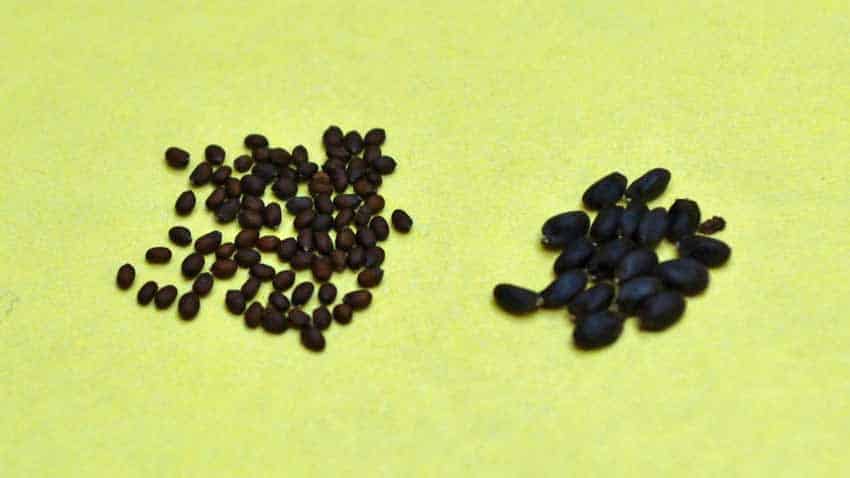
Holy Basil seed on left, Genovese basil seed on right
Once enough leaves have been harvested, let the flowers do their work and harvest the seeds as they have several different contributions to make besides just growing new plants next season. Basil seeds don’t readily “shatter” or scatter like sunflowers or other flowers, so it is simple enough to just let the flowers dry down and the seeds mature. To harvest, just snip the stalk at the base of the flower, exactly like pruning the early flowers. It is best to do this just before the flower stalks are completely dry as the seeds can scatter when the stalks are disturbed. Collect the stalks in a tall paper bag and allow them to completely dry for a month or more. Then shake the paper bag side to side and tap the stalks against the inside of the bag to finish freeing the seeds.
The resulting seed is delicately perfumed seed when crushed or ground. Its scent is unlike the parent plant, much more floral and light, but still strong enough to brighten up a room. Use a mortar and pestle or herb grinder to release its magic and use them in muffins, cakes, eggs, pancakes or any dish where a bright floral scent would be an unexpected welcome, especially in the colder seasons.
Making Fresh Tulsi Tea
We really enjoy fresh Tulsi tea in the summertime. We will walk you through just how easy it is to make-
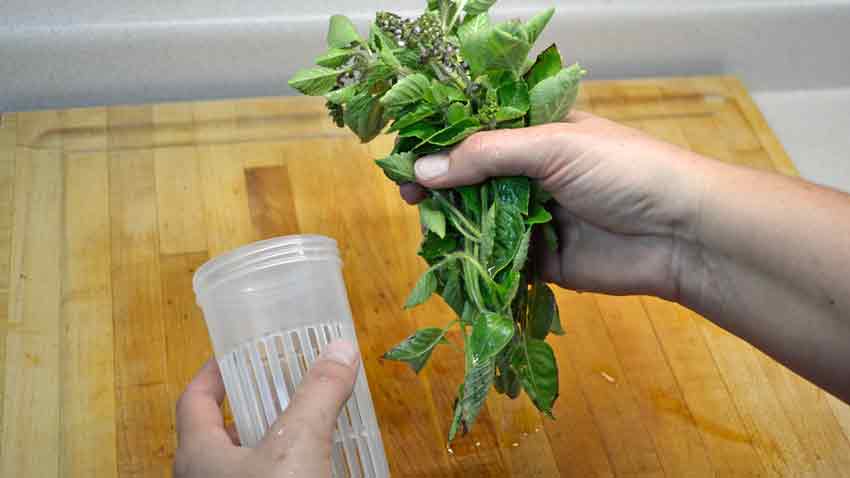
Making Tulsi or Holy Basil tea is very easy. We use a tea brewing pitcher that separates the tea leaves from the brewed tea, but you can use a large tea ball, or simply put the leaves into the water, let steep and strain. Boiling hot water isn’t needed, but warm water will brew faster and extract more of the essential oils than cold.
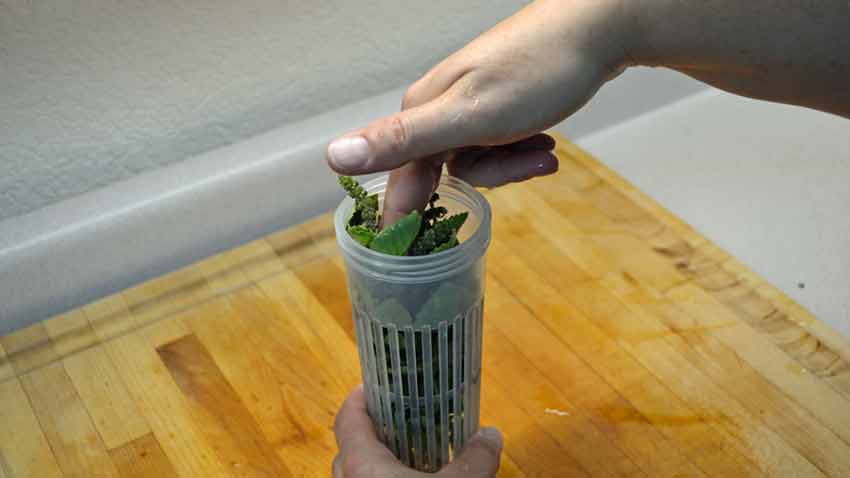
We like our Tulsi tea a bit stronger, so we gently pack the leaves in, but not too tight or they won’t brew well.

After putting the leaves into the pitcher, adding hot water and closing the top, let the tea brew.

The tea is ready to drink when you think it is – meaning, let your taste be the guide. Some like it much milder than others, so enjoy it your way!
After removing the strainer, the pitcher is the serving and storage container.

Time for some Tulsi tea and a few minutes to sit and relax!
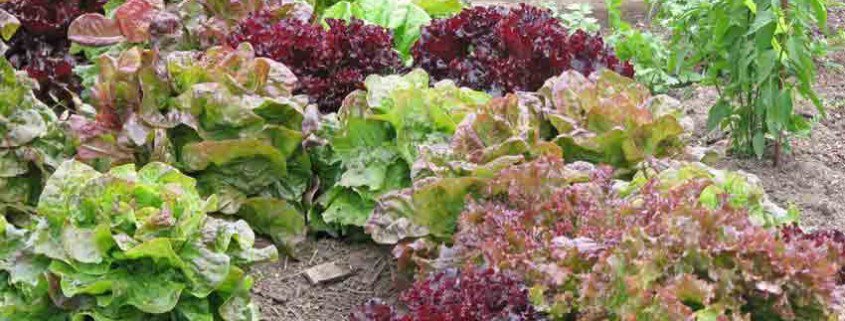
Succession Planting and Intercropping Techniques
Growing more food from the same garden space seems like a fantasy to many gardeners. Yet, there are a few highly proven, time-honored techniques which have been tested and refined over the past several centuries which are perfect for today’s gardens.
We will show you two of these techniques in today’s article, giving some examples to get you started. Do not be fooled by the simplicity of these approaches, as they are easy and quick to understand but have many nuances that will only show themselves to you with experimenting and careful observation.
Also, don’t be put off thinking these are too difficult to try or to have initial success with. You will be amazed at the increase from your existing garden bed with a first approach, but realize that a careful and thoughtful study will return much more for years to come.
How Succession Planting Works
Enjoying delicious, freshly picked greens from your garden from mid spring through winter, even after the first frosts and into the harder freezes is entirely possible with just a little planning and understanding. The amazing part is it doesn’t much matter what climate you live in. Most greens thrive in cooler weather, but there are some heat loving varieties which will fill in the hotter months.
Spinach is a fast growing cool season green that only lasts a short time, so it needs to be re-planted every couple of weeks for a continual harvest. This is known as succession planting. Lettuce is another cool season crop that can either be harvested continually for leafy types or must be succession planted for the heading varieties of lettuce.
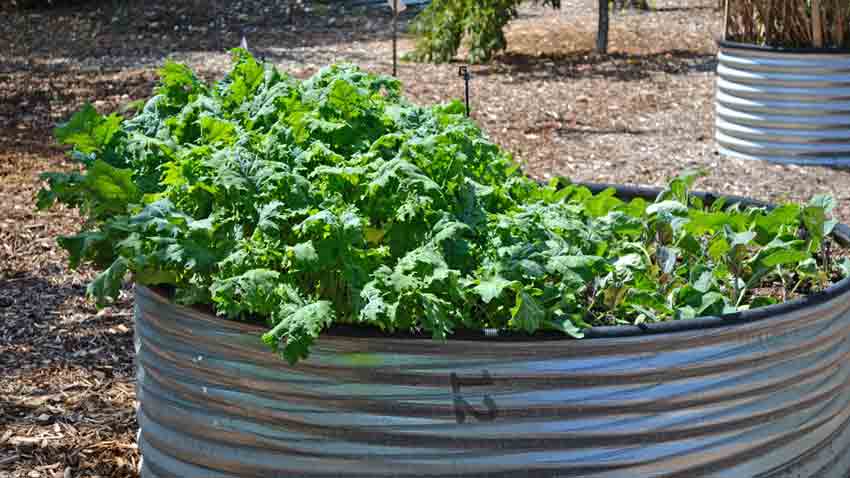
Large Container Succession Planting
Succession planting involves seeding a short section of a garden bed, letting the crop start to grow then planting the next section a couple of weeks later. This continues down the bed, with the crop maturing in successive waves and giving you a continual harvest. Most gardeners will succession plant only a couple of feet at a time, so as not to overwhelm themselves with too much of a harvest at one time.
Other greens, such as Swiss chard, kale and collard greens grow more slowly and can be harvested all season long – they are both heat and cold tolerant, giving double duty in the garden.
Heat loving greens include amaranth, New Zealand spinach, Huazontle or Red Aztec Spinach and both red and green Malabar spinach, besides the above mentioned types.
Make sure to expand your focus outside of only greens, as there are many other vegetables which will do extremely well in succession planting. One example for a single garden bed or row are a full garden bed planting of early spring peas (which have a harvest season of just a couple weeks) followed by Bok Choi or other Chinese cabbage in a succession pattern, which is then followed by New Zealand spinach going into the warmer weather. This could be extended with fall radishes, beets, Swiss chard or kale if there is enough growing season.
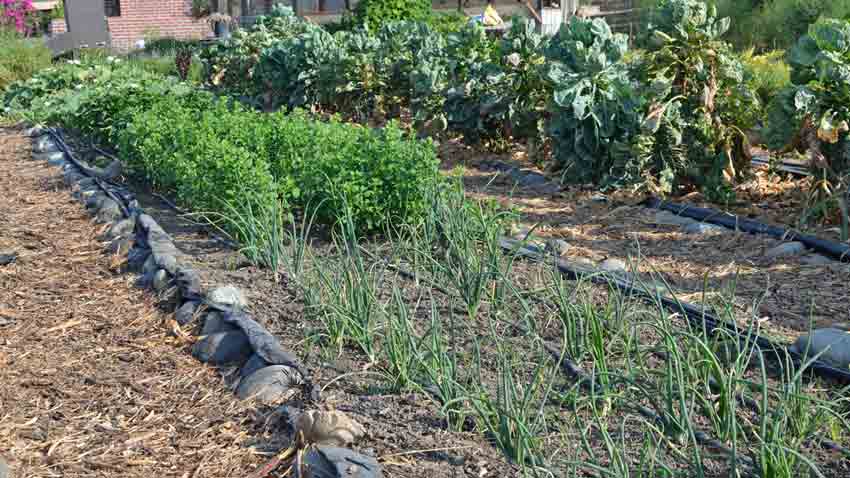
Green onions succeeding summer greens
From this one row, you have gotten three or four different vegetables on an almost continual basis from early spring into very late fall or early winter. If you are able to provide some cold weather protection or season extension for the bed, such as a plastic sheet row cover supported on PVC hoops, you can easily extend that season by a couple of weeks on the spring side and a month on the fall or winter side.
In some climates, just that one simple addition will give you the ability to grow year-round, with spinach, Swiss chard and kale rounding out the slower growing and colder winter.
Another example would be early spring spinach and lettuce, followed by bush snap beans, then fall beets. Or early season carrots can be followed by snap beans during the warmer months with radishes in the fall.
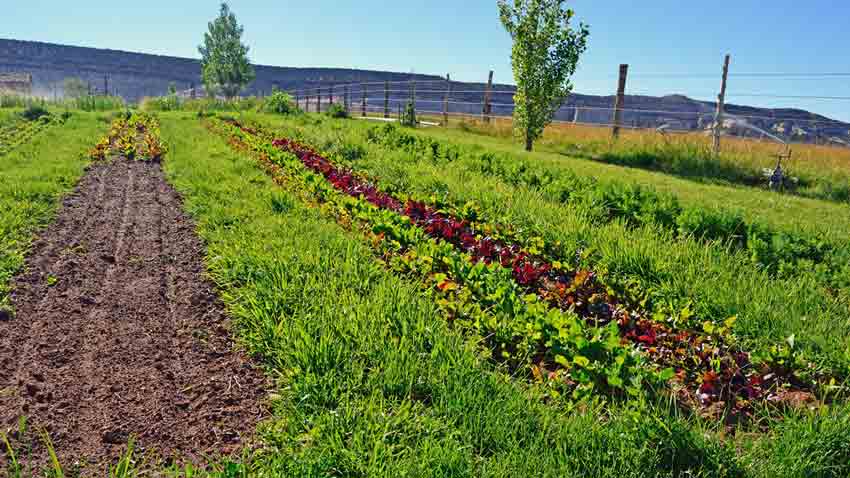
Succession planting on left and intercropping lettuces on right.
These varieties should be planted early – small beets and beet greens, young cabbage, carrots, cauliflower, kohlrabi, lettuce, green onions, peas, radishes, spinach, and turnips; as these are all cool-weather crops. They can be followed by warm-weather crops such as beans, melons, squash and transplants of eggplant, peppers and tomatoes. The warm-weather crops can then be followed by another planting of your favorite cool-weather crops which will mature in the fall.
Any succession can be made that allows crops to reach maturity within the growing season. Swiss chard, Chinese cabbage, collards, corn salad, endive, kale, leeks, lettuce, and mustard are cool-season crops that can follow warm-season crops for late autumn and winter harvest.
What Intercropping Is and How to Use It
Another technique to grow more from the same amount of garden space is called intercropping or interplanting. This makes use of faster maturing varieties planted alongside slower maturing ones. Both are planted at the same time, with the fast growing vegetables being pulled and eaten before they interfere with the slower growing ones. This makes greatly efficient use of a smaller garden space and can double or triple the amount of food grown on the same space.
Quick-maturing crops include: radishes, leaf lettuce, green bunching onions, turnips, and mustard greens. These crops usually mature in 60 days or less from sowing to harvest.
Slower or long-maturing crops include tomatoes, corn, squash, cabbage, eggplant, and peppers. These crops require more than 60 days from sowing until harvest, often 90 days or more.
When planning to intercrop a garden bed, pay particular attention to the days to maturity on the web site and description.
Here is a simple step-by-step guide to succession crop planning:
Intercropping has three main advantages compared to only growing one variety at a time in a garden bed. First, this method allows you to squeeze two, three or more beds of vegetables into one, without detriment. Something as simple as a bed of carrots with a trellis of cucumbers down the middle makes a big difference in the amount of food grown. Learn to think vertically as well as width and length of the garden bed.
The second advantage is with a bit of planning, plants can benefit and protect each other. Even passive protection such as a better microclimate under the plant leaf canopy can deter destructive pests. If you plant varieties of vegetables, herbs and flowers which are actively beneficial to each other, then you’ve just stepped everything up a notch!
The third advantage is a dense plant cover or canopy, creating a more beneficial and stable microclimate for the soil and micro-organisms in it. The moisture levels will be more consistent, needing less amount of water less frequently while keeping temperatures more stable, reducing stresses on the plants and their moisture transport systems.

Intercropping kale and Swiss chard in a container.
A word of caution here – plants do not like to be crowded or spaced too closely together to where they begin to compete for resources such as moisture, nutrients or light. Start small and add one crop to this year’s planned garden bed, not trying to squeeze all four in the first season. Once some experience is gained, then add more and in a year or two the garden bed might look like the following!
In his book “The Winter Harvest Handbook”, Eliot Coleman talks about the French market growers around Paris would sow an early spring hotbed with a mixture of radish and carrot seed by broadcasting the seed by hand. Lettuce seedlings would be immediately transplanted into the bed.
The radishes would mature first and be harvested, giving room for the carrots growing between the lettuces. The carrot tops would grow above the young lettuces until the lettuce matured and were harvested, leaving more room for the carrots. Once the lettuce was harvested, cauliflower starts were transplanted into the bed. Once the carrots were harvested, the cauliflower was alone until it was harvested and the bed made ready for the next set of crops.
Using this example, four crops of significant amounts are harvested from one bed during a single season. The bed wasn’t allowed to be idle after that season either, it had a fresh thick layer of well-aged compost applied and worked in, then it was re-seeded with a different mixture of seeds and transplants. Given this example of cool season crops being planted, the next set was probably warm season varieties such as beans, cucumbers, squash, Swiss chard, melons and bunching onions with transplants of tomatoes, peppers and eggplant.
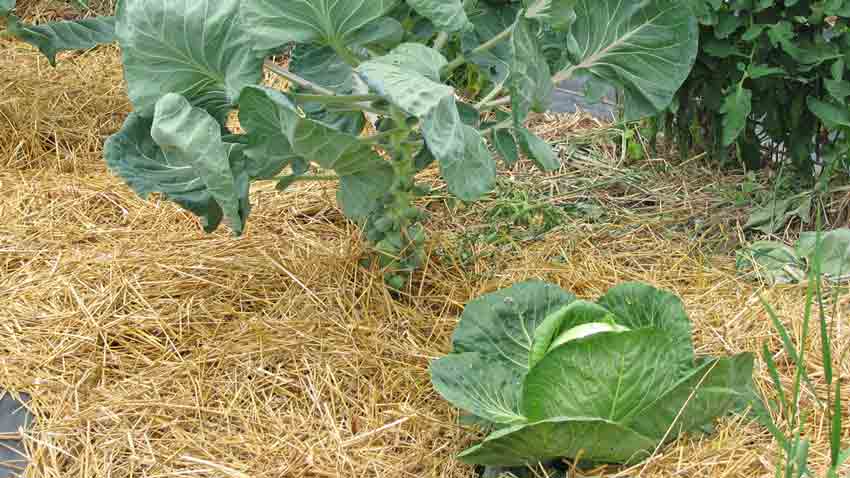
Fall intercropping – tomatoes finishing with cabbage and Brussels sprouts
With all of these positive, productive examples, there are a couple of things to realize at this point.
One, becoming successful at intensive intercropping and succession planting takes some skill and experience. Gaining that skill and experience requires making some mistakes, learning from them and documenting what was planted when in a Garden Journal for future reference.
While the explanation of intensive planting is easy to understand and we’ve shared a number of successful examples, what will ultimately work in your particular garden depends on several factors which are very possibly quite different than ours.
Two, managing a very intensively planted garden will give abundant yields of vegetables but will require more thought, planning and time in the garden initially during planting and again during the harvest when significantly larger amounts of crops are hitting the kitchen counter and dining room table. There will simply be much more food needing attention than before.
This leads to the need for skills and knowledge in preserving the gardens bounty through freezing, canning, dehydrating, fermenting and pickling. Of course, the consequence of this course of action is having much more food on hand and the inescapable sense of accomplishment when the realization strikes that there are several months’ worth of home-grown, delicious food put away.
Perhaps this is how one garden can change the world! Or maybe it should be one garden at a time…
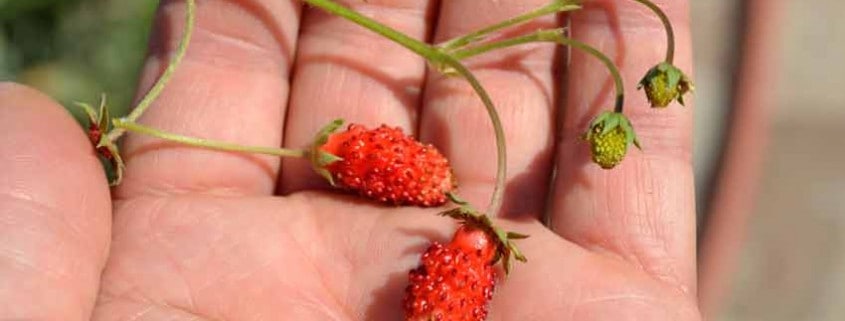
Alpine strawberries have captivated our taste buds for a very long time. They are tiny yet highly aromatic and hugely flavorful ancestors of our common strawberry. Archeological excavations have shown Stone Age people in Denmark and Switzerland enjoyed them immensely, as shown from the evidence of seeds in those sites.
What we would recognize as alpine strawberries were first domestically cultivated in ancient Persia, where they were considered delicacies fit only for royalty. As often happens, seeds made their way both east and west through trade along the Silk Road route, becoming widely grown and loved.
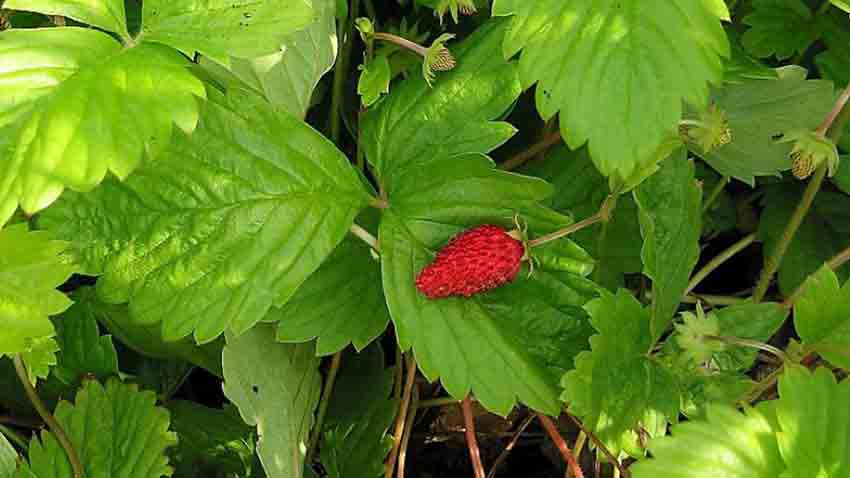 The Roman poet Virgil named the strawberry in works about country life, associating it with other wild fruits and citing the beauties of the fields in his third Ecologue. During the same period Ovid mentions the mountain strawberry in his description of the Golden Age in book one and again in book thirteen of his Metamorphoses narrative. Pliny is considered the last of the ancients to write of the strawberry, listing “Fraga”, the strawberry fruit, as one of the natural products of Italy in the twenty first book of his Natural History series.
From the 10th century until the early 19th, alpine strawberries were hugely profitable, highly regarded and very well known. After suffering from some mis-informed bad publicity in the mid-1100s, alpine strawberries became quite popular in religious paintings beginning in the late 1300s – often associated with Mary and the Baby Jesus in illuminated manuscripts and paintings. The Catholic Church and royal families from Italy, France, England and Germany were responsible for much of the promotion of the alpine strawberry as they tasted and fell in love with it.

Madonna among the Strawberries – with the carpet of alpine strawberries
A few excellent examples are located in the School of Cologne in Germany. “The Madonna of the Roses”, “The Garden of Paradise” and the “Madonna among the Strawberries” all portray the Madonna as a young girl in a closed garden with the infant Jesus in her lap. She is surrounded by roses, thistles, carnations, lily of the valley, iris, primrose and the entire plants of the alpine strawberry, showing its tiny, prolific red fruit and white five petal flowers along with its toothy leaves. The alpine strawberries are painted botanically correct and are exact, perfect replicas of what we see today. They are always portrayed in a place of honor and importance, reflecting the standing they held in elevated society of the day.
By the late 1300s the alpine strawberry was in widespread cultivation throughout Europe as more of the working classes began transplanting the alpine strawberry from the woods and wilderness to their gardens. Street vendors were selling the fruit to Londoners in 1430 when John Lidgate wrote the song “London Lickpenny” which mentions ripe strawberries and cherries for sale in London.
All strawberries up until the mid-1700s were all of the alpine or wood type; being very small, highly aromatic and having much more flavor than would be thought possible for their size. These characteristics are what made them so remarkable, along with their intense sweetness. Another interesting fact is not all of these strawberries were red; there were white and yellow varieties which were just as highly regarded as the red ones, having different flavors of their own.
This begin to change with the world exploration of the early 1700s, with plant and animal samples brought back to Europe from all over the world.
The modern domesticated large fruited strawberry got its start from these collecting expeditions, with a few strawberry plants brought back from a mapping trip to Chile by Amédée-François Frézier, a French naval engineer who noticed and enjoyed the tremendously large strawberries growing along the Chilean coast in 1712. He wrote the fruit were commonly as large as a walnut; almost three times the size of the alpine strawberry of the day. He brought back plants which were installed in the royal gardens and in Brittany, which grew well but did not set any fruit. It was later discovered the Chilean strawberries have male and female plants, and Frézier had only brought back female plants.
 It wasn’t until 30 years later when someone brought back male strawberry plants from Virginia that the Chilean strawberries began to produce fruit, creating the first hybrid strawberry. This new variety is the foundation of all domestic strawberries grown today with the large and familiar heart-shaped fruit.
As would be expected, alpine strawberries began a decline in popularity as their larger sized and heavier producing cousins gained recognition, both in Europe and America.
Alpine strawberries returned to their former, more exclusive roots, being highly valued by pastry and dessert chefs in France and across Europe for their highly concentrated flavors, balanced sweetness and heady aroma that would perfume a room. Eventually, French and Viennese pastry chefs would raise the use of “Fraises des Bois” to a high art form, competing with each other to make the most visually stunning, aromatic and delicious pastries and desserts possible.
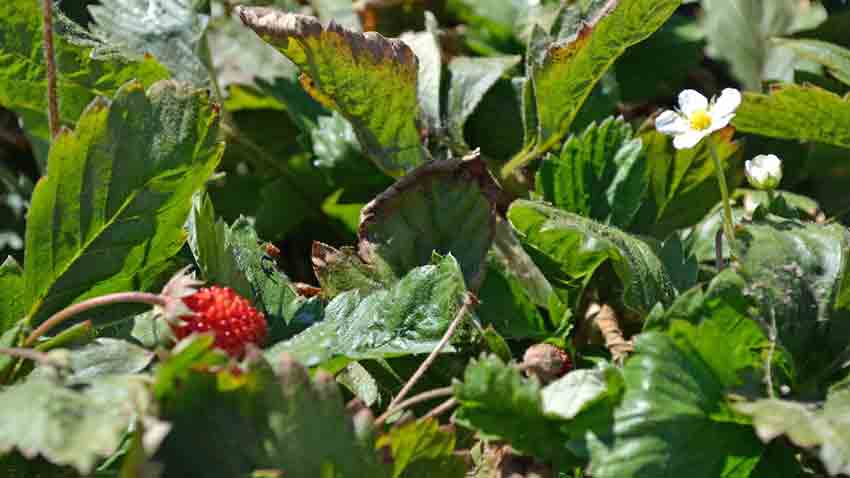 Today, alpine strawberries are almost nonexistent in grocery or specialty stores, but are imported from Europe as ingredients in gourmet jams, sauces, liqueurs and as a coloring agent in cosmetics. The best way to experience these flavors and scents – often described as “ambrosia” – for yourself is to grow them in your garden.
While alpine strawberries may not be as productive in weight as their domestic cousins, what they lack in quantity is more than made up for in quality. Given fertile soil, proper conditions and some care, they can be very productive. Enough so that some caterers, confectioners and resorts are buying from local growers specializing in alpine strawberries.
 Besides a good quality, fertile and well-drained soil, alpine strawberries need a good amount of sun. In hot areas, they will benefit from partial or afternoon shade. Consistent soil moisture is a key factor in encouraging production, along with a good layer of mulch along their roots to keep them moist. Another benefit is they readily grow true from seed, unlike domestic strawberries which must be started from vegetative propagation.
They don’t send out runners, instead concentrating their energies in flowering and fruiting. They will slowly increase their crowns and gradually grow into mounds about a foot in both diameter and height. They will often flower the first year, but normally won’t set fruit until the second year and will continue producing for several years if well kept. Because of their growth habits, alpine strawberries make for great border plantings as well as edging along a garden walkway or in larger patio containers. They are perennial and can be very cold tolerant if their crowns are heavily mulched to about eight inches before the first hard freeze.
With a little planning and care in planting and tending your plants, you can experience firsthand why mankind has had such an intense love affair with strawberries for so long. You get to taste the same explosion of flavors and be captivated by those intense aromas which Persian kings and European royalty enjoyed so long ago, right there in your home garden.

Papalo is a fabulous, but still relatively unknown, ancient Mexican herb you should be growing. A heat-loving alternative to cilantro, its flavors are both bolder and more complex. It has been described by some as somewhere between arugula, cilantro and rue; others say it tastes like a mixture of nasturtium flowers, lime, and cilantro. Younger leaves are milder flavored, gaining pungency and complexity as they mature.
Papalo (PAH-pa-low) is known by many names; Quilquiña, Yerba Porosa, Killi, Papaloquelite and broadleaf in English. It is a member of the informal quelites (key-LEE-tays), the semi-wild greens rich in vitamins and nutrients that grow among the fields in central and South America. These green edible plants grow without having to plant them. They sprout with the first rains or field irrigation, often providing a second or third harvest, costing no additional work but giving food and nutrition.
Other quelites include lamb’s quarters, amaranth, quinoa, purslane, epazote and Mache or corn salad.
Papalo pre-dates the introduction of cilantro to Mexico by several thousand years, which is a very interesting story all by itself. South America is thought to be the ancestral home of papalo.
Cilantro is also known as Chinese parsley and was brought to Mexico in the 1500s by Chinese workers in the Spanish silver mines of southern Mexico and South America. Spain had a huge trade industry with China, exchanging silver from America for china, porcelain and various drugs – opium and hashish among them. They also imported many Chinese workers for the silver mines, as European diseases had decimated the native population which had no immunity. The Chinese workers brought along foods, herbs and spices which were familiar to them, so cilantro came to the Americas.
Papalo is sometimes called “summer cilantro” due to its heat-loving character and its delay in bolting and setting seed until late summer or early fall.
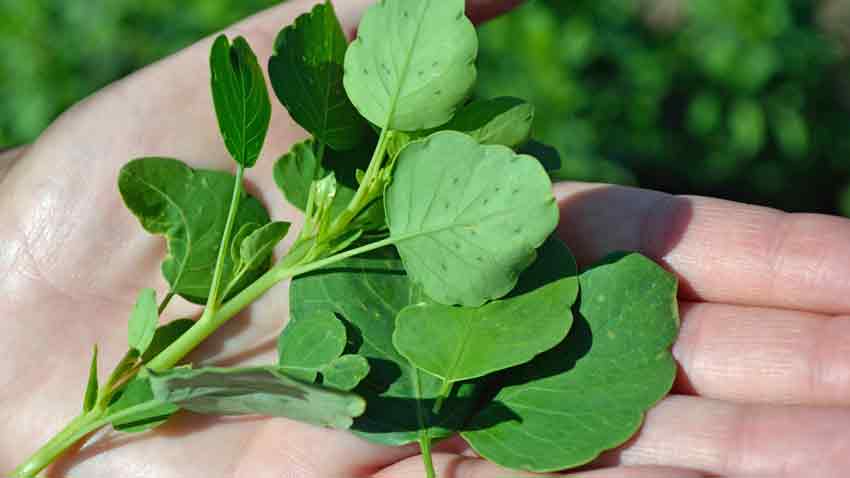
The name Papalo originates with the Nahuatl word for butterfly, and Papaloquelite is said to mean butterfly leaf. The flowers provide nectar to feeding butterflies, while also attracting bees and other pollinators to the garden with their pollen.
Part of the aroma and flavor is seen above with the oil glands which look like spots on the underside of the leaves. Those glands produce a fragrance which repels insects from eating its leaves.
There are two different leaf shapes grown – a broadleaf and a more narrow leaf, often called poreleaf. We have found the broadleaf variety to be more palatable, quite a bit more pungent than cilantro but quite tasty. When beginning to use papalo, start with 1/4 to 1/3 as much as the normal amount of cilantro. The flavor is much stronger and lasts longer, so a little goes a long way until you’ve gotten used to it. We grow and offer only the broadleaf variety.
When we hear about people complaining of papalo tasting of soap, detergent or having a rank or funky odor, usually they have encountered the poreleaf or narrow leafed variety. It is quite a bit more pungent than the broadleaf type, so usually comes as quite a shock to our palates.
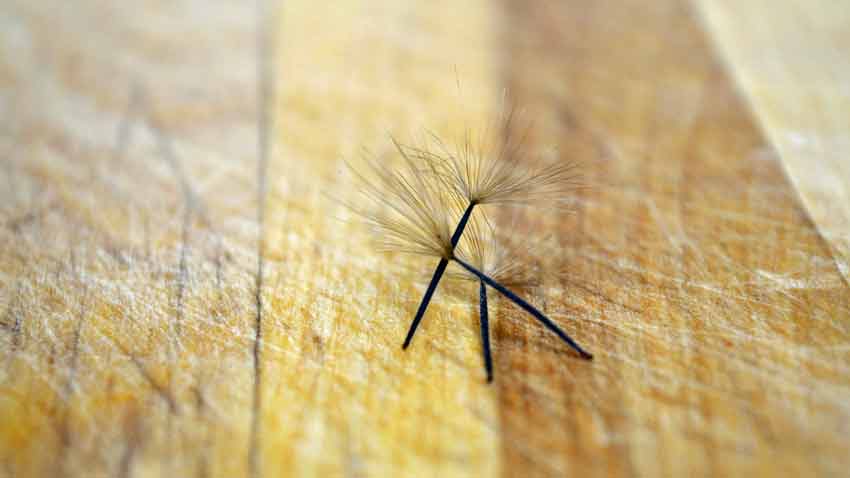
Papalo seeds look much like dandelion seeds, with the stalk and “umbrella” to help carry them on the wind to their new home. Having the umbrella attached is very important to good seed germination, which we will show you in just a bit.

The harvested seed comes from our grower in a big clear plastic trash bag, as it just isn’t possible to harvest and clean the seeds without breaking the umbrellas off. The seeds are almost weightless, so a big bagful that you can hide behind weighs less than a pound.
Cindy has a handful of seed heads, showing how they clump together after maturing. As the seed matures, the sheath or covering that protects the young seeds peels back, exposing these clusters to the wind, which will carry them away as they dry.
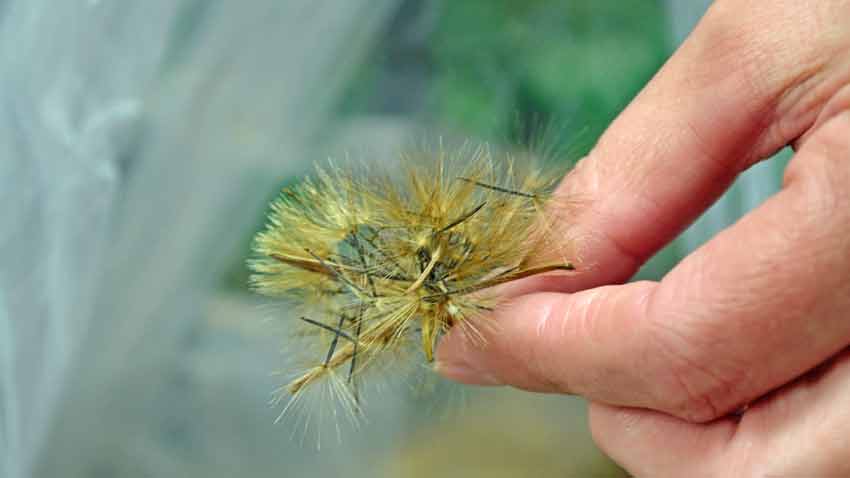
A closer look at the clump of seeds. We haven’t found a better way to separate them without damaging them, so we usually pack them much like this – by the ever so gentle pinch! There are probably 30+ seeds in this photo.

Papalo is often described as having “very low and variable” germination. This is true if the seed is packed in a standard seed packet, which breaks off the umbrella from the stem. From experimenting, we have found germination will drop to around 10% if the seed is broken, but will be as high as 90% or better if the seed is intact.
This photo of papalo in our germination tray shows the proof. Using seed germination paper to keep the seed damp, there was 100% germination in less than 72 hours. In fact, the seedlings hit the lid of the germination chamber, trying to get to the light.
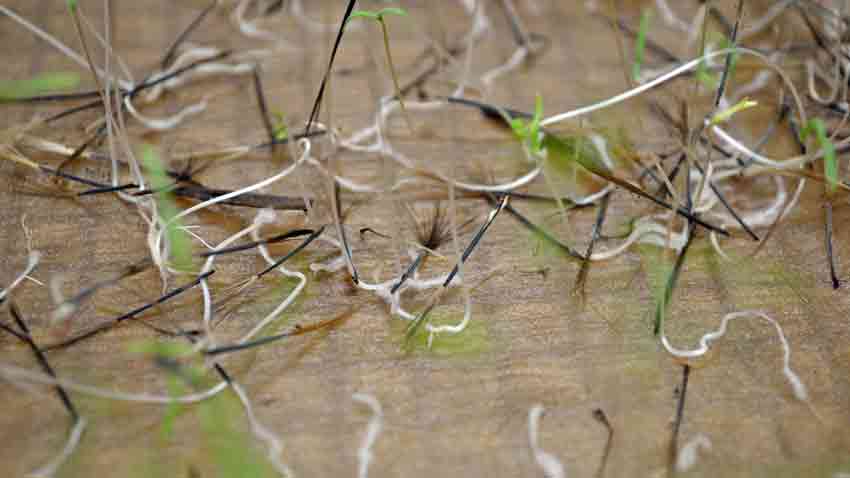
A close-up shows how the stem emerges from the bottom of the stalk, immediately turning vertical in growth, searching for light.
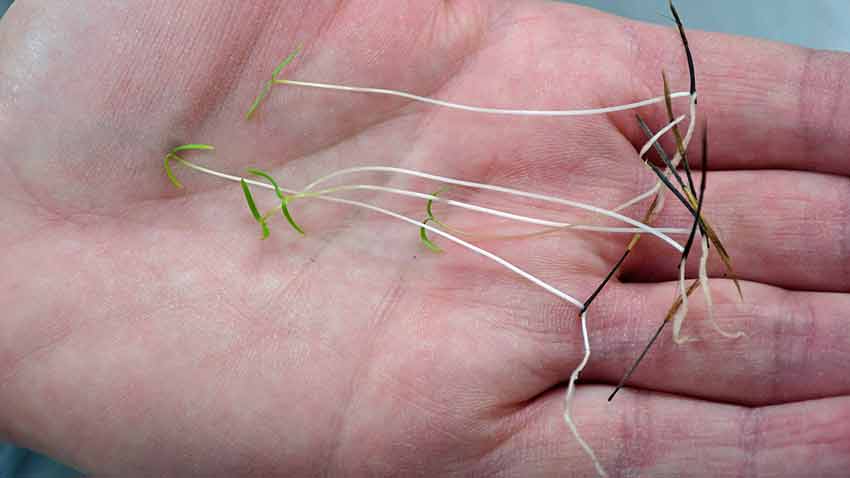
Seen in Cindy’s hand it is easier to identify the parts of the seed and where the seedling emerges from, as well as how tall they can grow in a short time.

We have developed this simple but highly effective packing box from our germination experiments. It keeps the seeds intact for planting as well as protecting them from being broken during shipping.
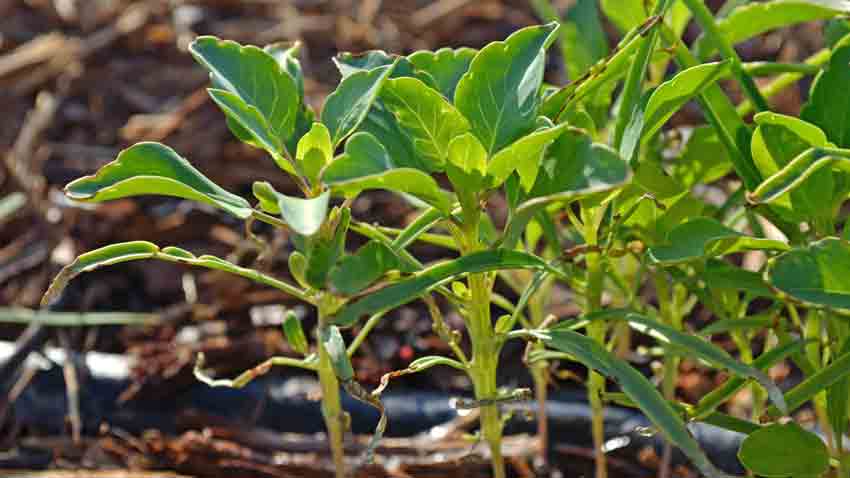
Young seedlings don’t have the oil glands developed yet, so they are milder in flavor and aroma than when they begin to mature. This planting is a bit thick, but it is sometimes difficult to separate the seeds without damage. In this case, just plant them thick and don’t worry about it. If desired, you can clip the unwanted or unneeded seedlings to thin them. Make sure not to pull them out, as this really disturbs the roots of the adjacent plants and seriously disrupts their growth.

Even in a very harsh spring with sustained high temperatures and punishing winds, the young papalo grows strongly. The weather effects can be seen in the drying of the leaf margins, as well as the scruffy and dry leaf appearance. The holes are not from a bug chewing on the leaves, but from the oil vaporizing from the porous oil glands. The lighter colored spots on the leaves are additional oil glands.
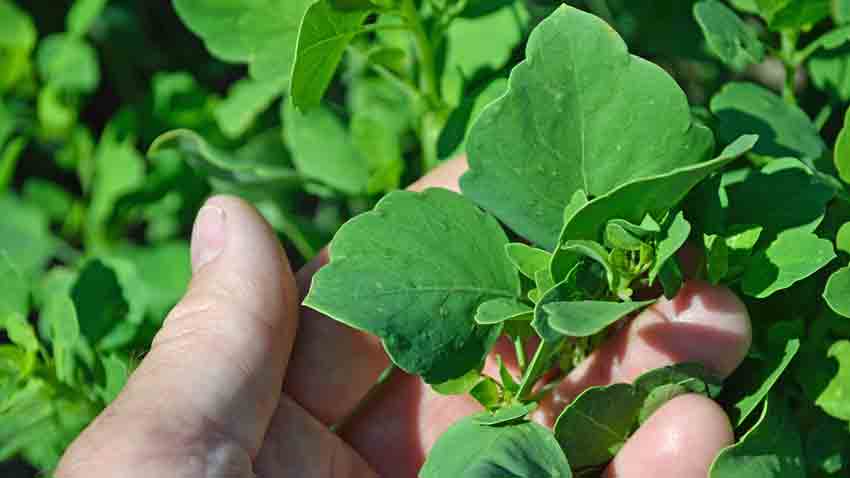
A fully mature papalo leaf in good growing conditions looks like this – a moderately deep, rich green with oil glands distributed across each leaf. The leaves have a medium thickness to them with a fairly substantial feel. They don’t feel delicate like some vegetable leaves, but aren’t thick and succulent either.
Touching them will release some of the aromatic oils, so you should be able to immediately experience their singularly unique aroma, even from an arm’s length away. This is the same with organically grown or home-grown cilantro – the aroma will be much more pronounced.
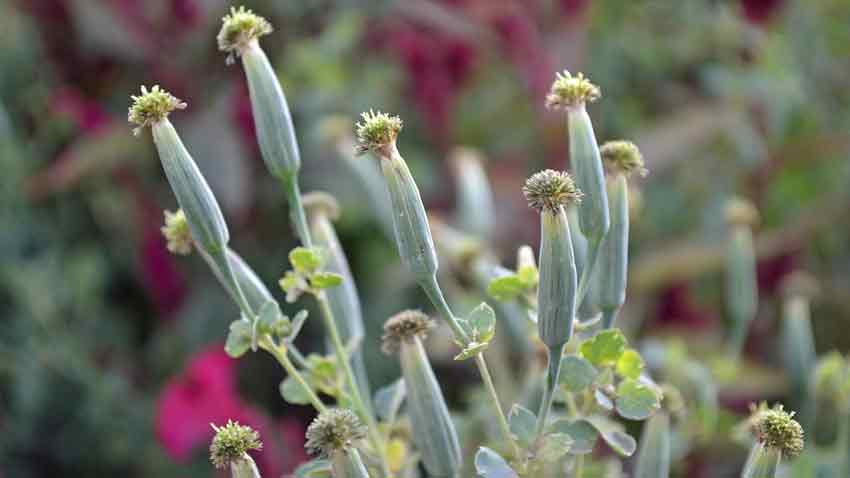
The seed heads start out looking much like marigold flower heads. After flowering, they will set seed and begin the cycle anew. When harvesting seeds to save, make sure to clip the seed head after it has fully matured and begun to dry but before it is completely dry. Otherwise, you will go out to the garden to collect seeds to find it has all blown away!
In October 1999, when Alice Waters, renowned chef of Chez Panisse in Berkeley, California, first tasted one variety of papaloquelite, she was ecstatic and demanded to know why she had never experienced it before. She purchased every seed packet available from the Underwood Gardens booth at the Taste of the Midwest Festival, an annual event sponsored by the American Institute of Wine and Food.
When we met Alice at Slow Food Terra Madre in Turin, Italy, in 2012, we mentioned this past connection. She immediately remembered the event, and her eyes lit up when we discussed the aromatic flavors and how she introduced them to her restaurant patrons.
It’s always used raw and added at the last minute, giving its signature, unique piquant flavor to dishes. It’s used in fish dishes, salsas and guacamole. There is a memorable guacamole that uses cucumbers and papalo for added depth of flavor that we can’t get enough of. We also really like it in scrambled eggs, fresh salsas, and finely diced in a strongly flavored salad of spinach, arugula, mustard greens, and kale. Devilled eggs take on an entirely new dimension with a couple of leaves finely diced and mixed into the filling. People always try to guess the mystery seasoning and always mistake it for something else.
In restaurants in the state of Puebla in Mexico, it’s common to find a sprig of papalo in a glass jar of water on the table, next to the salt, pepper and salsas — ready to be added raw to soups, tacos, tortas or beans. The diners will take off a leaf or two and tear it up finely before sprinkling it over their meal.
Papalo is very easy to grow and has a history stretching back thousands of years, so give it a try in your herb garden this season!
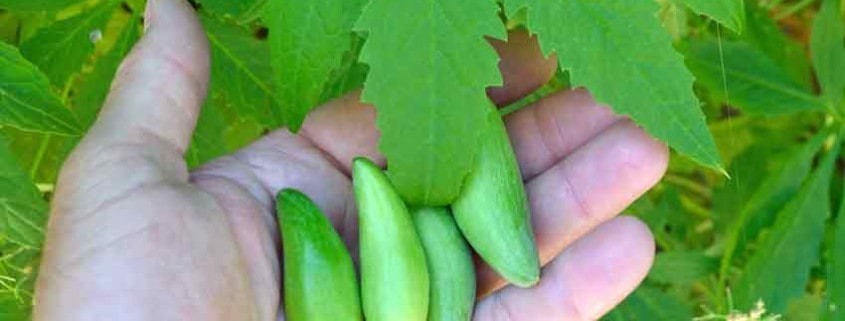
Achocha or Caihua (pronounced kai-wa) is an unusual and relatively unknown member of the cucurbit or cucumber family with a difference. Although they share family roots with cucumbers, squash, pumpkin, zucchini and melons, they arealmost completely immune to many of the diseases and pests that attack the other cucurbits – squash bugs, vine borers, cucumber worms and powdery mildew along with other fungal issues.
Achochaare hugely prolific both in leafy shade growth and fruit, making them a dual purpose plant for gardeners looking for a green shade or windbreak which gives a good supply of tasty food.
Originally domesticated in the Andes Mountains, the seeds travelled by trade from modern day Columbia in the north to Bolivia in the south. This ancient crop has been featured on pre-historic pottery and art and is discussedin the book “Lost Crops of the Incas” by the National Research Council. Today, they are widely grown all across Central and South America, as well as in many other parts of the world. For example, achocha is very popular in northern India, Nepal and Bhutan.

The seeds are very intriguing, looking much like flecks of bark or burnt chunks of a rough plant material. The color ranges from a medium brown to an almost black. Each mature fruit will have several seeds in it.
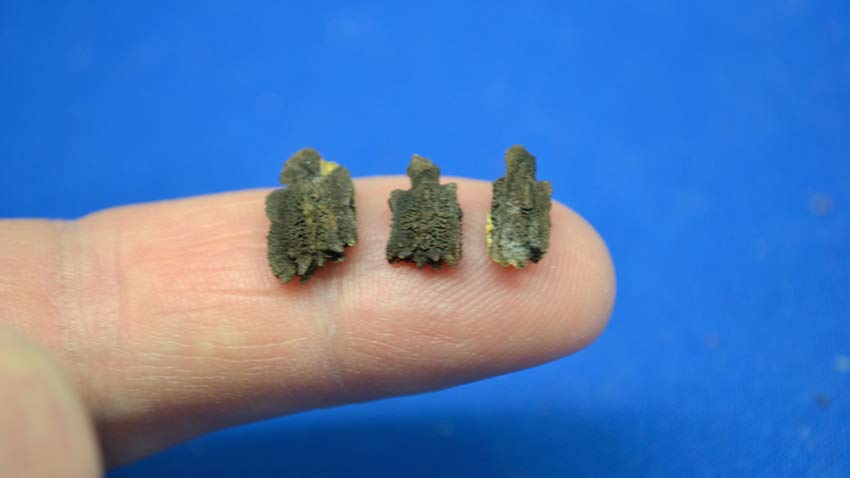
A close-up of the seeds shows how very different they appear from almost all other vegetables, and certainly other cucurbit family seeds.

Another look at the achocha seed. The majority of them have the little tail or protrusion seen here.
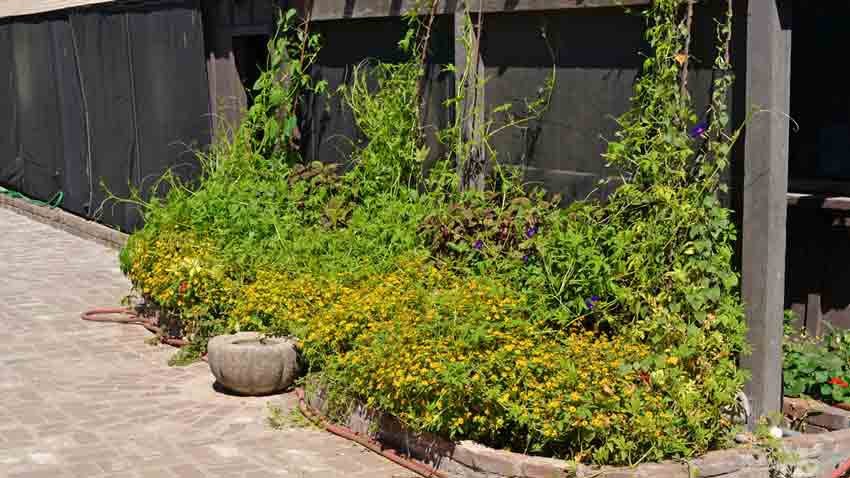
Achocha puts on vigorous vine growth with lots of leaves which provide a good shade for other crops. In areas with a long hot season, establishing them early will give better growth as they slow down during the hottest times. Giving them a bit of afternoon shade and protection helps them along, as they are seen growing up through a patch of Butter Daisies and climbing up a trellis.
This is a western facing wall, and they had a bit of a challenge in becoming well established with the afternoon heat. They had morning shade, but were exposed to full sun and heat during the hottest part of the day until almost sundown.
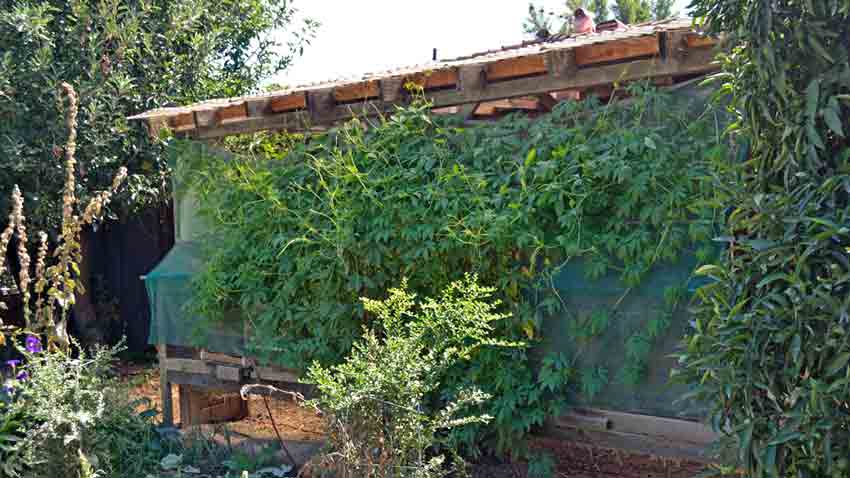
On the opposite side of the wide walkway, they are seen much more established and prolific. This is the east facing wall that is shaded from early afternoon, giving the plants enough protection from high heat and constant sun exposure to really take off.
This was the most productive planting, giving handfuls of fruit each harvest.

Cindy is holding a young fruit with the blossom cap still attached. At this stage the bark-like seeds are still fairly soft and immature. The fruit will not have completely hollowed out yet, but it is very edible and mild in flavor with a soft texture.
Once the plants begin setting fruit, they should be harvested regularly to encourage continued production. As they begin to produce, you will have handfuls of the fruit to work with!
The tiny, off-white flowers can be seen in the background. It is best to plant at least two plants so they can pollinate each other. The flowers will attract a number of smaller insects to help with pollination, among them the beneficial serphid fly which feasts on aphids, thrips and other soft bodied destructive insect pests.
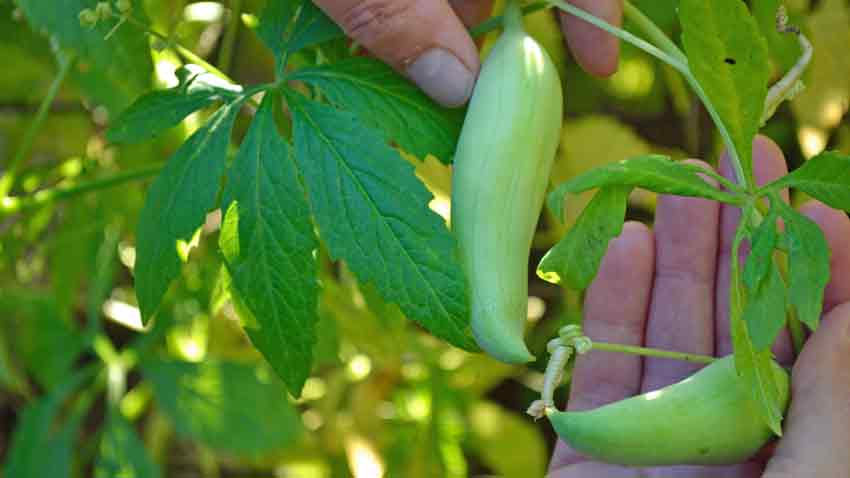
Another view of the size, shape and color of the achocha fruits, along with the foliage. There are a few different varieties of achocha – some with soft spines and a fatter fruit. Ours are more slender and smooth skinned with no soft spines.
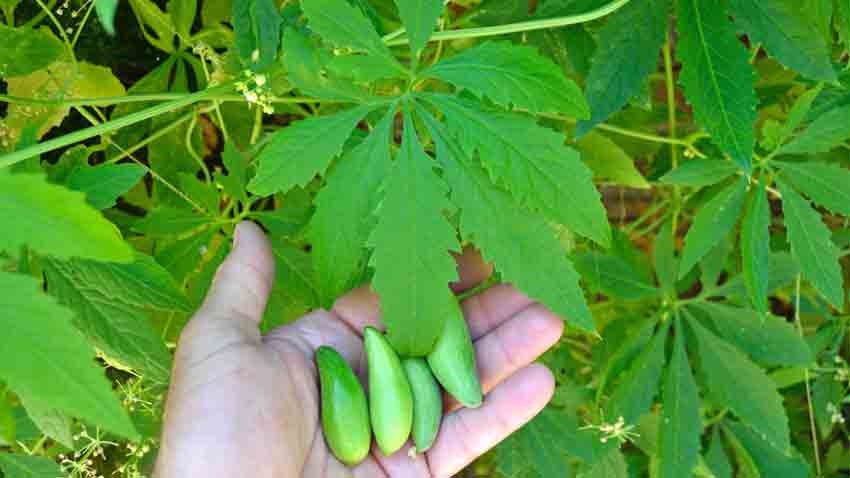
The foliage will sometime raise eyebrows and cause questions, as its long toothy leaves somewhat resemble another controversial plant. There is no relation, but it is a conversation starter!
One handful of fruit leads to discovering another, then another as well…

You’ll see why they have earned the name of “stuffing cucumber” when you slice them open and scoop out the seeds. There are enough recipes using them to fill a thick cookbook, but an easy and delicious starting point is to simply stuff them with sautéed sweet peppers and onions after slicing them open and just warming them up on the griddle.
Very colorful, unique and eye-catching along with being delicious, they will be the center point of the table.
In Central and South America the fruits are eaten either raw or cooked after removal of the seeds. They are also prepared as stuffed peppers; stuffed with meat, fish or cheese and then baked or fresh.
Kids often love to pick and eat them in the garden, and they make an excellent addition to salads. The tender shoots, tendrils and young vines are edible and eaten raw or very lightly cooked.
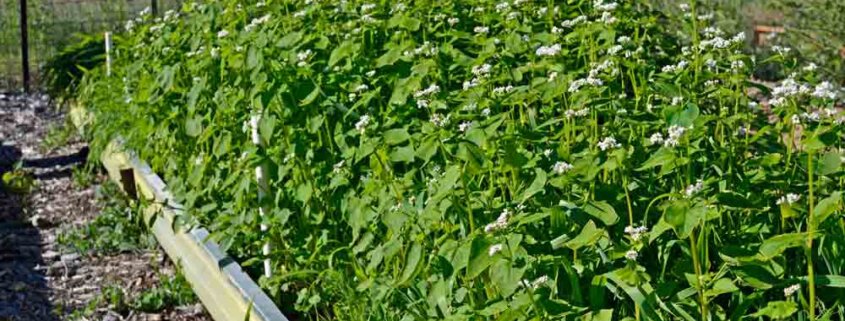 2019 Terroir Seeds
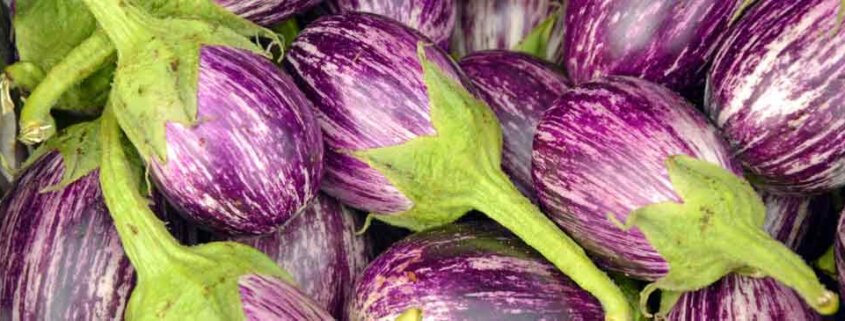 2019 Terroir Seeds | Underwood Gardens