Get ready for a vibrant spring garden! Learn why fall is the perfect time to plant wildflowers and flower seeds for a blooming display.

Get ready for a vibrant spring garden! Learn why fall is the perfect time to plant wildflowers and flower seeds for a blooming display.
Stephen was invited to provide an article on seed quality for Acres USA’s January 2017 issue that focuses on seeds. This is the article that was published in that issue.
Everyone wants higher quality seed – from the seed company, seed grower, breeder and home gardener to the production grower. Even people who do not garden or grow anything want better seed, though they may not realize it.
Education and quality seed is the focus of our company – Terroir Seeds. We make constant efforts to continue learning and educating our customers about how seeds get from the packet to their garden. We recently had the opportunity to visit several cutting-edge seed testing laboratories and the USDA National Center for Genetic Resources Preservation to learn even more about seed testing and preservation. We want to share an insider’s look into a side of the seed world that the average person may not know exists.
Let’s look at this need for higher quality seed from a different perspective.
Everyone is a participant in what can be called the “seed economy”. Everyone, that is, who eats or wears clothes!
Anyone who eats depends on seed of some sort for their daily food – from fruits and vegetables to grains, beans, rice and grasses for dairy and meat production. Seed is intimately tied into all these foods and their continued production. Without a continued, dedicated supply of consistently high quality seed there would be catastrophic consequences to our food supply.
Cotton, cotton blends, wool, linen, hemp and silk fabrics all come from seed. Cotton comes from a cotton seed, wool from a sheep eating grass and forage from seed, linen from plant stalks grown from seed, hemp from seed and silk from silkworms eating leaves that originated as a seed.
Even those who grow and cook nothing need better seed! They still eat and wear clothes.

Chile de Agua for sale at market
The Chile de Agua pepper from Oaxaca, Mexico is a prime example of how seed preservation works. A well-known chef specializing in the unique Mexican cuisine of Oaxaca needed this particular chile for several new dishes. This chile wasn’t available in the US, so we were contacted through friends to work on sourcing the seed.
We found two sources in the US of supposedly authentic Chile de Agua seed and another in Oaxaca, Mexico. After the Oaxacan seed arrived, and those from Seed Saver’s Exchange network and the USDA GRIN station in Griffin, GA we sent them to our grower for trials and observation. All three seed varieties were planted in isolation to prevent cross pollination.
Authentic Chile de Agua has unique visual characteristics, the most obvious being it grows upright or erect on the plants, not hanging down or pendant. Both seed samples from the US were pendant with an incorrect shape. Only the Oaxacan seed from Mexico was correct. We then pulled all the incorrect plants, keeping only the seed from the correct and proper chiles.
The next 3 seasons were spent replanting all the harvested seed from the year prior to build up our seed stock and grow a commercial amount sufficient to sell. This process took a total of four years to complete.
There are two major approaches to improving seed quality – seed testing and seed preservation. One verifies the current condition of the seed, while the other works to preserve previous generations for future study and use.
There are several different methods of seed testing, from genetic verification and identifying DNA variations to diseases to the more traditional germination and vigor testing.
Likewise, approaches to preserving the genetic resources of seed are varied – from a simple cool room to climate and humidity controls for extended storage to cryogenic freezing with liquid nitrogen.
At its most basic, testing of seed simply verifies the seed’s characteristics right now. Whether testing for germination, vigor, disease screening, genetic markers or seed health, the results show what is present or absent today. Changing trends in important characteristics are identified by comparing with previous results.

Seed germination testing
This trend analysis is a perfect example of seed testing and preservation working together, as previous generations of seed can be pulled for further testing or grown out and bred to restore lost traits.
Modern seed testing labs perform a staggering array of tests and verifications on seed samples.
Germination, vigor and physical purity are the standard seed tests for agricultural crops, flowers, herbs and grasses.
These three tests are critical for determining a seed’s performance in the field, and satisfy the US seed labeling law showing germination, physical purity and noxious weed percentages.
Seed health testing screens for seed-borne pathogens like bacteria, fungi, viruses and destructive nematodes. Seed for commercial agriculture and home gardens are often grown in foreign countries and shipped into the US, and vice versa. Seed health testing verifies the incoming or outgoing seed is free of pathogens that could wreak havoc.

Seed vigor test
Plant breeders use the healthiest seed stock possible that is free of any pathogens which would compromise breeding efforts. Agricultural researchers use tested pathogen-free seed to avoid skewing results or giving false indications from unforeseen disease interactions.
Hybrid seeds need to be tested for genetic purity, confirming their trueness to type and that the hybrid crossing is present in the majority of the seed sample. Traditional open pollinated breeders will use genetic purity testing to confirm there is no inadvertent mixing of genetic variations, verifying the purity of the parental lines.
It is common to test heirloom corn for GMO contamination – called adventitious presence testing. This test identifies any unwanted biotech traits in seed or grain lots. This is an extremely sensitive DNA based test, capable of detecting very low levels of unwanted traits in a sample – down to hundredths of a percent. This relatively expensive test demonstrates the absence of GMO contamination, an important quality aspect in the heirloom seed market.
Genetic fingerprinting, also called genotyping, identifies the genetic make-up of the seed genome, or full DNA sequence. Testing with two unique types of DNA markers gives more precision and information about the genetic diversity, relatedness and variability of the seed stock.
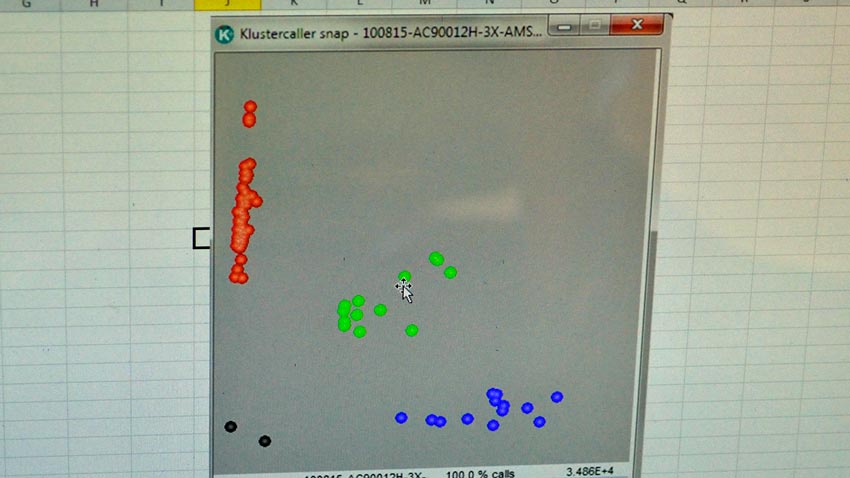
Computer graph of DNA testing
Fingerprinting verifies the seed variety and quality, while identifying desirable traits for seed breeders. This testing identifies 95% of the recurrent parent genetic makeup in only two generations of growing instead of five to seven with classic breeding, saving time and effort in grow-outs to verify the seed breeding. Genotyping also accelerates the discovery of superior traits by their unique markers in potential parent breeding seed stock.
Using established open pollinated seed breeding techniques, genetically fingerprinted parents help produce the desirable traits faster and with less guessing.
To be clear, these are not genetically modified organisms – GMOs – they are traditionally bred by transferring pollen from one parent to the flower of another, just as breeders have done for centuries. No foreign DNA is introduced – a tomato is bred to another tomato, or a pepper to another pepper.
The difference is how the breeding is verified, both before and after the exchange of pollen from one plant to another. The genetic markers identify positive traits that can be crossed and stabilized, and those markers show up after the cross and initial grow-outs to verify if the cross was successful. If it was successful, the grow-outs continue to stabilize and further refine the desired characteristics through selection and further testing. If it wasn’t successful, the seed breeder can try again without spending several years in grow-outs before being able to determine the breeding didn’t work like expected.
There are several different types of seed preservation, just as with seed testing. The foundational level is the home gardener, grower or gardening club selecting the best performing, best tasting open pollinated varieties to save seed from. Replanting these carefully selected seeds year upon year results in hyper-local adaptations to the micro-climates of soil, fertility, water, pH and multiple other conditions.
Seed preservation work also happens with online gardening or seed exchange forums, regional and national level seed exchanges such as Seed Saver’s Exchange and governmental efforts with the USDA.
Many countries around the world have their own dedicated seed and genetic material preservation networks, such as Russia’s N.I.Vavilov Research Institute of Plant Industry. It is named for Nikolai Vavilov, a prominent Russian botanist and geneticist credited with identifying the genetic centers of origin for many of our cultivated food plants.
The Millennium Seed Bank Partnership is coordinated by the Kew Royal Botanic Garden near London, England and is the largest seed bank in the world, storing billions of seed samples and conduct research on different species. Australia has the PlantBank, a seed bank and research institute in Mount Annan, New South Wales, Australia.
The Svalbard Global Seed Vault on the Norwegian island of Spitzbergen is a non-governmental approach with donations from several countries and organizations. AVRDC – the World Vegetable Center in Taiwan has almost 60,000 seed samples from over 150 countries and focuses on food production throughout Asia, Africa and Central America. The International Center for Tropical Agriculture (ICIAT) in Colombia focuses on improving agriculture for small farmers, with 65,000 crop samples. Navdanya in Northern India has about 5,000 crop varieties of staples like rice, wheat, millet, kidney beans and medicinal plants native to India. They have established 111 seed banks in 17 Indian states.
It has been estimated there are about 6 million seed samples stored in about 1,300 seed banks throughout the world.
Seed banks aren’t the only ways to preserve a seed. Botanical gardens could be called “living seed banks” where live plants and seeds are planted, studied, documented and preserved for future enjoyment and knowledge. Botanical gardens range from established and well-supported large city gardens to specialized and smaller scale efforts to preserve a single species or group of plants.
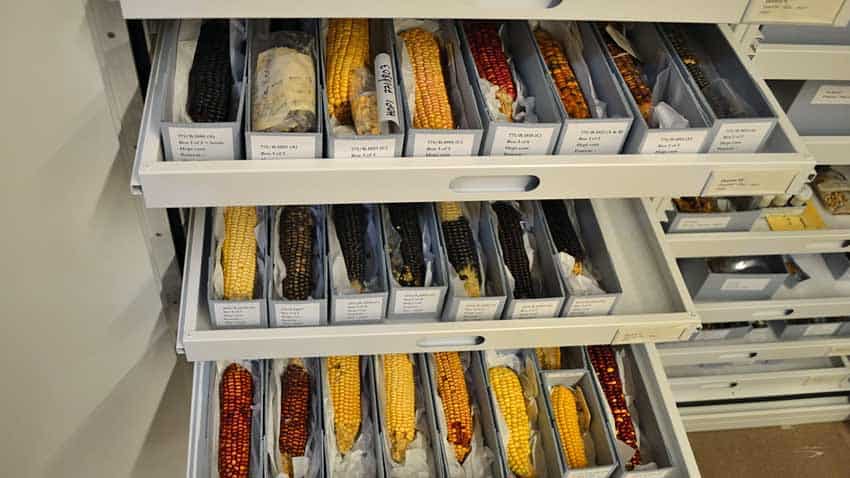
100 year old Native American corn in herbarium
An herbarium is another form of seed bank with a single purpose of documenting how a plant looked at a specific location at a specific time. Herbaria are like plant and seed archeological libraries with collections of dried, pressed and carefully preserved plant specimens mounted and systematically cataloged for future reference.
An herbarium can show what corn grown by the Hopi tribe a century ago looked like, or how large the seeds and leaves of amaranth were 50 years ago. Different herbaria focus on certain aspects such as regional native plants or traditional foods grown by native peoples during a specific time.
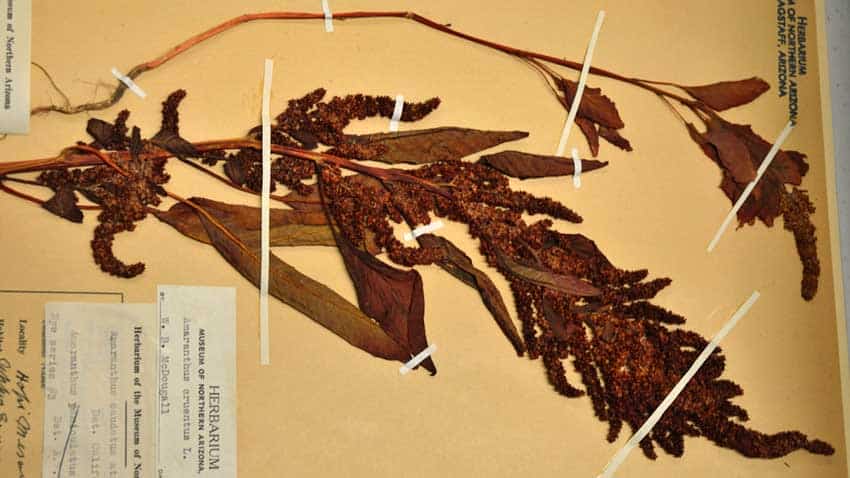
50 year old Amaranth in herbarium
The USDA plays two important roles in seed preservation that is little understood outside those in the seed industry.
The first is the Germplasm Resources Information Network or GRIN for short. It is also known as the National Plant Germplasm System. This collaborative system works to safeguard the genetic diversity of agriculturally important plants. Congress funds the program but it partners with both public and private participants. Many of the seed banks are on state university campuses with private sector breeders and researchers using the available seed resources.
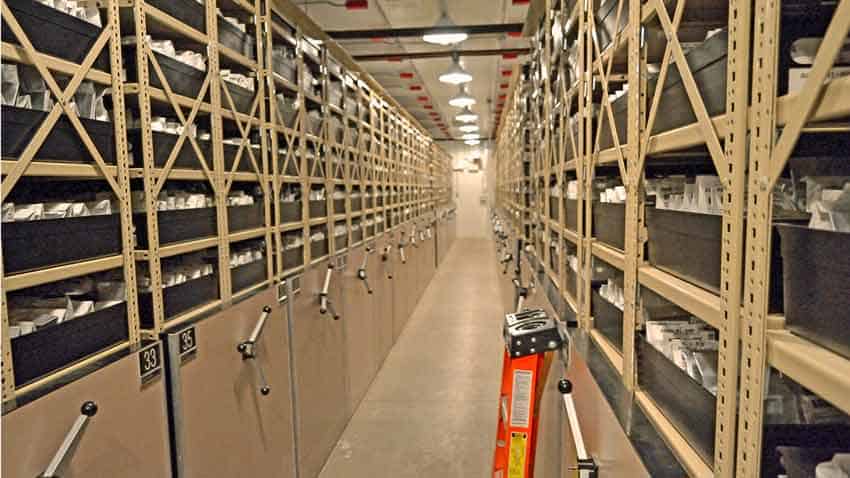
USDA National Center for Genetic Resources Preservation cold vault
There are 30 collection sites that maintain specific seed stock and conduct research on them. Some are dedicated to a single crop like the Maize Genetic Stock center in Urbana, IL which collects, maintains, distributes and studies the genetics of corn. Potatoes are maintained and studied in Sturgeon Bay, WI and rice is kept in Stuttgart, AR. Others maintain regional varieties like the UC Davis location that focuses on tree fruit and nut crops along with grapes that are agriculturally important in the central valley of California.
The second role is the USDA National Center for Genetic Resources Preservation (NCGRP) in Fort Collins, CO. This is the “back-stop” for the GRIN system as well as other private, public institutions and government programs around the world. They store the foundational collections of all the GRIN locations while also working with organizations such as the International Maize and Wheat Improvement Center in Mexico, the International Rice Research Institute in the Philippines and the International Plant Genetic Resources Institute in Rome.
Founded in 1958, the NCGRP maintains, monitors and distributes seed and genetic material samples from their long-term backup storage. After receiving seed samples, they test, clean and condition the seed for the proper long-term storage environment.
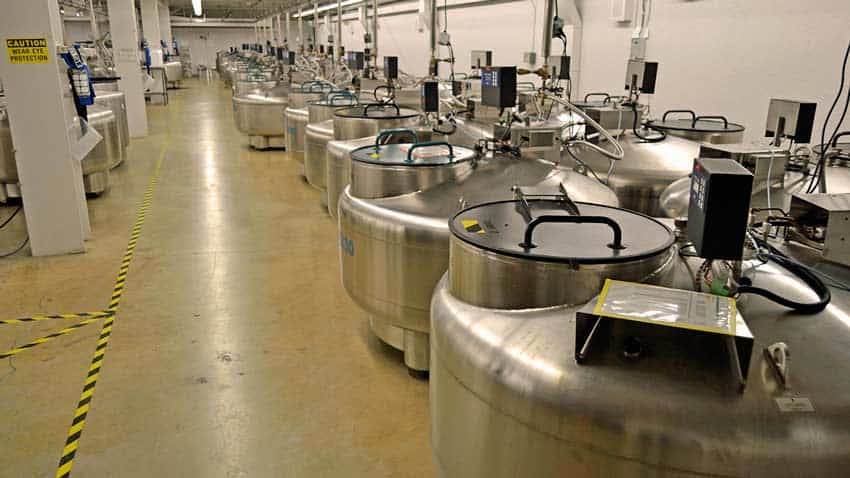
USDA NCGRP’s liquid nitrogen vault
Two long-term storage methods are used. One is a traditional low temperature/low humidity storage and the other is liquid nitrogen storage. The traditional storage is kept at 0°F and 23% relative humidity. Seeds are kept in heat sealed, moisture proof foil laminated bags.
Before seeds are stored in liquid nitrogen a sample is given a liquid nitrogen test to ensure the extreme cold won’t damage the seeds. The sample is exposed to liquid nitrogen for 24 hours, then germinated after coming back to room temperature and evaluated for any germination issues.
If the test results are normal the seeds are stored in clear polyolefin plastic tubes that are barcoded and sealed. The filled tubes are arranged in metal boxes, labeled and stored in liquid nitrogen tanks.
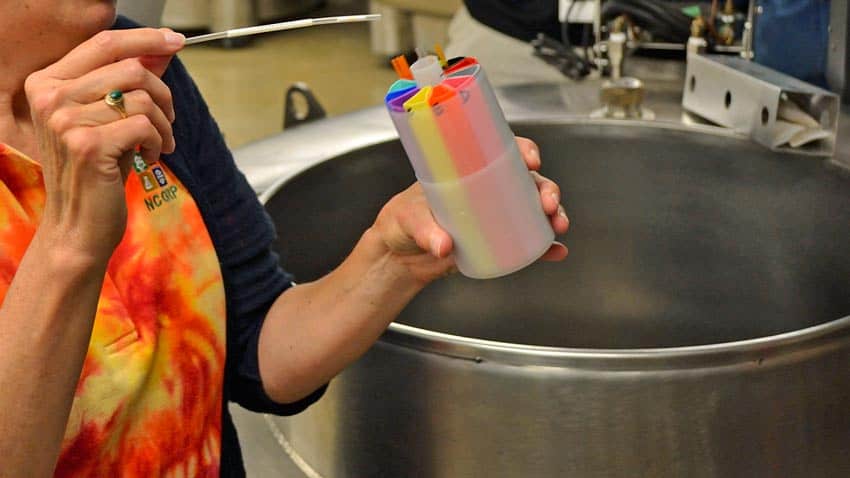
USDA NCGRP’s liquid nitrogen vault sample straw
The vault housing both storage areas is completely self-contained and separate from the adjoining buildings. It has its own backup generator, can withstand up to 16 feet of flooding, tornadoes and the impact of a 2,500-pound object moving at 125 miles per hour. It also has a full suite of electronic security.
If these approaches and techniques seem extravagant, it is with good reason. Our food availability and security increasingly relies on intensive production of fewer variety of crops that are very similar genetically. Along with increased production is increased vulnerability on a larger scale to pests, diseases and other stresses.
By collecting, preserving, testing, studying and distributing seeds and genetic materials immediate food system challenges can be met along with solutions and adaptations for future needs. Changes in growing conditions due to population growth, weather variability, transitions in land use and economic development all make the need for quality seed more important.
All the players in the seed economy support and advance the knowledge and quality of our seed used today. Just as the home gardeners and garden clubs preserve local seed varieties, seed companies are a “back-stop” for them. Seed banks and research facilities back up the seed companies and provide material for seed research.
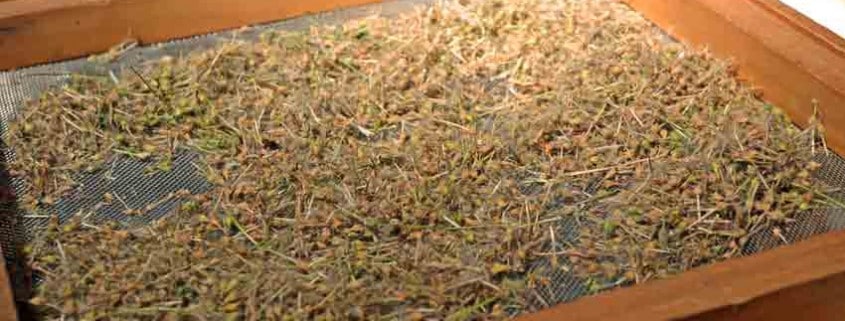
Seed quality matters, whether you are a home gardener, small-scale grower or large farmer; whether you buy all of your seeds, save some for next season or a combination, this information can help you be better informed, make better choices and buy more wisely.
The marriage of the concepts of heirloom seeds and seed saving is not new by any means, but rather one that has been growing and gaining ground in the past several years. For some, this is a welcome return to a more traditional method of agriculture, while others use heirlooms for their flavor and diversity to improve the breadth of their products and offerings to the public.
Cindy and I have been home gardeners for 18 years and involved with soil restoration and rangeland improvement projects with local ranchers for 20 years. Our interest in food, especially good food, goes back a bit further than that! Our appreciation for seed quality and seed saving came from both our work with soils and interest and enjoyment of good food. Tasting the flavors of our garden produce sparked the interest of how to keep those characteristics that the seed produced for the future, to be able to enjoy them and share with others. Thus our seed saving education began.
Several years after taking over, refining and expanding an established family owned heirloom seed company of 20 years, we’ve gained knowledge from the differences and similarities in seed quality, production and seed saving from these two different perspectives. We want to share some of these with you; along with lessons we’ve learned along the way that can help improve everyone’s seed quality.
We will work from a point-to-point framework, showing the goals, concerns, differences, and similarities in both types of seed production and preservation approaches.
The foundational goal is the same for both the home gardener and seed company – having a sufficient quantity of high-quality seed stock of each variety needed for next year that is pure and true to type. This sounds simple enough, but in practice is not always easy to accomplish for either one.
We are approaching this from a seed quality standpoint, not just a seed saving one. Saving seed is fairly simple to do, but the results from planting those seeds can be very mixed; without a basis of understanding of seed quality, people can be disappointed and confused as to why they got the results they did. Both the home gardener and the seed company must understand seed quality to be successful in their respective endeavors.
Goals
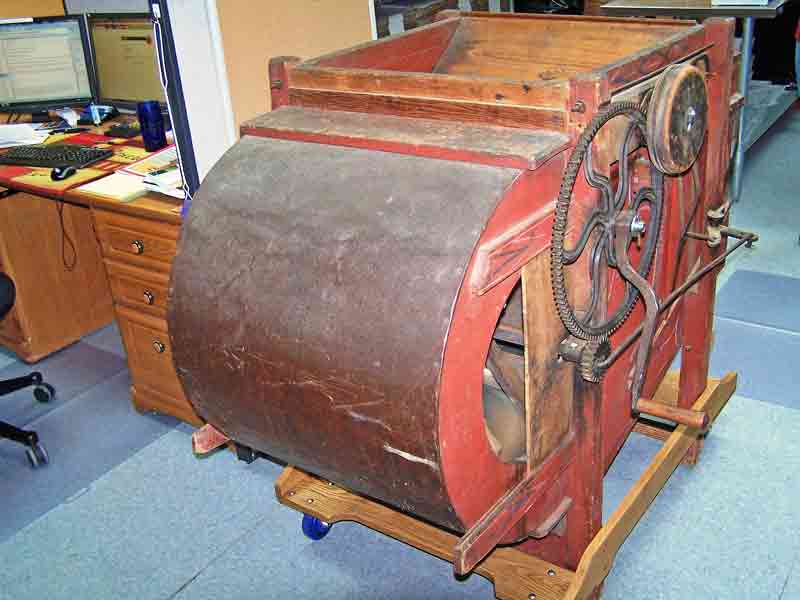
Antique Hand-Cranked Seed Cleaner
Let’s look at the goals and concerns from both points of view:
The home gardener might state the reason for saving seeds as, “Enough seeds for next year’s planting, reduce the amount of seeds needed to buy, take advantage of selection and adaptation to achieve better production in our local climate.” These reasons are the very roots of why home scale seed production is important on a local and regional scale. A diversity of varieties are kept alive that are simply not possible on a national scale, as some regional adaptation can only happen in a small geographical area and won’t be applicable to a larger audience, but are no less important for the local people in that area.
As a seed company, our goals might be, “Produce a sufficient quantity of enough varieties and volume of seed to sell next season, introduce several new varieties, provide a wider selection for gardeners than they can produce themselves and provide a high-quality standard that maintains our reputation.” This reflects how the seed industry started, by offering varieties that were new, unusual or were not available in an area and offering a professional standard of germination and production that benefitted the gardener and grower.
These are similar goals, but on completely different scales and for different results. Their achievement and success depends on how the concerns or challenges are recognized and approached. We have economies of scale as a seed company with our network of growers, but the home gardener has some advantages that we would have a hard time taking advantage of, like keeping a locally adapted regional variety alive.
There are no one-size-fits-all best solutions to the availability of quality seed. A resilient, robust and diverse seed and food economy require home gardeners, regional and national seed exchange programs to participate alongside independent seed companies to contribute all of their unique advantages and skills. Only in this way can the full expression of the diversity and adaptability of open-pollinated seeds be realized and utilized. This might be considered the definition of seed quality!
An obstacle for the home gardener used to be the lack of access to solid, proven and reliable seed saving information and resources. There were lots of introductory articles, booklets, and classes on seed saving, but little in the way of intermediate or advanced classes, books, forums or articles for the home gardener. Thankfully, this is not the case anymore, as the internet has given the home gardener access to more detailed and advanced information.
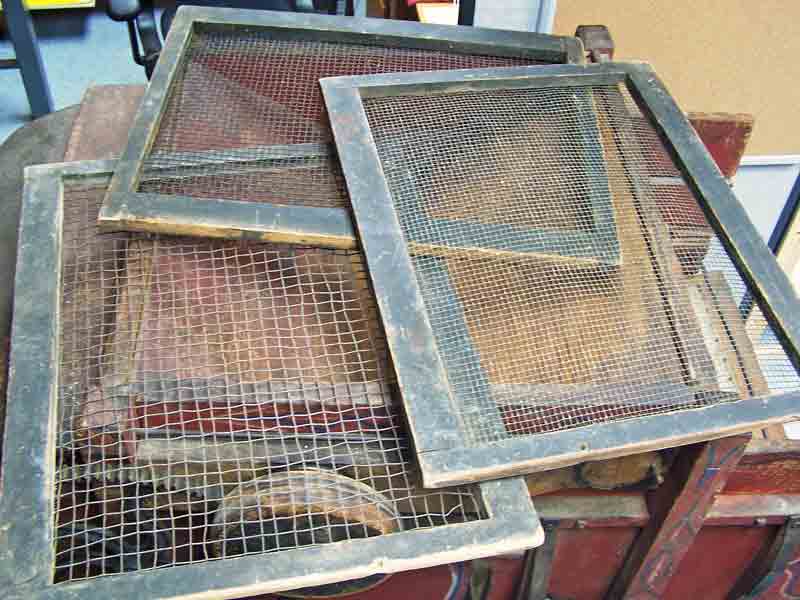
Antique Seed Cleaner Screens
A few examples are Seed Savers Exchange, an excellent resource for the home gardener to learn from and exchange seed stock with. There are also online resources usually used by seed professionals but accessible by anyone such as GRIN, the Germplasm Resources Information Network of the USDA and PFAF, Plants for a Future. There are several books available that are excellent in their education of producing seeds; one is “Seed to Seed” by Suzanne Ashworth that has been one of the standards for seed production and saving for over 20 years. Another newer one is “The Complete Guide to Saving Seeds” by Robert Gough & Cheryl Moore-Gough, which covers flowers, trees, and shrubs.
In addition to the above-mentioned resources, as a seed company, we have access to our growers and other professionals – a group of experienced food and seed producers who have learned through years of training, experience and trial-and-error how to produce the best seeds to continue the traits and characteristics of each variety they grow. These resources are closely guarded, as a highly experienced seed grower is a very valuable resource for any seed company.
Challenges
When looking at the challenges of producing high-quality, viable seed in enough quantities for next year, both the home gardener and seed company face similar concerns. Seed quality should be the primary concern for both. Without high quality, true seed there would be too much variability in all aspects of agriculture, from seed germination, growth, health, pest and disease resistance, food production and the harvesting of more seed. The quality is achieved through proper management, isolation, harvesting, and testing ensuring the viability, vigor and growing true to type of next year’s seed crop.
Management methods
Management for the home gardener starts with the decision of how many plants to use for seed production as opposed to food production, which can be quite different. Ripe vegetables often have immature seeds, while mature seeds are normally found in inedible, overripe or almost rotting vegetables. Some varieties can produce both food and seed by simply letting chosen specimens ripen and mature their seeds on the vine or bush, while the rest are harvested for food, such as a perfect tomato tagged to let ripen for its seeds. Others will need to be kept solely for producing seed, such as a lettuce plant that needs to be allowed to bolt to set seeds.
Minimum Viable Population
A sufficient number of plants, called a minimum viable population, should be used to avoid a genetic bottleneck or the loss of genetic adaptability and diversity that inevitably occurs over time. Sometimes this is hard for the home gardener to do, as often there isn’t enough space for the population needed while allowing for other vegetables to be grown. Our tomato example serves here, as the minimum viable population is 100 plants, way too many for most home gardeners. The rule of thumb is that outcrossing varieties such as tomatoes need 100 plants as a minimum genetic population, while inbreeding ones like peppers need 20 plants. So what is a home gardener to do?
Even modest home garden seed production often results in much more seed than one gardener will use in several years. One very effective solution is participation in member to member seed exchanges either locally, regionally or nationally. This has the dual benefit of introducing a greater amount of genetic diversity to overcome a smaller plant population from any one garden while dispensing extra seed.
As a seed company, this concern is overcome by the number of plants needed to produce the quantity of seed for next year’s sales, and most seed growers who are also food producers have separate fields for seed production, so there is no conflict with seed vs. food growing.
Isolation and Selection
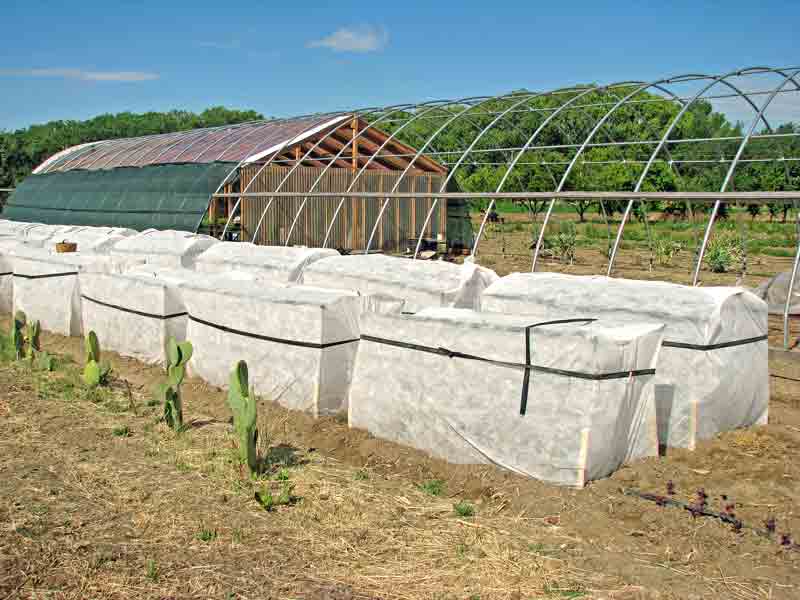
Isolation Cages
To keep seed quality high, isolation and selection are both used as part of quality management. Isolation simply means keeping two similar varieties, such as peppers, from cross-pollinating. Selection chooses the most desirable characteristics to save seed from or removes undesired characteristics from the seed producing population.
Isolation methods can be time, distance or physical. The time method is simply planting two cross-pollinating varieties at different times so that they aren’t flowering at the same time. Distance isolation involves planting far enough apart so that the pollen or pollinators cannot reach each other. Physical barriers prevent the spread of pollen from one plant population to another by cages, pollen sacks or socks, a thorough but time and labor-intensive approach.
Home gardeners often use time isolation by either planting at different times during a growing season, or only planting one variety each season. Distance isolation can become a challenge, depending on the size of the garden or property. Usually, only very dedicated seed savers will use physical barriers.
Our seed company utilizes a network of seed growers to solve the different seed crop isolation requirements. Time isolation is used by those with longer growing seasons while larger growers use the distance approach, having the needed space on their properties. Another solution is several growers producing different seed varieties at the same time. Physical isolation is used extensively when correcting undesirable traits in a variety, during grow-outs to re-introduce a new or rare variety or for traditional seed breeding and stabilization.
Selection is another aspect of quality management in seed production, with two approaches – negative and positive. Negative selection, or rogueing, removes undesirable aspects, characteristics or traits from the seed producing population to maintain the established variety. An example of this is a potato-leaved tomato. Any regular-leaved tomatoes growing in the row would be removed as undesirable for that particular tomato’s characteristics. Another might be the color of the flowers of a vegetable – the purple ones would be removed, as yellow is the color of the correct characteristics. Positive selection involves saving seed with desirable aspects, characteristics or traits such as a large, sweet, striped, early paste tomato. Positive selection over a period of a few years is how local adaptation can be enhanced for the home gardener, and new varieties brought onto the market for seed companies.
Both the home gardener and seed company grower would over-plant slightly to account for selection losses, and perform the selection process as part of their daily gardening and inspection activities.
Germination Testing and Trialing
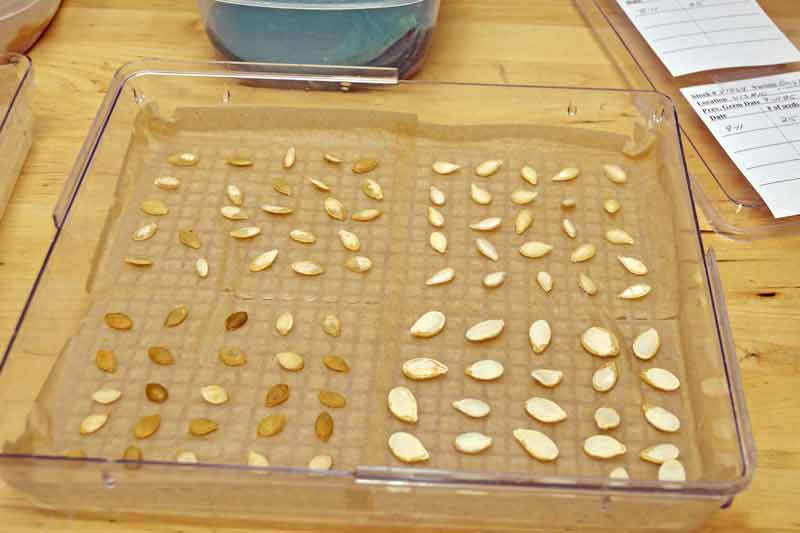
Seed Germination Testing
Two final aspects of quality seed management are germination testing and trialing or grow-outs, which give proof of the seed sprouting quickly with lots of vigor and growth energy, growing true to type with weather tolerance, disease resistance and good production amount. This becomes “the proof in the pudding”, as it shows any weaknesses and confirms the desired characteristics of the variety being produced.
The home gardener can easily test the germination of the current crop of seed early in the winter, as most seed needs to dry completely and age a few weeks before showing the best germination. For most crops a moist paper towel in a sealed plastic bag works very well to test germination. The grow-out can be as a food crop next year so that the production and garden space are not wasted.
We as a seed company will either have the germination tests performed by the grower so that any issues can be addressed before the seed is shipped to us, or we will perform them once we receive the seed from our smaller growers. Either way, all of our seed is tested for germination prior to being sold to our customers. Next spring’s grow-out will be done either by us or the grower, depending on the grower, the seed variety and seed volume.
There are those that would argue that the heirlooms we have today are the result of families saving their seeds and passing them down from generation to generation. This is partly true, but only partly. We have the abundance of heirlooms today thanks to the families that saved them, the local and regional seed exchanges that helped keep them alive and the seed companies that grew them out, advertised them to a wider audience and sold them across the country.
Aunt Ruby’s German Green tomato is a perfect example – grown in northern TN for over 200 years, passed to a great-grandniece, they would have been lost if they hadn’t been passed to Bill Minkey who donated them to Seed Savers Exchange. They grew the seeds out, told their story and they survive today because of that collaboration. Another excellent example is that of the Concho chile from northeastern Arizona. It was grown in the tiny town of Concho, AZ for several hundred years after being traded by the Espejo expedition in 1563 to the local Hopi Indians. Around 2000 it was almost extinct with only a couple of families continuing to grow it. A local lavender farm resurrected it and shared the seeds with us, and we have helped it to reach all across North America and several other countries.
It took the effort of everyone – the gardener, the seed exchange and the seed company to keep these and many other heirlooms alive; one alone wouldn’t have been able to do it. This is the circle of life of the seed, along with those who care for the seed.
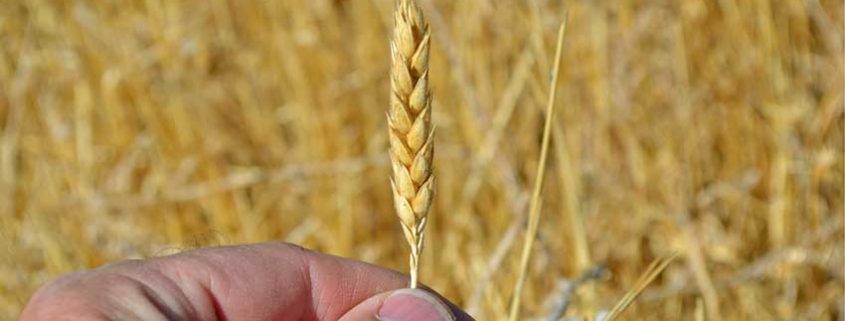
White Sonora Wheat is enjoying a resurgence of popularity today all across the country, thanks to restoration efforts in Arizona and South Carolina. Introduced in the early 1700s by Jesuit Father Eusebio Francisco Kino to the Sonoran region of Mexico and Southern Arizona, White Sonora Wheat was the staple wheat for the western United States for almost 200 years, from the early 1700s to the 1900s. Starting in the early 1800s, California planted Sonoran wheat almost exclusively.
Its popularity was partly due to its resistance to Fusarium fungus, drought tolerance and its exceptionally sweet flavor for baking. It was also prized as a brewing grain, again for its flavor it gave the beer. During the Civil War, much Sonoran wheat was exported from Arizona and California to the eastern states making up for lost production due to the war.
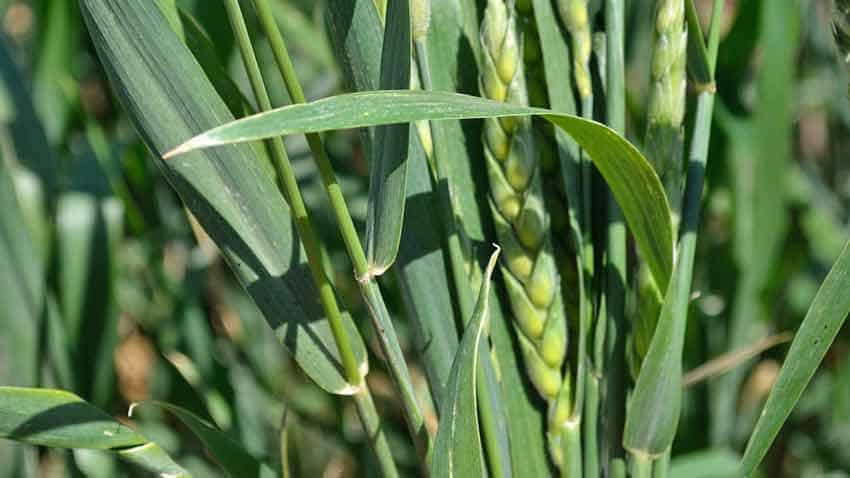
Several factors contributed to its demise as the staple variety of wheat, from expanded cattle ranching in Mexico, the droughts and loss of water as a power source in the 1950s, the closing of many flour mills in Sonora in the mid-1960s, the Green Revolution with its hybridized wheat varieties and the switch from wheat production to vegetables as dams closed off the rivers in northern Mexico. By about 1975, there were no more commercial sources of White Sonora Wheat available.
A lot of attention is being paid to wheat today, mainly due to the rise of gluten intolerance or celiac disease in which a person cannot digest the gluten part of wheat in their diet. For a more in-depth look at this issue, read my article “What’s Wrong with Our Wheat?”.
This is one of several areas where White Sonora Wheat really shines, as it is lower in gluten and higher in protein than today’s super-hybridized dwarf varieties. White Sonora Wheat is an extremely flavorful semi-hard white spring wheat that can be used for whole wheat flour in breads, cakes, pancakes, tortillas, and more. By many accounts this is the best flour for cakes, breads and tortillas ever. Because it is a white wheat, not a hard red wheat, it makes lighter products that have a sweeter and lighter flavor than those typically associated with whole wheat. The berries can also be boiled and used like rice or sprouted for wheat grass.

Another advantage the White Sonora Wheat has is a thinner, more paper-like husk, unlike other ancient cereal grains that require a mill to remove the husk and then can be ground. When we recently visited our grower, we were shown a large bag of the wheat that had just been harvested, with no other cleaning or sorting. You can see the video below, and see the weed seeds among the wheat, but also the very few seed heads that have any husks on them. The husks are removed by the mechanical action of the harvester, with the remaining ones rubbed off easily with a couple of fingers.
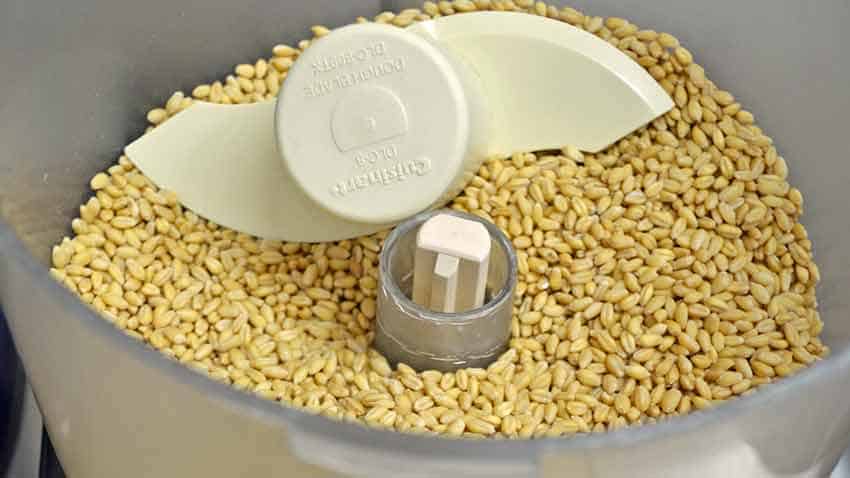
For the home gardener or small scale grower, this can be done fairly easily with some hand or kitchen tools. Depending on how much wheat you have to process, a kitchen food processor such as a Cuisinart fitted with the plastic dough blade can separate the husks from the grains. Pulse the blade to prevent from breaking too many of the grains and making it harder to separate the wheat from the husks or chaff. Fill the bowl up about 1/2 to 2/3 full and work in batches.
Another method is to use a 5 gallon bucket with a paint mixer attachment on a hand power drill, either the spiral or traditional cross or paddle type. Use a moderate speed and move the mixer around the bucket to create the friction that loosens the husks. You will need to stop and check the progress, but will quickly get a feel for how long to use the mixer.
White Sonora Wheat has a root structure much like a perennial prairie grass with long taproots and a web of smaller feeder roots, unlike the simple and shallow hybrid roots of today’s wheat. These longer taproots bring water and nutrients from deeper in the soils, making the plant less susceptible to moisture fluctuations. It also helps to open up the soil when the wheat is harvested as the root system decays, leaving behind a network of air and water passages. The wheat can thrive on marginal soils and actually produces better flavor on these soils, though production volume is lower than modern ones.
With all of its advantages, flavor and nutrition, ease of growth and harvest, along with being adapted to dry climates and improving the soil, it is easy to see why White Sonora Wheat is regaining its rightful popularity! It is usually planted as winter wheat in areas with mild winters and as spring wheat everywhere else.
One of our customers graciously sent some photos showing how he processed the wheat after harvesting it. He started with 3 oz. and the end results are pretty impressive! Thanks to Paul from California for sharing these with us!
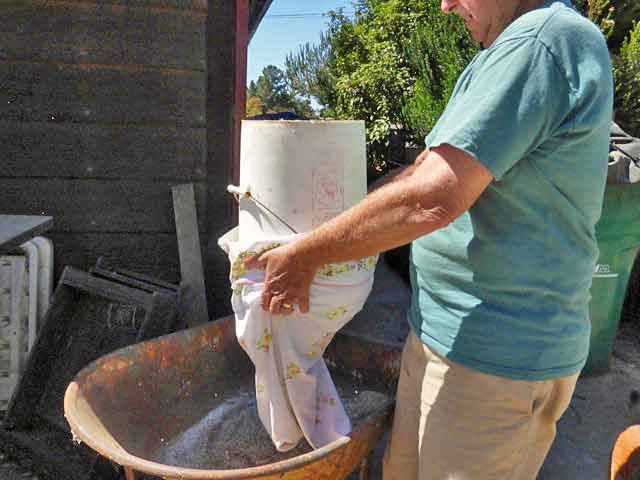
He starts with dumping the uncleaned wheat into a sack or heavy pillowcase – heads, chaff and remainder of stems – all of it.
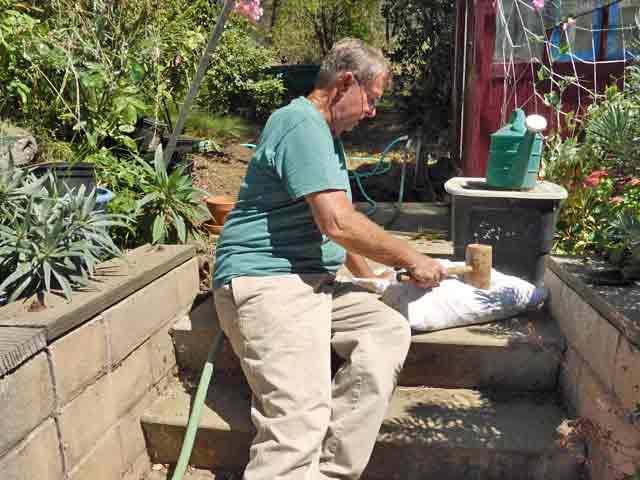
Then using a large, lightweight wooden mallet, he applies physical friction to the bag and wheat, loosening the hulls. This isn’t a pounding action, and he tries not to hit through to the bottom of the sack, only gently thumping the top and going down about halfway into the wheat.
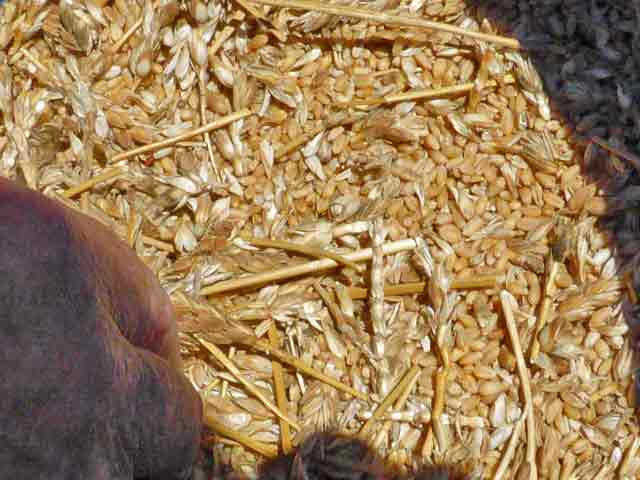
After a few minutes of friction, this is what the wheat berries look like – very much the same as what comes out of the combine, but with some stalks and stems in the mix.
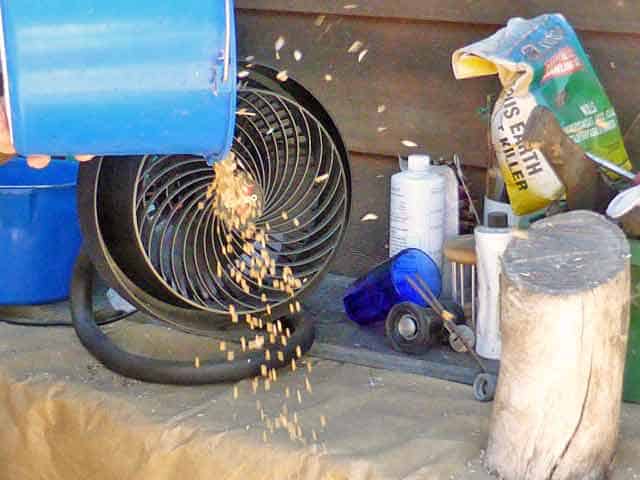
Next is winnowing the wheat, or separating it from the husks or chaff. The basics of this process haven’t changed since it was written about in the Bible – use a breeze to blow the lighter chaff off of the heavier wheat berries. Paul said he had to repeat this step a couple of times, but got a really clean batch of wheat.
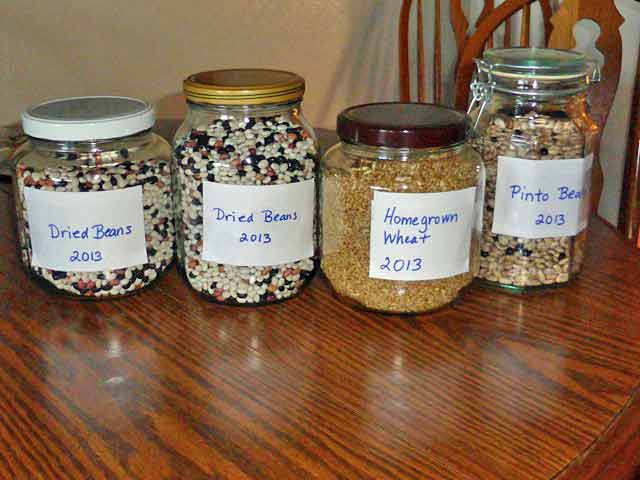
Here are the results! Pretty good harvest from a 3 oz. start. This is fairly typical return with wheat, it should be in the range of about 40:1, meaning if you plant 1 oz. your harvest should be around 40 oz.

Survival seeds, emergency seeds or emergency seed banks – whatever term is used – have had a lot of attention and marketing focused on their purchase, storage and use in the recent past. The scenario usually goes something like this: buy this vacuum packed, nitrogen flushed can of emergency seeds for feeding your family in a disaster or crisis situation. The seeds are specially packaged for long life, and a single can will plant a 3/4 – 1 acre garden. These emergency seeds will be good for anywhere from 4 -5 years up to 20 – 30 years, depending on whose website you visit. One container of seeds can easily feed a family, more often a neighborhood. You can save the seeds from the harvest, ensuring a continual source of seed to grow more food for yourself. Sounds reasonable and encouraging, doesn’t it?
There are some faults with this direction of marketing and thought, though. Let’s look at a few of them to gain a somewhat different perspective on this issue. First is the quality of the emergency seeds themselves. If the seeds aren’t high quality and from an experienced, knowledgeable grower with a good germination potential and are pure and true to type, you are starting with a mixed bag and will get poor results. This rests on the seed supplier. If they are like most “Survival” supply companies they are a reseller, buying all of their inventory from wholesale companies, marking up the prices and shipping the products to you. They aren’t gardeners or growers and are not knowledgeable about agriculture or the seeds they are selling. It is worth asking some questions of them, such as where their seeds come from and how are the seeds sourced.
Another concern is how the seeds are packed. Seeds are living organisms and need certain conditions to remain alive. Vacuum packing and nitrogen flushing are very commonly used sales terms in describing why you should buy a particular brand of emergency seeds. These techniques sound great in helping to extend the shelf life of the seeds, but are really unnecessary for real-life emergency needs, as we will soon see.
The viability or lifespan of the seeds in storage is much more dependent on the temperatures and humidity levels than what gas the seeds are flushed with. Storage in high temperatures or high humidity conditions will drastically shorten the germination ability of the seeds – sometimes to just a few months – instead of the years that are advertised. Yes, the container is sealed but is not immune to outside temperatures. Besides, after the seeds are opened, how is the nitrogen flushing going to be replaced? It’s not, and it doesn’t really matter because the seeds realistically should be used in a relatively short time-frame and not stored for decades. You need the food that the seeds will grow, not just a container of seeds. Think about how humans have kept themselves alive for thousands of years, planting stored seeds from the previous couple of years, without the modern benefit of nitrogen flushing and vacuum storage, not to mention freezers or refrigerators.
Speaking of using the seeds in a relatively short time-frame, meaning planting and producing food from them, the seed stock should be rotated on a regular schedule just like the rest of your food stocks. Under normal household conditions, most seeds will be viable for 3 – 5 years. Some exceptions are the onion family – onions and leeks – as well as the hulless pumpkins. Their viability and germination really starts dropping off after the first year. They should be used regularly to grow food for the family and then replaced as the stock for a variety is used up.
Now we come to the most important point of emergency seeds in storage – their use. Unfortunately, many folks will look at the purchase of an emergency seeds source as a check to be made on a preparedness checklist. They will get their can of seeds in the mail, check the list off, and put the seeds in a safe place and move on to the next item on the list. This is analogous to that same person buying a firearm and ammunition, checking off the list and putting them in the closet. When needed, they realize that they have bought a rifle but the ammunition is for a shotgun, they’ve never tried to load the rifle and don’t know how to aim or shoot with it! Oversimplified, yes, but the point is the same. Seeds have incredible potential but their food value when sitting in the closet is pretty slim. They have to be used – planted and grown – to produce the food and realize the potential that they represent.
Gardening is a skill, much like being able to shoot accurately, clean and reload the firearm in a safe and efficient way. Other similar skill-sets are first aid, fire-starting or other bushcraft skills. These are perishable skills that must be practiced to be effective. Gardening is much more than simply scattering some seeds, watering them a bit, waiting a few days and then harvesting some food, as anyone who has practiced the art of gardening for more than a year will attest to! It takes time to make the mistakes, realize them as mistakes and learn from them. The time to start learning to grow some of your own food is today, not when the power goes out or the fuel shortages have stopped the trucks from delivering food to the local supermarket. It takes some time to learn the techniques of good gardening, and waiting until an emergency is in progress to start could be a very costly mistake in many ways.
Another mistaken assumption is being able to save seeds from the first year’s garden to continue a seed supply into the next year. This really ties into the skill of gardening in the above paragraph. Almost no-one that is inexperienced in gardening will be able to gain the skills in that first year needed to understand and maintain plant isolation, pollination and minimum population needs to ensure a viable and genetically robust supply of all of the seed varieties that they plant in the garden in that year.
First year gardeners will have their hands full learning the intimacies of their garden’s climate, soil nutrition and moisture needs along with how to keep the small and large veggie predators at bay, keep the young seedlings from freezing in a late frost or the grasshoppers or bugs from eating all of the leaves during the height of the summer. Seed production is an entirely different chapter to learn! That is why seed companies are around. Once a gardener has some experience in growing their food, then simple seed saving can be started with a much better understanding of what is needed without overwhelming them. They will then be much more successful than someone who is just starting out and trying to learn and be successful at everything in the first season.
A final thought on relying on emergency seeds as a food supply: what kind of food supply are your emergency seeds going to provide in the middle of the off season – meaning the winter in most of the country, or the middle of summer in the lower desert regions? Emergencies or disasters don’t always occur when the weather is nice and the garden can be worked. For this reason, a supply of emergency seeds needs to have a broader focus than most on the market. What can be planted that will grow quickly enough to provide nutritious fresh edibles for a family, no matter what time of year it is or what the growing conditions are?
Sprouts are an excellent example of what can be grown in any climate, at any time of year, with no soil, sunlight or space requirements. Four square inches on a countertop is all that they need. Many backpackers will continually sprout seeds for a fresh food supply when on long, multi-month treks for just this reason. A simple rinse once a day is all that they need to ensure a tasty, highly nutritious fresh food with no work.
For these and several other reasons, relying on a pre-packaged container of emergency seeds to supply the majority of your food in an emergency is probably not the best plan, especially if you are not an experienced gardener already. A seed supply can supplement an emergency food pantry with fresh greens and tasty vegetables, making the dehydrated or freeze-dried menus much more enjoyable. Let’s look at one approach to growing some of your own food based on an emergency timeline. We need to examine several assumptions that must be made before going on, as there is no possible way to anticipate every disaster or emergency scenario, or forecast in this article the range of home preparations that can and should be made. Most of these are easily prepared for well in advance.
The assumptions are these –
Starting on the day the power fails or the emergency occurs, let’s look at a timeline of what is possible, things to have in preparation and how everything can tie together to feed yourself in the short and medium term.
For the first week you should be able to eat out of your refrigerator and freezer. This is where the importance of a fairly well stocked fridge and freezer comes into play. Those that only have stale milk and coffee in the fridge won’t have the other resources to accomplish what we are talking about. The refrigerator will keep things cool for 2 – 3 days, depending on your location and temperatures outside. The freezer will become your fridge in 3 – 4 days as things thaw out but stay cool.
On the first day of the emergency, several things need to be done to start the sequence of growing that will help feed and sustain you for the next week to month or so.
As you can see from the list above, there will be a limited diet for the first three weeks to a month if you are not currently growing anything when the emergency occurs. This is why a well-stocked refrigerator, freezer and pantry are important, along with an on-going garden. Being able to use the fresh garden produce to supplement the dried, canned, freeze-dried and otherwise prepared foods will make meals much more interesting and tasty. Of course, if a garden is already in production, then everything changes, as the food supply isn’t nearly as threatened.
A supply of emergency seeds can be a critical positive factor in any disaster preparedness plan. It is perhaps best to look at any seed supply as part of a “Life Assurance Plan” where the basic needs of your family are supplied without needing to run out and buy something (or everything) when an emergency happens. A Seed Assurance Plan, as part of life assurance, means investing in seed, growing knowledge and experience instead of waiting for the disaster to strike and hoping that the seed will grow into enough food to feed you.
Hope is not a plan for providing for your family, especially in a disaster or emergency. You don’t hope to find a job, business, or career that will help feed, clothe, and house your family in daily life. You plan, get education and experience, and take risks and actions that move you in the direction you want and need to go. The exact same thing applies to your seed supply!
One thing that we do hope is that this article has given you food for thought in how a good supply of heirloom seeds, along with common sense forethought, can help get you through any unforeseen emergency or disaster. Obviously, this is an introduction to some concepts that aren’t being talked about nearly enough. This is a complex topic with many branches, offshoots and directions to go that really can’t be introduced here. The next steps are up to you, but aren’t difficult. Get started today and start small. Read more, get more education, become more informed and start your garden, even if it is just a couple of 5 gallon buckets on the patio or back deck. Find what interests you and pursue that angle or direction.

Have you ever wondered what goes into the packets of heirloom seeds that you get in the mail? Those little paper envelopes have a lot of work, care, love and attention in them. We wanted to show you a little peek behind the scenes on how we pack our seeds here at Terroir Seeds.
Some people don’t know that we hand pack each and every one of our heirloom seeds packets, while others don’t understand why we don’t use a machine to pack them. To answer the second point first, the seed packing machines that are used in larger seed companies are prohibitively expensive, even when available used. They are fast, but require cleaning and recalibration to the new seed for each and every seed variety packed. In our company, this would mean we would spend about two thirds of our time cleaning and calibrating the machine and less than a third in packing seeds. It doesn’t make sense for us quite yet! And yes, we actually do hand pack each and every seed packet that we ship!
For quality control, we only work with one type of seed at a time. This avoids mix-ups, as all tomato or pepper seeds look the same! When a new batch of seed arrives for the season, we count the number of seeds that are supposed to be in each packet, then find the correct measure that will consistently give us the number we are looking for. This may mean we count the same seeds several times, to make sure we are putting the correct number in a packet. We try to err on the generous side. Sometimes that is the same measure as the year before, but not always. Differing weather conditions, nutrient availability, pest and disease pressures all play a part on the physical size of the seeds from year to year.
As you probably imagine, this part of our business is very important to our continued growth. It is a detail oriented, behind-the-scenes type of job that requires high levels of concentration. With our growth, keeping up with the seed packing is requiring more time and will soon be a full time job.
We hope you enjoy the video and learn a bit more about why we put so much effort and love into our seeds!

“Seeds hold the potential for everything, the beginning and the end and the beginning all over again. Seeds are the building blocks of every meal we eat; all our fruits and vegetables, all our grains, plus the meat and milk that’s raised on grass and grain.”
Simran Sethi is an award-winning journalist, strategist & educator who teaches & reports on sustainability, environmentalism & social media for social change. Simran is dedicated to a redefinition of environmentalism that uses innovative forms of engagement & includes voices from the prairie, urban core & global community. She recently gave an inspiring presentation at TEDx Manhattan on Seeds – The Buried Beginnings of Food where she shared how much seeds really do matter to all of us, no matter where we live or what we do as a profession.
After showing how few varieties of edible plants we cultivate for our food – about 150 out of more than 80,000 – she goes on to explain the vast majority of humankinds food comes from just about 30 species. In America, over half of our daily calories come from just 4 foods – rice, corn, wheat and potatoes! We are seeing the results of a gradual shrinking in the variety of our food supply over the past 50 years, what is known as a loss of agricultural biodiversity. This is the unintended consequence of a system that was originally intended to increase productivity and feed the world – large-scale industrialized agriculture.
Moving on, she shows the staggering loss of the cultivated foods we used to depend on – by some estimations a 75% loss of food varieties that have disappeared since 1900. Combined with this is the alarming consolidations in the ownership of seeds, essentially seed monopolies. Three corporations now account for over half of the global commercial seeds market today. This includes hybrids and GMOs, both of which can’t be saved and re-planted for the next year. With this model, seeds have become non-renewable resources, inventions created by companies that farmers are required to buy from year after year.
One company now controls the genetics of nearly 90% of the corn, cotton and soybeans grown in the United States. That same company bought the world’s largest developer and grower of vegetable seeds in 2005. As she so emphatically states,
“Monopolies are hideous with our cellphones, we know this! They are disastrous with food, because food and seeds aren’t just any other commodity.”
Watch her powerful presentation, learn a few things and become inspired to take a more active part in your food!
There is a groundswell among home gardeners looking to grow their gardens in a less chemically intensive and more biologically responsible way. They spend hours reading and researching the best ways to build the health and fertility of their soils, improve the microbial communities in the soil and attract earthworms and beneficial insects and pollinators. The appearance of more earthworms, a new species of butterfly or pollinating moth is cause for celebration.
Seeds are a high priority for these gardeners. The purity, quality and provenance are paramount. After all the work and care that goes into the soil and preparation, they rightly want the best and highest quality seeds possible.
Surprisingly, this is exactly where the home gardener and small scale grower may be getting shorted on quality. Growing for seed as opposed to growing for food has its own unique challenges. For a plant to set seed it must reach full maturity, set flowers and produce seed. This takes much longer than a plant grown for food which is usually harvested at a much younger stage, succulent and tender. Producing seed exposes the plant to a whole host of insects and diseases that younger plants may not experience, due to the phytochemical changes that take place as the plant matures sexually in order to reproduce.
Margaret Roach wrote a great opinion piece in a recent New York Times Sunday Review:
“In my own vegetable beds I use no chemical heroics, and yet I had been using some conventionally produced seed that is often coddled and adapted to a life of “high inputs” that it won’t get from me or from an increasing number of other chemical-averse home gardeners.
That packet of seed may not grow as well in my garden as one that wasn’t grown with chemicals, and it also probably contributed to upstream pollution.”
Agricultural regulatory agencies allow an expanded use of petro-chemical pesticides, fungicides and fertilizers if a grower specifically grows for seed production and not food production. Many large-scale seed growers take advantage of this loophole, with the unintended consequence of creating a population of seeds that have become dependent on high-input, chemically intensive agriculture that many home gardeners are moving away from.
This has been ongoing for several decades now and is just being discovered as more and more gardeners and small scale agriculturalists are growing with less chemically intensive methods and are looking for sources of seed that are in line with their vision.
The end result of using seed grown under these conditions is that they usually don’t perform as well. They don’t germinate as strongly, are slower to put on growth, develop fewer flowers and are much more pest, disease and weather susceptible. In short, they simply aren’t as strong and resilient as those seeds grown in more biologically active soil with little to no chemical inputs.
While modern chemical agriculture initially looks very promising with better growth and increased yields, it is always discovered that plants grown with amply available macro-nutrients afforded by the chemical fertilizers become lazy and lose the ability to work for their nutrition, growing ever more dependent on the applied fertilizers for food and pesticides to control the insect populations.
The solution to these issues is to find seed sources that concentrate on growing their seed in a natural and low-input manner. These are often smaller, family-owned companies that are happy to answer questions on how their seeds are grown. They know the story of the seed they offer and willingly share it. Patronizing these companies only helps to strengthen the entire system by rewarding those that are congruent with the natural order of agriculture.

San Marzano tomatoes are world-famous with a long and storied history as the absolute best plum tomato for sauce and pizza. They are also excellent for canning, peeling and drying. Chefs worldwide prefer this variety to all others for making their signature sauces, and it is the only tomato that is acceptable for making true Neapolitan pizza. Many Americans are becoming fans and learning why this tomato created the peeled and sauce industry in Italy and across Europe.
San Marzano tomatoes are named for where they originate, the Campania region of southern Italy above the “toe” of the “boot”. Valle del Sarno is the valley where the recognized and protected variety is grown. The reason for this strict preference is the soil – a rich volcanic soil from Mount Vesuvius – that gives the tomato its distinct richness and depth of flavor. In fact, they are the only tomato that can be used for a true, recognized Neapolitan pizza! People who have tasted the native tomatoes grown in the volcanic soils claim that they can tell the difference between tomatoes grown there and those grown elsewhere, even if it is similar soils.
San Marzano tomatoes are thinner with a pointier end than Roma tomatoes, with a noticeably richer and mildly sweeter flavor. It has a thinner skin with fewer seeds and a meatier flesh than the Roma, with a higher pectin content that produces the thicker sauces it is famous for. This famous variety was developed from traditional breeding of three Italian tomatoes in the late 1800s; the King Umberto, Fiaschella and the Fiascona. Only the King Umberto tomato is still grown!
San Marzano tomatoes have been commercially popular since around 1875 when the first cannery was built to pack and ship these jewels across Italy and Europe. The popularity of the San Marzano declined during the 1970s as hybrids gained popularity for their thicker skins and tolerance of machine harvesting and marketability, but saw a resurgence in the late 1990s as people realized the flavor that had been lost with the original. Of 27 cultivars being grown in the Valle del Sarno area in the early 1990s, only 2 were selected as being the most representative of the traditional San Marzano. In 1996 the European Union granted Protected Designation of Origin status to the San Marzano tomato.
The San Marzano Redorta is one of the more popular cultivars of San Marzano due to its larger size and prolific production. The name creates some confusion, as this tomato comes from the Tuscany region, which is north of Campania where the tomato originated. It is supposedly named for a mountain – Pizzo Redorta – in the Lombardy region near the Italian Alps, which is much further north still. So, a larger version of the treasured San Marzano that is from Tuscany and not Campania, yet named for a mountain that is almost the length of Italy away? Stranger things have happened!
We do know that it is a great tasting and producing tomato with all of the traditional characteristics that have made the San Marzano tomatoes famous and have brought it back to being a heavyweight in the sauce tomato world. Whether you grow the traditional San Marzano or the Redorta, the flavors and production are sure to win you over.
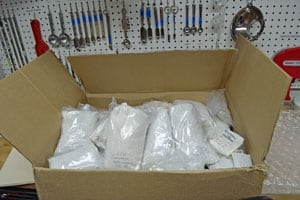
The holidays come early when you work with heirloom seeds, as shipments from growers start arriving in early November and continue as the seeds are harvested, cleaned, dried and shipped to us for packing.
Some of our seeds arrive in cloth bags with hand-written variety descriptions on them, others arrive in large paper bags tied shut and yet all of them clearly show the care and love put into their growing and production. We wanted to give you a short tour of what it is like when seed arrives!
This particular shipment is always accompanied with high anticipation, as it comes to us from one of our growers who is incredibly talented and experienced. Their advice has been invaluable, whether it is in recommending new varieties to offer or catalog suggestions.

Bags of Heirloom Seeds
Each variety is in its own cloth bag with the variety name handwritten on it. They are wrapped in plastic to protect them from possible moisture in shipping. This particular box was a bit smaller this year, as we brought home almost this same amount when we visited our grower this past September.
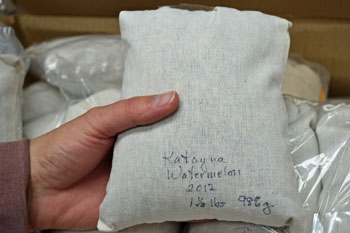
Heirloom Seed Treasure
When we received the very first shipment of seeds, we were talking about how they resembled bags of treasure. Cindy remarked that this is very much just that- treasure from the past that has been kept alive by people before us that valued these seeds enough to save and preserve them for the future.
That future is now, and we are the recipients of that treasure of knowledge and hard work. This Katanya watermelon is from a woman named Katanya who brought its seeds with her when she immigrated from Russia. It is humbling and thrilling at the same time to hold more than a hundred years of history in a bag in your hands, along with who knows how much future!

Papalo Seed!
Some of the seed is just fun to handle and play with. Papalo is one such variety; an ancient Mexican herb that was largely replaced by Cilantro, a Chinese herb. It is extremely light and feathery, resembling a dandelion seed with its “parachute”. Papalo requires special handling and packaging, as if the seed is broken off of its parachute, the germination suffers drastically. The bag Cindy is holding weighs a couple of pounds at the most.
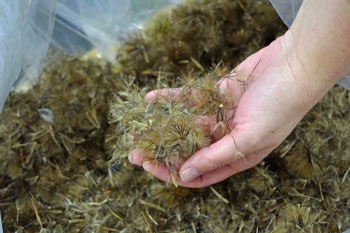
Handful of Papalo
This handful of Papalo has about a hundred seeds, which have to be packed and shipped in small boxes to prevent them being broken in transit. When we do bulk sales on this it is by the number of plants needed, not by weight!

Bag of Heirloom Corn
This package was a new treat for us. It is Oaxan Green Dent corn from one of our newest growers. Oaxan Green Dent makes green corn tamales for the Zapotecs of southern Mexico and a very tasty green masa. They produce everything by hand, even the shucking of the cobs and shelling of the corn kernals.
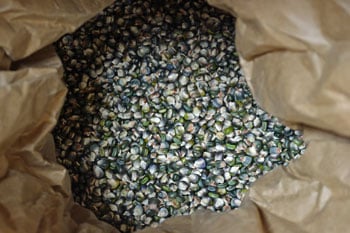
First Peek of Oaxan Green Dent Corn
Here is what we saw on our first peek into the bag! Very colorful and striking. Very unlike what we are used to seeing as bulk corn.
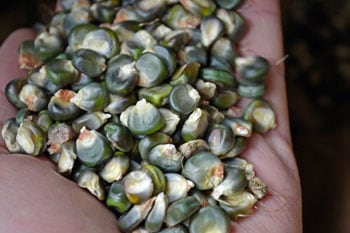
Oaxan Green Dent Corn
A closer look at its colors. Heirloom corn glamor shot!
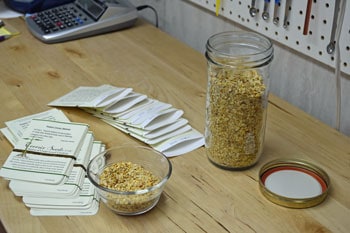
Hand Packing Melrose Pepper Seed
Of course, all of this new seed arriving means there is work to do. Everything we sell is hand packed, every single packet! As each new shipment of seed arrives we re-verify the number of seeds to a packet, then count that number and find a measurement that corresponds to it. We always try to give a bit more seed than advertised, as each packet is packed by measurement, not individually counted. A new shipment of Melrose Pepper is ready to be packed here.
Thanks for joining us, we hope you enjoyed a brief look at what happens when we receive new shipments of heirloom seed!
Unleash the flavor of the past with heirloom seeds. Find out how these seeds can bring back memories of delicious, homegrown produce.
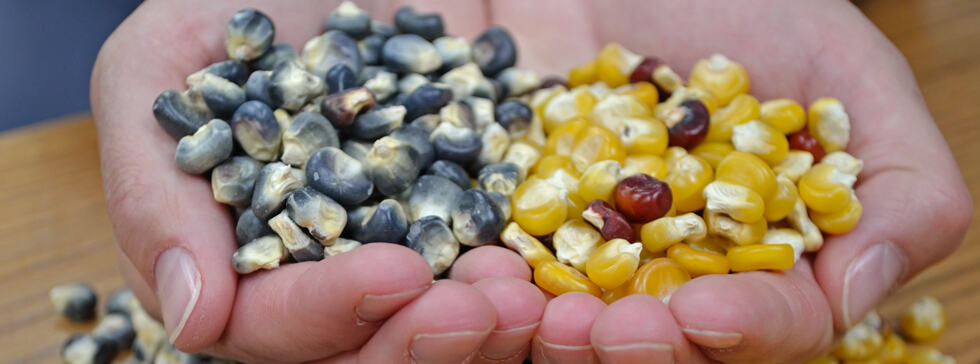
Two of the most important ingredients in growing food are healthy, fertile soil and good quality seed. As gardeners and growers, there is often an arc in the quality of both that directly corresponds to the arc of knowledge and experience of the grower. At first, most home gardeners will start out buying seeds from almost anywhere, without the realization that all seeds are not the same in terms of quality, but also germination and vigor in production. As time goes on, experience and knowledge are earned, and the grower becomes increasingly particular in selecting the seeds that they want to grow from. They usually get to know a company and the performance of their seeds, either through a friend or by experience. We all know the definition of experience, right? Experience is what you get when you don’t get what you want!
This is a type of question that we receive a lot- how are your seeds grown? are they organic? are they well-suited to my climate? do you grow your own seeds, or buy them? Most of the time, the real question is- What is the quality and performance of your seeds? How do I know that I am getting the best possible quality at a reasonable price? Most gardeners and growers that have some years of growing behind them realize that the best, “guaranteed lowest” price is often not at all. Paying $2.00 for a packet of seeds vs. $3.50 a packet may seem like a good deal, but there is more than just the price that must be looked at. If that $2.00 packet has 10-15 seeds and the $3.50 one has 45 seeds for a tomato or pepper, and knowing that high quality tomato seeds will last at least 2-3 years in good storage conditions, then the “more expensive” packet is a much better buy, as it is half the price, when comparing equal amounts of seeds. Or when comparing prices, there are 2 to 3 times more seeds at the same cost. Plant what you need this year, share some with friends and neighbors and you’ll still have enough to plant with next year, maybe the year after that. This is good economy. Long ago, Cindy and I realized that we would never be wealthy enough to afford to buy cheap quality. Let me elaborate. Boots that cost twice as much new, but will last 3 times as long and can then be rebuilt for another service life is money well spent, over saving some dollars today, but being forced to buy the same boots 3-5 times over the same time period. Another benefit of quality is … quality. The better quality will be more enjoyable to use, work better, or grow better with more flavor, nutrition, resistance to pests and diseases or weird weather patterns.
We have just returned from visiting two of our growers in California, and have some good photos that illustrate the differences between high volume, mass-produced seeds and how ours are grown, harvested and cleaned. One of our growers is also a mentor to us; a highly respected traditional plant breeder, introducing the Chocolate and Green Pear tomatoes last year; and an acknowledged expert in seed saving and seed purity. We turn to this grower to identify and correct problems that show up with heirlooms. The other grower is a larger seed grower that we contract with; we are a small portion of their total seed production. Yet they take the time to get to know us and their quality control processes, ensuring that their seed meets our quality criteria.
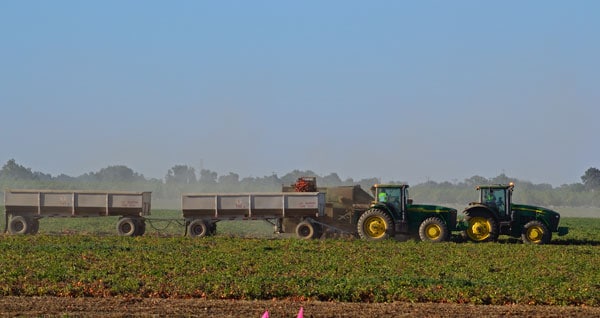
Tomato Combine
Let’s look first at commercial, conventional seed production. We will use tomatoes as the example, as they are in season right now, and show the amount of work required to produce the quality needed for heirloom seeds.
Large tracts of land are planted by machine (usually with hybrid varieties) and grown until ready for harvest. There is too much acreage under growth for any hand work, so periodic spot inspections are carried out throughout the season. When it is time for harvest, a large tomato combine machine is pulled by a tractor down the rows to harvest the tomatoes. All of them, regardless if they are fully ripe or not, or if they are smaller or under-developed. The plants are separated from the fruit by a huge vacuum, then the tomatoes are transferred to a gondola bed pulled alongside, to be hooked to a semi truck and transported to the processing facility. Above you can see the double gondolas pulled by a tractor. If you look closely, you can see the people in the cabs to get a sense of how big the equipment is. The transfer spout of the combine can just be seen over the top front of the lead gondola.

Tomato Combine- Rear View
This is a rear view of the same combine/gondola. The tomatoes are falling into the gondola, and the remains of the tomato plants are left behind the combine. From here the tomatoes will go to a large crusher to separate the seeds from the rest of the tomato. The seeds will be washed and fermented to remove the gelatin coat, washed again, dried and packaged for shipment to the seed company. The tomato remains might be used for animal feed, or composted.
The challenge from a quality standpoint is that there is no selection possible in the field, it must be done at the processing facility- probably from a conveyor belt with people on both sides, looking for rotten tomatoes and debris. They won’t select for the largest and best of the variety, the ripest and tastiest, as there are simply thousands of tomatoes rolling past fairly quickly. They won’t be able to feel the tomatoes, picking out the ripest and most ready. Nobody will taste the tomatoes to check for flavor and ensure that it holds to the standard for that variety. No one will inspect them for the visual characteristics that make that specific variety unique and valued. The goal is to capture all of the seeds possible, as that is how the grower is paid- by the weight or volume of seeds.

Tomato Isolation Cages
This is in direct contrast to how our seed growers operate. They have smaller plot sizes that enable them to better control various factors and observe growth, flowering and fruit set patterns often and make needed changes during the season. The smaller plots also allow better isolation by time, distance and/or physical barriers to prevent cross pollination that would result in hybridization. This is one of the key factors in ensuring the highest quality seed possible.
Our growers inspect the growth of the tomato plants frequently, and remove any that are stunted, or show abnormal growth. This is done several times throughout the growing season, as flowering happens, and again during fruit set. This technique is a process of specific selection of traits or characteristics throughout the growing process- growth patterns, flower color, fruit size, color, shape and taste. It is labor intensive and requires a lot of handwork and hours in the field, but results in a superior seed. The tomatoes are harvested by hand with the fruit selected for the largest, best characteristics of the variety, best flavor and production right there in the field. The tomatoes are either processed in small batches by hand, or in larger batches by machine- depending on the grower and the volume of production that they do. Either way, there are more hands and eyes on the tomatoes than commercial processing, as there are significantly fewer fruits in the workflow. After separating the seeds from the tomato, the seeds are fermented to remove the gel coat, screened, washed, dried and inspected one last time before being packed for shipping to us.
Production growing for seed only happens after trials to determine viability, suitability and quality of that variety. Some of the trials take a couple of years before seed production begins. We don’t want to offer an heirloom that does not offer superior flavor, growth and resilience characteristics. In all of the selection processes, flavor and taste are at the forefront of the decision process. We have had a couple of instances when our grower called and said that we shouldn’t offer the variety because the flavor was not remarkable enough to qualify as an heirloom, or did not exhibit the flavor profile that it was known for. That means an entire growing season is lost, and the trouble-shooting begins, but it is better to lose a year or more than to offer an inferior quality variety. All of our seed production is focused on home gardeners and small scale growers such as Farmer’s Market and CSA growers.
Now that you have the answer to the questions above – What is the quality and performance of your seeds? How do I know that I am getting the best possible quality at a reasonable price?- you understand more of our processes and commitment to the quality of our seeds that we offer to you, our customer.
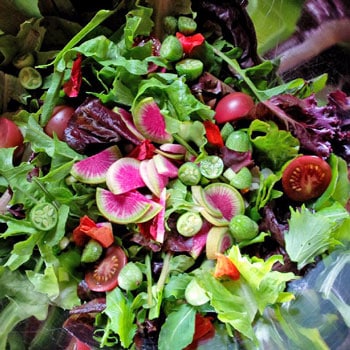
Many of us have gotten used to eating the few select varieties of fruits and vegetables that are available in the grocery store. The grocery store produce is pretty, but it doesn’t taste like much.
Incredible, exceptional taste is the single biggest reason so many people are turning to heirloom vegetables. Once you experience the sheer depth of the flavor that any heirloom variety has compared to the supermarket one, you will always want more. You will find heirloom produce to be more flavorful as well as much higher in nutrients. You can eat a salad with no dressing because all the greens and veggies just taste so good. Many heirloom vegetables have been saved and selected for decades and sometimes even centuries because they are have the best flavor and production in home and small market gardens. Flavor is once again the biggest concern for small growers, as they don’t ship their produce farther than the local Farmers Market.
Recent studies have shown that the newer hybrid varieties that are developed to optimize production don’t have as much nutrition as their heirloom counterparts. So now, not only do the supermarket veggies have less taste, but they don’t nourish us as well. Heirlooms tend to be hardier so it is easier to grow organically without all the chemicals that the popular commercial produce has. So it is also cheaper in the long run to grow plants from heirloom seeds. Heirlooms tend to ripen at different rates, which spreads the production out, unlike hybrids that have been specifically developed to ripen all at once. This means that you have a longer season to enjoy the produce, instead of getting hammered with all of the crop at once.
Another benefit of heirlooms is they don’t have all of the development costs and research associated with hybrids, so the seeds themselves are usually less expensive. Some seed companies try to counter this cost basis by selling seed packets at a smaller charge, but you wind up getting a lot fewer seed- sometimes as few as 10-15! You can save seeds from heirlooms, replant them and they will adapt to your specific garden climate, becoming even more flavorful, nutritious and productive. This is a huge benefit, one that ties directly to how we have fed ourselves for the past 12,000- 15,000 years. Seeds saved from hybrids won’t grow the same plant, and genetically modified seeds either won’t regrow at all or you will face serious lawsuits for saving and replanting their seeds. Heirloom seeds offer many advantages over hybrid and genetically modified seeds.
In response to our customers requests, we have just released our new and unique seed collections online at Underwood Gardens Heirloom Seed Collections. We have an initial 14 collections that are specially priced and carefully selected to make your growing experiences as easy and rewarding as possible. This makes it easy to explore a new area of gardening that you might be interested in, but aren’t ready to jump in fully. Almost all of our collections have a book with them to guide you through the process and help you make your decisions along the way.
These collections allow you to be extremely creative, not just in gardening but in creating gifts and useful everyday items as well. From crafting the perfect personalized homegrown herbal tea for your tea loving friend, making kitchen helpers out of gourds from your garden to creating a personally designed, grown and arranged dried flower bouquet for that special occasion when nothing else will quite do. These collections help you go far beyond what is available in any store, and in the process learn how to create a new and deeply satisfying gardening extension.
 © 2024 Terroir Seeds | Underwood Gardens